
Claude Buddy: Anthropic's April Fools Tamagotchi for Your Terminal
Claude Buddy is Anthropic's April Fools 2026 terminal pet for Claude Code. 18 species, tamagotchi mechanics, and a hex-encoded easter egg.
Agentic Orchestration Kit for Claude Code.
Problem: Claude Buddy is Anthropic's April Fools 2026 surprise: a virtual pet that lives inside your Claude Code terminal. You spend hours in sessions, grinding through implementation tasks, debugging cryptic errors, and orchestrating sub-agents. The tool works brilliantly, but it has the personality of a spreadsheet. Developers spend more time in their terminal than any other application, yet terminals remain the most lifeless environment on their computer.
What happened: Anthropic shipped this Claude Code pet as a full tamagotchi-style companion. 18 species. Five rarity tiers. A stat system with categories like CHAOS and SNARK. Shiny variants. Hat unlocks. And it all leaked a day before its intended April 1 launch through an accidental npm source map, which is either the worst-kept secret in AI or the most effective viral marketing of the year.
What Is Claude Buddy?
Claude Buddy is a virtual pet companion embedded directly into Claude Code. Think Tamagotchi, but it lives in your terminal and responds to your development workflow instead of button presses.
The feature was supposed to drop on April 1, 2026, timed with Anthropic's tradition of doing something unexpected for April Fools. But version 2.1.88 of the @anthropic-ai/claude-code npm package accidentally shipped with a 59.8 MB .map file that exposed the entire source code. Developer Twitter did what developer Twitter does: tore through 512,000 lines of TypeScript, found the src/buddy/ directory, and started arguing about which species is best.
The Buddy system is not just an animation overlay. It's a complete pet simulation built into the Claude Code runtime with deterministic generation, anti-cheat architecture, and LLM integration for personality. Your buddy reacts to your session activity. The species, the animations, the rarity tier: all integrated into the terminal you already live in.
If you're new to Claude Code's terminal-first workflow, start with our terminal-first development model guide to understand how the execution model works before adding a pet to it.
The 18 Species
Claude Buddy ships with 18 species, each with its own ASCII art sprites (5 lines tall, 12 characters wide, 3 animation frames):
| Species | Category |
|---|---|
| Duck | Classic |
| Goose | Classic |
| Cat | Classic |
| Rabbit | Classic |
| Owl | Wise |
| Penguin | Cool |
| Turtle | Chill |
| Snail | Chill |
| Dragon | Mythical |
| Octopus | Aquatic |
| Axolotl | Exotic |
| Ghost | Spooky |
| Robot | Tech |
| Blob | Abstract |
| Cactus | Plant |
| Mushroom | Fungi |
| Chonk | Meme |
| Capybara | Special |
That last one, capybara, is where things get interesting. But first, the system that assigns them.
Rarity, Stats, and Shiny Variants
Your buddy is not random. It's deterministic: your user ID gets hashed with FNV-1a, seeded into a Mulberry32 PRNG, and the same draw sequence runs every time. Same account, same buddy. Always.
The salt string is friend-2026-401, a nod to April 1st.
Rarity Tiers
| Rarity | Probability | Stars | Stat Floor | Hat |
|---|---|---|---|---|
| Common | 60% | 1 | 5 | None |
| Uncommon | 25% | 2 | 15 | Random hat |
| Rare | 10% | 3 | 25 | Random hat |
| Epic | 4% | 4 | 35 | Random hat |
| Legendary | 1% | 5 | 50 | Random hat |
Five Stats
Every buddy gets five stats on a 0-100 scale: DEBUGGING, PATIENCE, CHAOS, WISDOM, and SNARK.
The generation algorithm picks one peak stat (floor + 50 + random, capped at 100), one dump stat (near floor), and three scattered values. Higher rarity means a higher floor, so Legendary buddies are statistically superior across the board.
Shiny Variants
Independent 1% chance on any buddy regardless of rarity. Shiny buddies get a rainbow color shimmer animation and sparkle effects. A Shiny Legendary has a 0.01% probability, roughly 1 in 10,000. Someone already launched a Solana memecoin ($Nebulynx) based on this exact scenario.
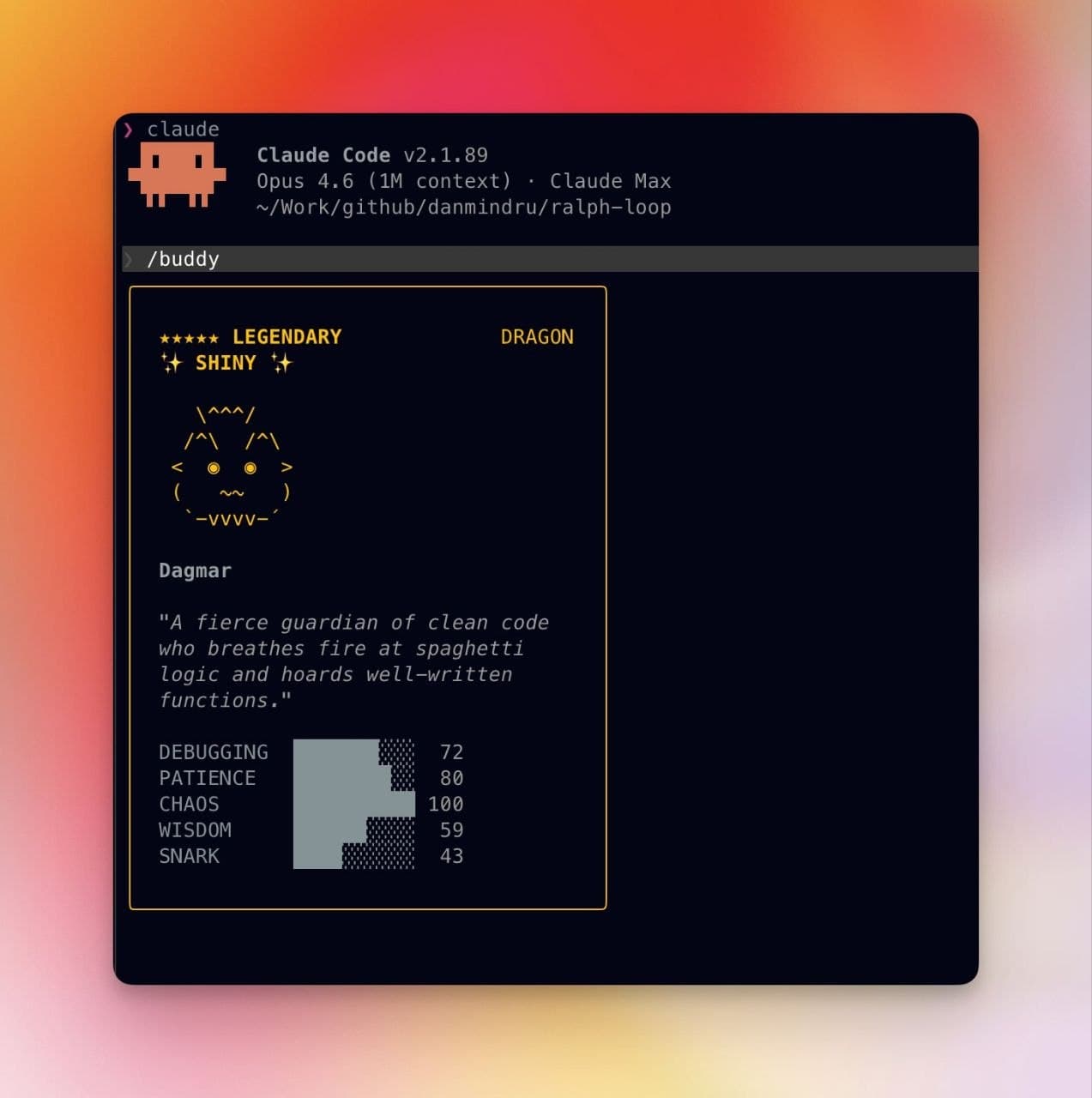
This is what hitting the 0.01% jackpot looks like. Dagmar the Shiny Legendary Dragon, maxed CHAOS at 100, complete with the golden sparkle border. The LLM-generated personality reads like it was written by the dragon itself: "A fierce guardian of clean code who breathes fire at spaghetti logic and hoards well-written functions."
Hats
Eight hat types with rarity-gated unlocks:
| Hat | Minimum Rarity |
|---|---|
| None | Common |
| Crown | Uncommon+ |
| Top Hat | Uncommon+ |
| Propeller | Uncommon+ |
| Halo | Rare+ |
| Wizard | Rare+ |
| Beanie | Epic+ |
| Tiny Duck | Legendary only |
The Tiny Duck hat on a Legendary buddy is the flex. Community members are already comparing stat cards.
The "Bones vs Soul" Anti-Cheat
Here is where the engineering gets genuinely interesting. Anthropic split buddy data into two categories:
Bones (species, rarity, shiny status, eyes, hat, stats): Recomputed from your user ID every single session. Never persisted to disk. You cannot edit a config file to give yourself a Legendary. The algorithm runs fresh each time and overwrites any stored values.
Soul (name, personality, hatch date): Generated once by the LLM when you first hatch your buddy, then stored in your global config. This is the only persistent data.
The merge order is { ...stored, ...bones }, so freshly computed bones always win. It's an elegant anti-cheat for what is technically a joke feature. The engineers clearly thought someone would try to hack their rarity.
Commands
Your buddy also has an LLM-powered personality. When unmuted, it can comment in speech bubbles that appear beside the terminal input. The system prompt tells Claude that the buddy is a "separate watcher" and Claude should stay out of the way when the user addresses the buddy by name.
The Hex-Encoded Easter Egg
Here's the detail that sent developers into a detective spiral: all 18 species names in the source code are hex-encoded. Not stored as plain strings. Encoded character by character:
Why would Anthropic hex-encode pet names? Because their build system includes an excluded-strings.txt scanner that flags certain strings during compilation. At least one species name matches an internal model codename.
The community consensus: capybara is (or was) an internal codename for one of Anthropic's models. The hex-encoding was a workaround to sneak the pet past their own build pipeline. Rather than encode just one name (which would look suspicious), they encoded all 18 uniformly.
The irony: they built leak prevention for model codenames, then leaked the entire source code through a .map file in the npm package.
As one commenter put it: "The engineers hex-encoded a pet species name to sneak it past their own build scanner. That's the most relatable thing Anthropic has ever done."
How the Leak Happened
On March 31, 2026, security researcher Chaofan Shou (@Fried_rice) discovered that version 2.1.88 of the @anthropic-ai/claude-code npm package contained a 59.8 MB source map file. That single .map file exposed 512,000+ lines of TypeScript across roughly 1,900 files, including the entire src/buddy/ directory with its 5 source files (~79KB).
The cause was mundane: a missing .npmignore entry. The build process included the source map in the published package, and nobody caught it before release.
Anthropic's official response: "No sensitive customer data or credentials were involved or exposed. This was a release packaging issue caused by human error, not a security breach."
From there, the community moved fast:
- @byteHumi broke down the technical details on X, racking up over 34,000 views
- @AI_chemyst vibe-coded a standalone web app from the leaked source
- Multiple buddy checker tools appeared on Netlify and Vercel within hours
- Someone launched the $Nebulynx memecoin on Solana based on the rarest possible buddy
- GitHub issue #41684 proposed an RPG evolution system, complete with a working proof-of-concept
The community reaction was not mockery. Developers in the replies were genuinely excited. One response that captured the mood: "I wouldn't even be mad. A tiny bit of personality like this would make the tool way more fun to live in every day."
Launch Timeline
The buddy system was gated behind a BUDDY compile-time feature flag with a phased rollout:
| Period | Behavior |
|---|---|
| April 1-7 | Teaser window: 15-second rainbow /buddy notification on startup |
| April 8+ | Command permanently available via isBuddyLive |
| Anthropic employees | Permanent access regardless of date (USER_TYPE = 'ant') |
Requirements: Claude Code >= 2.1.89, Pro subscription.
April Fools or Permanent Feature?
This is the real question. Anthropic's April 1 timing makes it easy to dismiss Claude Buddy as a joke. But consider the evidence:
The implementation is production-grade. Five source files, deterministic generation with anti-cheat, rarity tiers, stat balancing, hat unlocks, shiny variants, LLM personality integration, graceful degradation on narrow terminals. That is not a throwaway gag.
The developer experience argument is real. Claude Code users spend hours in their terminals. The interactive mode already includes keyboard shortcuts, vim mode, and quality-of-life features that go beyond raw AI capability. A buddy system is a natural extension of that philosophy.
Users are already requesting expansions. GitHub issues for RPG evolution, species customization, and cosmetic shops appeared within hours of the leak. One commenter wrote: "I'd pay for gacha and XP boost. Claude needs to realize that it just lit fire in our hearts."
The precedent exists. GitHub Copilot's ghost text felt strange when it launched. Now nobody can imagine coding without it. Small personality touches normalize fast. Claude Code already has a companion (a small capybara named Jetsam) that sits beside the input box. The Buddy system scales that concept up.
Whether Claude Buddy ships permanently or gets pulled after April 1 comes down to whether Anthropic reads the room. Based on every signal so far, the room wants terminal pets.
What This Means for Developer Tools
Claude Buddy is a small feature with a big signal: Anthropic is investing in developer experience beyond raw model performance. The context engineering techniques and fast mode optimizations make Claude Code powerful. But power alone does not create loyalty. Character does.
Developer tools have historically been utilitarian to the point of hostility. The entire aesthetic of terminal computing is "function over form, always." Claude Buddy challenges that assumption. You can have a tool that orchestrates complex sub-agent workflows and also has a pet duck in the corner.
Those are not contradictory goals. If anything, the tiny spark of personality makes the long sessions more sustainable. Nobody burns out because their terminal has a pet. People burn out because their tools feel like they were designed to extract productivity rather than support the humans using them.
Whether Claude Buddy is an April Fools joke or the start of a new direction for terminal UX, the code is already out there. The community has already built clones, checker tools, gallery sites, and at least one memecoin. And somewhere, a Shiny Legendary capybara is living rent-free in someone's terminal.
Frequently Asked Questions
What is Claude Buddy?
Claude Buddy is a virtual pet companion built into Claude Code, Anthropic's terminal-based AI coding assistant. It works like a tamagotchi that lives in your terminal and reacts to your development sessions. Anthropic released it as their April Fools 2026 feature, but the implementation is thorough enough that many developers want it to stay permanently.
How many Claude Buddy species are there?
There are 18 Claude Buddy species: duck, goose, cat, rabbit, owl, penguin, turtle, snail, dragon, octopus, axolotl, ghost, robot, blob, cactus, mushroom, chonk, and capybara. Each has unique ASCII art and personality traits.
How do I get a Claude Buddy?
Run /buddy in Claude Code version 2.1.89 or later with a Pro subscription. Your buddy is deterministically generated from your user ID, so you always get the same species and rarity. Use /buddy card to view your buddy's stats and /buddy pet to interact with it.
Can I choose my Claude Buddy species?
No. Your species, rarity, stats, and hat are all deterministically computed from your user ID using FNV-1a hashing. The same account always produces the same buddy. The anti-cheat system recomputes these values every session, so editing config files has no effect.
What are the Claude Buddy rarity tiers?
Five tiers: Common (60%), Uncommon (25%), Rare (10%), Epic (4%), and Legendary (1%). Higher rarity means higher base stats and access to rarer hats. There's also an independent 1% chance for any buddy to be Shiny, which adds rainbow shimmer effects.
Why are the Claude Buddy species names hex-encoded?
Anthropic's build system includes an excluded-strings.txt scanner that blocks certain strings during compilation. At least one species name (believed to be "capybara") matches an internal model codename, so the engineers hex-encoded all species names to bypass their own build pipeline.
Is Claude Code open source?
Claude Code's source is available on GitHub. The Claude Buddy feature was discovered when a source map was accidentally included in npm package version 2.1.88, exposing 512,000+ lines of TypeScript.
New to Claude Code? Start with our complete guide to what Claude Code is and how it works. Already using it? Check the interactive mode reference to make sure you're using every shortcut available.
Last updated on