
Claude 4: Sonnet 4 and Opus 4 Launch the Next Generation
Claude 4 launched May 2025 with Sonnet 4 and Opus 4. The generation that brought Claude Code mainstream with professional coding capabilities.
Agentic Orchestration Kit for Claude Code.
Claude 4 is the generation that turned Claude Code from an interesting experiment into a professional software engineering tool. Anthropic launched the family on May 22, 2025, with two models: Sonnet 4 and Opus 4.
Key Specs
| Spec | Sonnet 4 | Opus 4 |
|---|---|---|
| API ID | claude-sonnet-4-20250514 | claude-opus-4-20250514 |
| Release Date | May 22, 2025 | May 22, 2025 |
| Context | 200K tokens | 200K tokens |
| Max Output | 16,384 tokens | 16,384 tokens |
| Status | Active (still available) | Superseded by Opus 4.1 |
What Claude 4 Brought to the Table
The Claude 4 family represented a generational leap in coding capability. Before this release, Claude Code was a promising tool that early adopters were experimenting with. After it, Claude Code became a daily driver for professional developers.
Professional software engineering. Claude 4 models could handle real-world codebases, not just toy examples. Multi-file refactoring, complex debugging across dependency chains, and meaningful code reviews became reliable operations.
Agentic reliability. Both Sonnet 4 and Opus 4 showed significant improvements in following complex, multi-step instructions without drifting off-task. This made agentic workflows (where Claude executes a sequence of tool calls to accomplish a goal) practical for production use.
Better instruction following. Previous Claude models would sometimes ignore parts of detailed prompts or add unwanted changes. Claude 4 brought noticeably tighter adherence to constraints and specifications.
How It Compared to Claude 3.7
Claude 3.7 Sonnet introduced extended thinking, which was a significant capability. But Claude 4 built on that foundation and delivered across the board:
- More consistent code quality across long sessions
- Fewer hallucinated imports and non-existent APIs
- Better understanding of project context and conventions
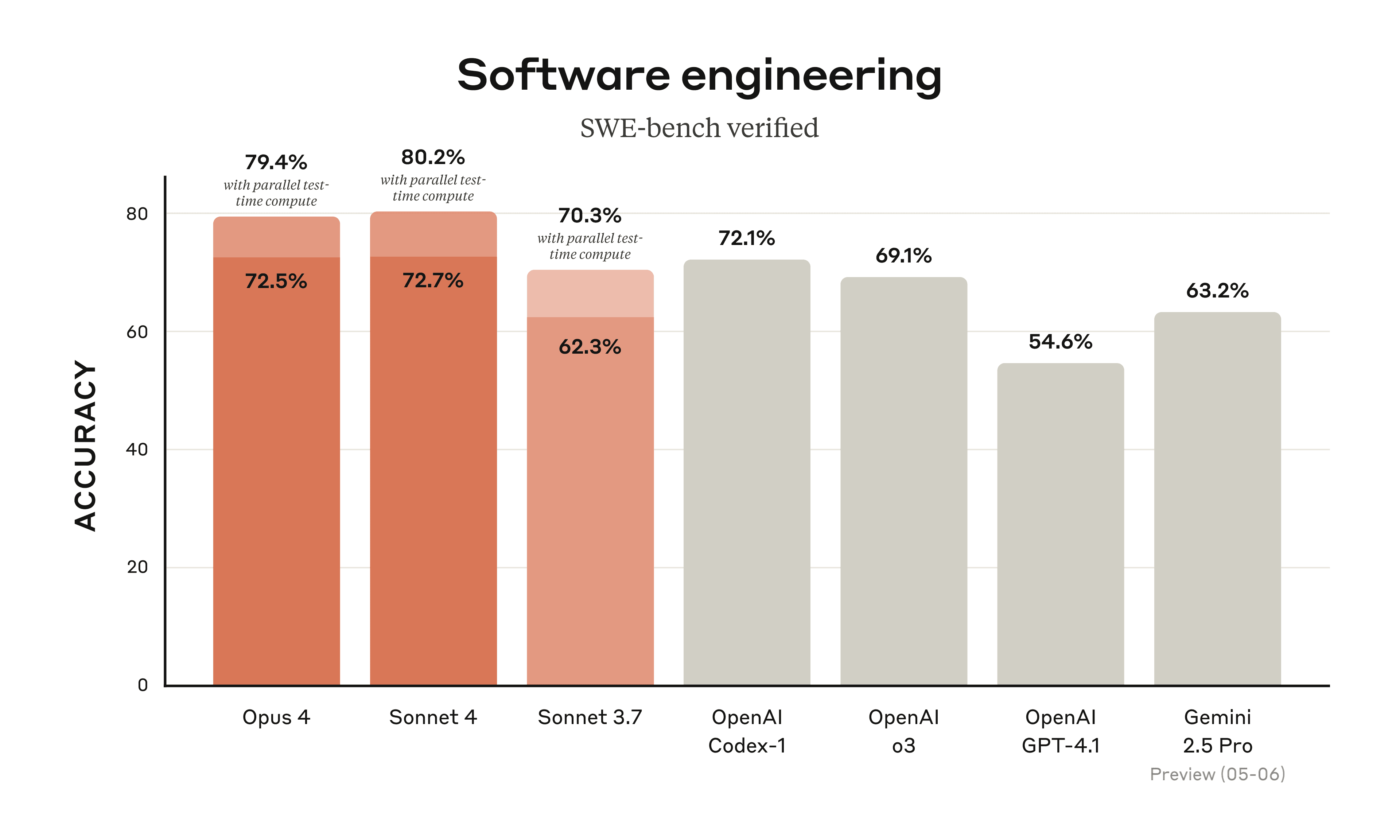
- Stronger performance on real-world software engineering benchmarks (SWE-bench)
The difference felt less like a spec bump and more like going from a junior developer to a mid-level one. Claude 4 models understood what you were trying to build, not just the literal instruction you gave.
The Two Models
Sonnet 4 became the workhorse. Fast enough for interactive development, capable enough for most tasks, and priced for all-day use. Most Claude Code users ran Sonnet 4 as their default.
Opus 4 was the heavy hitter. Reserved for complex architecture decisions, deep debugging, and tasks that required maximum reasoning depth. More expensive, slower, but noticeably better at problems that required holding many constraints in mind simultaneously.
Current Status
Sonnet 4 remains available through the API and can still be referenced by its model ID. Opus 4 has been superseded by Opus 4.1, which improved on its reliability for production workflows.
For most users today, the 4.5 generation is the recommended starting point. But Claude 4 deserves its place in the timeline as the generation that proved AI-assisted coding could be a serious engineering workflow.
Related Pages
- All Claude Models for the complete model timeline
- Opus 4.1 for the next Opus iteration
- Model selection guide for choosing the right model today
Last updated on