
Claude Opus 4.1: Incremental Refinement for Production Code
Claude Opus 4.1 shipped August 2025 as a focused update to Opus 4. Improved reliability and code quality for production engineering workflows.
Agentic Orchestration Kit for Claude Code.
Claude Opus 4.1 was a focused reliability update to Opus 4, released on August 5, 2025. Not a headline-grabbing capability leap, but the kind of refinement that production teams care about: fewer regressions, cleaner output, and more consistent behavior across long sessions.
Key Specs
| Spec | Details |
|---|---|
| API ID | claude-opus-4-1-20250805 |
| Release Date | August 5, 2025 |
| Context Window | 200K tokens |
| Max Output | 16,384 tokens |
| Availability | General Availability (GA) |
| Status | Superseded by Opus 4.5 |
What Opus 4.1 Improved
Anthropic positioned this as a stability release, and the improvements reflected that focus.
Code quality consistency. Opus 4 occasionally produced inconsistent output quality, especially toward the end of long sessions. Opus 4.1 smoothed this out. The code you got in turn 50 was closer in quality to the code you got in turn 5.
Reduced regressions. When refactoring or modifying existing code, Opus 4 sometimes broke adjacent functionality. Opus 4.1 showed measurable improvement in preserving working code while making requested changes.
Better error handling patterns. The model generated more robust error handling by default, with fewer instances of swallowed exceptions or overly generic catch blocks.
Instruction adherence. Tighter compliance with detailed specifications, particularly around formatting constraints, naming conventions, and architectural boundaries.
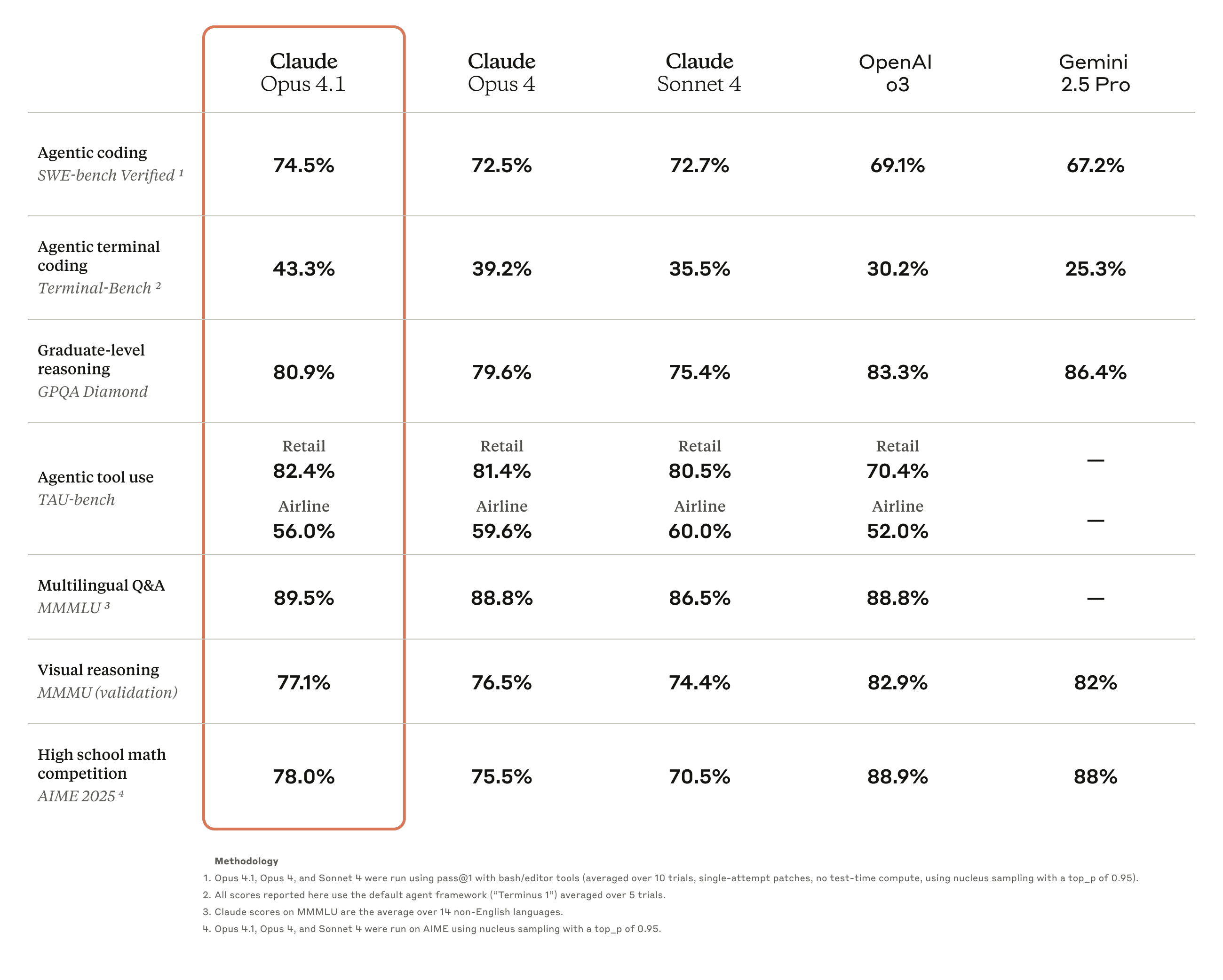
How It Compared to Opus 4
Think of this as a point release, not a major version. If Opus 4 was the foundation, Opus 4.1 was the quality-of-life patch.
Users who ran Opus 4 for daily work noticed the difference immediately in reduced "cleanup passes." The model's first attempt was correct more often, which meant less time reviewing and fixing generated code.
There was no significant change to pricing, context window size, or fundamental capabilities. The improvements were about doing the same things with fewer mistakes.
Who Benefited Most
Teams running Claude Code in production workflows got the most value from Opus 4.1. If you were using Opus 4 for:
- Multi-file refactoring across large codebases
- CI/CD pipeline integration where code needed to pass tests on first generation
- Complex debugging sessions spanning dozens of tool calls
- Code review and security audit workflows
Then Opus 4.1 reduced your iteration count and improved first-pass accuracy.
Current Status
Opus 4.1 has been superseded by Opus 4.5, which brought dramatic cost reductions and token efficiency improvements. Opus 4.1 remains an important stepping stone in the model timeline, but there is no practical reason to select it over the current Opus generation.
Related Pages
- All Claude Models for the complete model timeline
- Claude 4 family for the generation overview
- Sonnet 4.5 for the next major release
- Model selection guide for choosing the right model today
Last updated on