
Claude Sonnet 5: Pricing, Benchmarks, and the New Daily Driver
Claude Sonnet 5 scores 63.2% agentic coding at $2/$10 per million tokens, closing the gap with Opus 4.8. Specs, benchmarks, pricing.
Agentic Orchestration Kit for Claude Code.
Claude Sonnet 5 costs $2 per million input tokens and $10 per million output tokens, now its standard rate. It is the default model on the Free and Pro plans and available to Max, Team, and Enterprise. On Anthropic's headline agentic coding benchmark (SWE-bench Pro) it scores 63.2%, against 69.2% for Opus 4.8 and 58.1% for the Sonnet 4.6 it replaces, and it edges past Opus 4.8 on knowledge work. The API model ID is claude-sonnet-5, and it shipped June 30, 2026. Every number on this page is grounded in Anthropic's official Sonnet 5 announcement and system card.
Update, September 2026: Sonnet 5 launched at $2/$10 as introductory pricing through August 31, 2026. Anthropic's pricing page now lists $2/$10 as the standard price and states that the scheduled September 1 increase to $3/$15 will not occur.
Anthropic calls Sonnet 5 "the most agentic Sonnet model yet." The pitch is specific: it can make plans, drive browsers and terminals, and run autonomously through long, multi-step tasks at a level that, in Anthropic's framing, previously required larger and more expensive models. That makes Sonnet 5 the new workhorse for daily agentic coding, the model you leave running by default and only escalate to Opus 4.8 when a task genuinely needs the extra accuracy. It supersedes Sonnet 4.6 as the recommended Sonnet across every plan.
Quick Answers: Pricing, Free Access, and Specs
If you came here for one number, here it is. These are the facts most people search for, answered directly and grounded in Anthropic's release.
- How much does Sonnet 5 cost? $2 per million input tokens and $10 per million output tokens. It launched as introductory pricing through August 31, 2026, and is now the standard price. The planned move to $3/$15 was cancelled.
- Is Claude Sonnet 5 free? Yes, in the everyday sense. It is the default model on the claude.ai free tier and on Pro, and it is available on Max, Team, and Enterprise. API access is paid at the rates above.
- What is the context window? 1 million tokens, with a 128,000-token max output (up to 300,000 via the Batch API extended-output beta).
- When was it released? June 30, 2026. The API ID is
claude-sonnet-5. - How does it compare to Opus 4.8? On SWE-bench Pro it trails Opus 4.8 by 6 points (63.2% vs 69.2%), it slightly outperforms Opus 4.8 on knowledge work, and it costs roughly half as much per token. Full table below.
For the model that still sits above it on raw accuracy, see Opus 4.8. For the full lineup, see every Claude model.
Key Specs
| Spec | Details |
|---|---|
| API ID | claude-sonnet-5 |
| Release Date | June 30, 2026 |
| Context Window | 1M tokens |
| Max Output | 128,000 tokens (up to 300,000 via Batch API extended-output beta) |
| Knowledge Cutoff | January 2026 |
| Tokenizer | Updated tokenizer (same input maps to ~1.0 to 1.35x more tokens than prior gens) |
| Pricing | $2 input / $10 output per 1M tokens (launch intro rate, now standard) |
| Availability | claude.ai (default Free and Pro), Claude Code, Messages API, Bedrock, Vertex AI |
| Status | Active, current recommended Sonnet |
What Changed: The Most Agentic Sonnet Yet
Sonnet 4.6 was a coding-quality release. Sonnet 5 is an autonomy release. The headline is not a single benchmark, it is how far the model will carry a task on its own before it stalls or asks for help.
It finishes multi-step jobs end to end. The behavior partners describe most often is sustained execution. Zapier's Daniel Shepard put it plainly: "We handed Claude Sonnet 5 a two-part job and it finished end to end. That used to stall halfway." Sualeh Asif at Cursor reported that "agents stay on plan, follow our conventions, and ship clean multi-step changes." That is the practical difference between a model you babysit and a model you delegate to.
It debugs like an engineer, not a patcher. Several teams flagged root-cause behavior over symptom-patching. Dominic Elm described Sonnet 5 tracing "a failure to its actual root cause" and shipping "a durable fix instead of patching the symptom," while Neel Chotai noted it "wrote a reproducing test, implemented the fix, then stashed it" unprompted. For agentic coding loops, that test-first instinct is what keeps an autonomous session from drifting.
It knows when to say no. Lovable's Fabian Hedin framed the safety gains as a capability, not a tax: "A model that knows when to say no is just as important as one that knows how to build." That matters more as Sonnet 5 takes on browser and terminal work where a wrong action has real consequences.
The tokenizer changed. Sonnet 5 ships an updated tokenizer that processes text differently to improve performance. The tradeoff is that the same input can map to roughly 1.0 to 1.35x more tokens depending on content type. Anthropic set the introductory pricing specifically to keep the transition "roughly cost-neutral" while the per-token math shifts.
Benchmark Results
Sonnet 5 beats Sonnet 4.6 across the board and closes most of the distance to Opus 4.8. The numbers below come from Anthropic's published benchmark table (rendered as the chart on the announcement page and reported by TechCrunch and The Decoder).
| Benchmark | Sonnet 5 | Sonnet 4.6 | Opus 4.8 |
|---|---|---|---|
| SWE-bench Pro (agentic coding) | 63.2% | 58.1% | 69.2% |
| Terminal-Bench 2.1 (agentic coding) | 80.4% | 67.0% | 82.7% |
| Humanity's Last Exam (no tools) | 43.2% | 34.6% | 49.8% |
| Humanity's Last Exam (with tools) | 57.4% | 46.8% | 57.9% |
| OSWorld-Verified (computer use) | 81.2% | 78.5% | 83.4% |
| GDPval-AA v2 (knowledge work) | 1,618 | 1,395 | 1,615 |
Read the table honestly and the hierarchy is intact: Opus 4.8 leads Sonnet 5 on coding, terminal, computer use, and reasoning, by margins from half a point (Humanity's Last Exam with tools, 57.9% vs 57.4%) to six-plus points (SWE-bench Pro, 69.2% vs 63.2%, and Humanity's Last Exam without tools, 49.8% vs 43.2%). The single exception is knowledge work, where Sonnet 5 edges ahead on GDPval-AA v2 (1,618 vs 1,615). The real headline is the jump over Sonnet 4.6: Terminal-Bench 2.1 climbs more than 13 points (80.4% vs 67.0%) and GDPval-AA v2 rises about 16% (1,395 to 1,618). That generational gain, not any claim of Opus parity, is what "most agentic Sonnet yet" buys you.
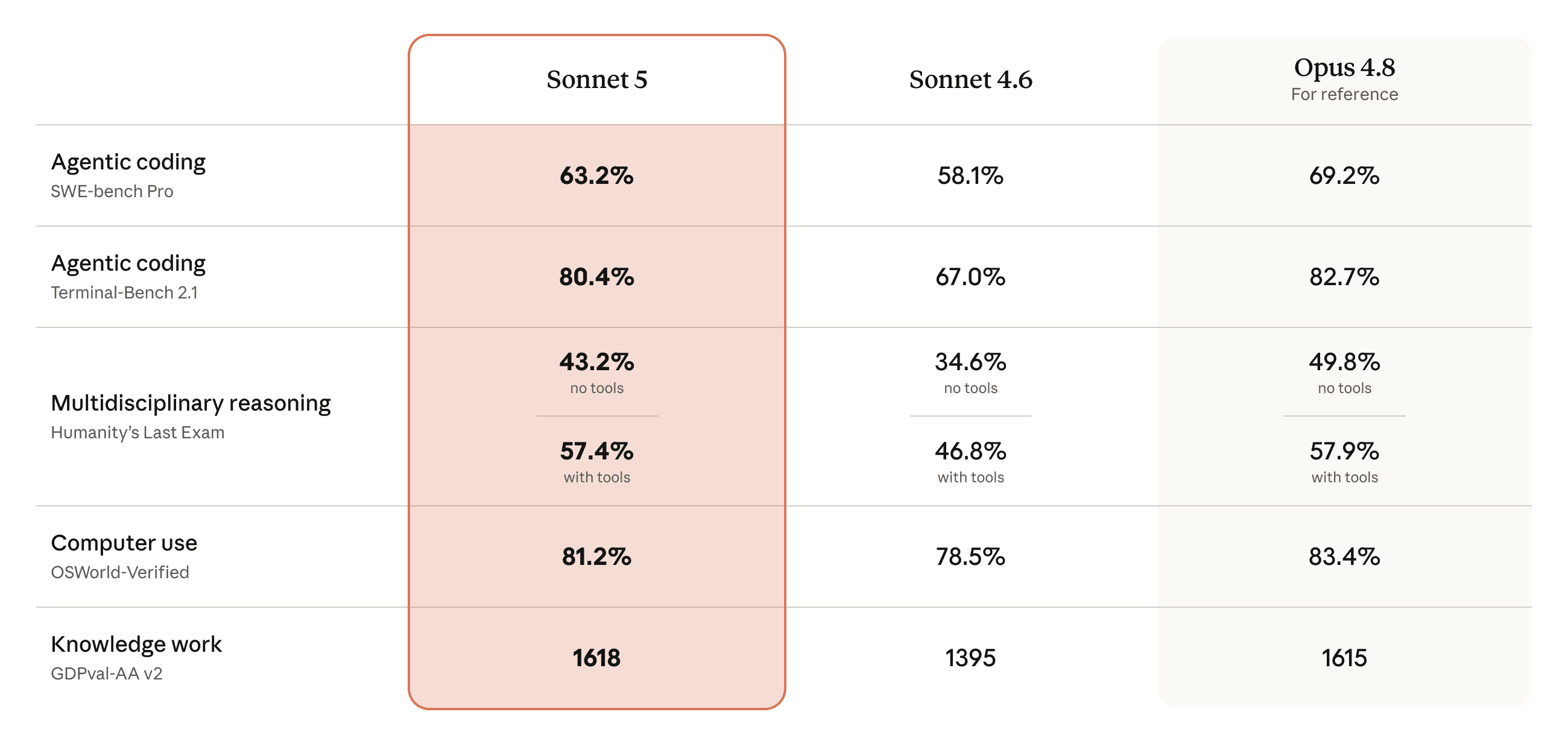
The shape of the comparison is the value prop: Sonnet 5 lands a few points behind Opus 4.8 on coding, terminal, and computer use, ties it on knowledge work, and costs 60% less per token. For most daily work, that gap is small enough that price, not capability, becomes the deciding factor.
Safety Profile
Anthropic reports that Sonnet 5 has a lower overall rate of undesirable behaviors than Sonnet 4.6. It is better at refusing malicious requests and more resistant to prompt-injection attacks, and it shows lower hallucination and sycophancy rates than its predecessor. For teams running computer use or processing untrusted documents, the prompt-injection improvement is the one that matters most day to day.
There are two honest caveats. First, Sonnet 5's rate of misaligned behavior is higher than Opus 4.8 and Claude Mythos Preview, so the most safety-critical workloads still belong on the higher-aligned models. Second, on cybersecurity, Anthropic notes Sonnet 5 has "much lower ability to perform dangerous cybersecurity tasks than our current Opus models." It cannot develop a working Firefox exploit (0.0% success), and cyber safeguards are enabled by default. The full evaluation set, including detailed alignment metrics and prompt-injection numbers, is in the Claude Sonnet 5 system card. Read it before deploying in a regulated or high-risk environment.
Pricing: $2/$10 Is Now the Standard Rate
| Tier | Input (per 1M) | Output (per 1M) |
|---|---|---|
| Standard (launch intro rate, kept) | $2 | $10 |
| Cancelled Sep 1, 2026 increase | $3 | $15 |
Sonnet 5 launched at $2/$10 as an introductory rate through August 31, 2026, set to offset the new tokenizer's higher token counts so the move to Sonnet 5 stayed roughly cost-neutral. Anthropic's pricing page now lists $2/$10 as the standard price and says the scheduled September 1 increase to $3/$15 will not occur. That puts Sonnet 5 below the $3/$15 Sonnet has charged since the 4.5 generation, which Sonnet 4.6 still charges.
For context on where Sonnet 5 sits in the price ladder, $2/$10 is 60% less than Opus 4.8 at $5/$25 and a fifth the cost of Fable 5 at $10/$50. TechCrunch notes Sonnet 5 also lands cheaper than OpenAI's GPT-5.5 and Google's Gemini 3.1 Pro and pricier than Gemini 3.5 Flash. Anthropic's own announcement makes no cross-vendor comparison. Prompt caching and the Batch API discount carry forward. If you are managing spend across a team, the usage optimization guide covers how to route cheap tasks here and reserve Opus for the work that needs it.
Is Claude Sonnet 5 Free?
Yes. Sonnet 5 is the default model on the claude.ai free tier and on Pro, which is the most generous free access any agentic Claude model has launched with. "Free" here means included in a plan, including the no-cost tier, rather than free API calls. If you want Sonnet 5 without a subscription, you pay per token through the API at the rates above. There is no free API tier. For a side-by-side of what each plan includes, see the model selection guide.
How to Use Sonnet 5 in Claude Code
Set Sonnet 5 as your default model:
For a per-session override without changing your default:
Inside an interactive session, switch models on the fly with the slash command:
The model is available across claude.ai (default for Free and Pro), Claude Code, the Messages API, Amazon Bedrock, and Google Vertex AI. The API identifier is claude-sonnet-5 on the Claude API and Vertex AI, and anthropic.claude-sonnet-5 on Bedrock. If you want model routing configured out of the box, so simple tasks fall to Sonnet 5 and heavy work escalates to Opus 4.8 automatically, ClaudeFast's Code Kit ships with that routing for every active Claude model.
Sonnet 5 vs Sonnet 4.6: What Changed
| Feature | Sonnet 4.6 | Sonnet 5 |
|---|---|---|
| SWE-bench Pro | 58.1% | 63.2% |
| Terminal-Bench 2.1 | 67.0% | 80.4% |
| OSWorld-Verified | 78.5% | 81.2% |
| Humanity's Last Exam (tools) | 46.8% | 57.4% |
| GDPval-AA v2 (knowledge work) | 1,395 | 1,618 |
| Autonomy | Strong coding, asks often | Plans, uses browsers/terminals, finishes end to end |
| Safety | Strong, on par with Opus 4.6 | Lower undesirable behaviors, better prompt-injection resistance |
| Tokenizer | Prior generation | Updated (~1.0 to 1.35x token counts) |
| Max output | 16,384 tokens | 128,000 tokens |
| Standard pricing | $3/$15 per 1M | $2/$10 per 1M (launch intro rate, now standard) |
Everything Sonnet 4.6 did well carries forward at a lower price. The upgrade is autonomy and reach: longer tasks completed without hand-holding, meaningfully stronger terminal and computer use, and a higher output ceiling. If you run Sonnet 4.6 today, switch to claude-sonnet-5. Existing prompts and Claude Code configs carry over.
Sonnet 5 vs Opus 4.8: Which Should You Use?
This is the decision most developers actually face, and Anthropic frames it as an effort dial rather than a hard line. Its guidance: "Opus 4.8 ... is still the model of choice for higher accuracy on these tasks, but Sonnet 5 provides developers with lower-priced options." It adds: "Between Sonnet 5 and Opus 4.8, users can adjust the effort level to find the right balance of cost and performance."
| Use Sonnet 5 when... | Use Opus 4.8 when... |
|---|---|
| Daily coding, fast iteration, most agentic loops | Correctness-critical refactors and architecture calls |
| Cost matters and volume is high | The 6-point SWE-bench Pro accuracy gap pays for itself |
| Browser, terminal, and computer-use automation | Long-horizon work where a small error rate compounds |
| Knowledge work, where it ties Opus 4.8 | The most safety-sensitive or regulated workloads |
The practical rule: make Sonnet 5 your default and escalate to Opus 4.8 only when a specific task justifies the premium. For the full head-to-head on benchmarks, price, and specs, see Sonnet 5 vs Opus 4.8. Above Opus 4.8 sits Fable 5, the frontier model, for the rare long-horizon job where even Opus is not enough. For tactical switching during a session, see the model selection guide.
Also Launched: Claude Science
Sonnet 5 did not ship alone. Anthropic announced Claude Science, a customizable app that integrates the tools and packages researchers use most, produces auditable artifacts, and provides flexible access to compute. It is aimed at research workflows rather than coding, but it underlines the direction: the same agentic reliability that makes Sonnet 5 a good daily driver is being packaged for science teams who need reproducible, auditable runs.
Frequently Asked Questions
Is Claude Sonnet 5 free? Yes. It is the default model on the claude.ai free tier and on Pro, and it is available on Max, Team, and Enterprise. API access is paid at $2/$10 per million tokens, now the standard rate.
What is the Sonnet 5 context window? 1 million tokens, with a 128,000-token max output per response (up to 300,000 tokens through the Batch API extended-output beta).
How does Sonnet 5 compare to Opus 4.8? Sonnet 5 scores 63.2% on SWE-bench Pro versus Opus 4.8's 69.2%, slightly outperforms it on knowledge work (GDPval-AA v2), and nearly matches it on Humanity's Last Exam. Opus 4.8 keeps a clear edge only on pure agentic coding accuracy, at roughly double the price.
Why did Sonnet 5's introductory price become standard? Sonnet 5 launched at $2/$10 as introductory pricing through August 31, 2026, set to keep the upgrade roughly cost-neutral against the new tokenizer's higher token counts. Anthropic's pricing page now lists $2/$10 as the standard price and states that the scheduled September 1 increase to $3/$15 will not occur. The pricing page gives no reason for the change.
Does Sonnet 5 break existing Sonnet 4.6 code? No. Switch the model ID to claude-sonnet-5 and existing prompts and Claude Code configurations carry forward. Budget for the tokenizer change if you track per-call token costs closely.
What is the Sonnet 5 API model ID? claude-sonnet-5 on the Claude API and Google Vertex AI, and anthropic.claude-sonnet-5 on Amazon Bedrock.
Related Pages
- Every Claude Model for the complete timeline from Claude 3 to Opus 5
- Opus 4.8 for the higher-accuracy flagship Sonnet 5 escalates to
- Sonnet 4.6 for the predecessor Sonnet 5 replaces
- Model selection guide for switching models tactically mid-session
- GPT-5.6 Sol for how the competitive landscape stacks up
- GLM 5.2 vs Opus 4.8 vs Sonnet 5 for how Claude compares to the leading open-weights model
- Usage optimization for managing costs across models
Last updated on