
Claude Fable 5.1 & Mythos 5.1: Benchmarks, Pricing, Changes
Claude Fable 5.1 benchmarks, pricing, specs: $10/$50 unchanged, cache reads cut 75%, three breaking changes vs Fable 5, and what Mythos 5.1 is.
Agentic Orchestration Kit for Claude Code.
Claude Fable 5.1 keeps Fable 5's $10 per million input and $50 per million output list price and cuts the bill anyway. It ships September 1, 2026 as claude-fable-5-1, per Anthropic's announcement, with cache reads at $0.25 per million tokens, a 75% cut from Fable 5's $1, which Anthropic estimates lowers typical Fable spend by about 25% and highly agentic spend by up to about 45%. On the launch table it leads Fable 5 and Opus 5 on all seven benchmarks, leads GPT-5.6 Sol on every row where Sol is charted, and more than doubles Fable 5 on Terminal-Bench-Science (52.6 vs 24.7). Its sibling Claude Mythos 5.1 is the same model with more permissive safeguards, available only to vetted cybersecurity and life-sciences organizations. If you read one section, read What Changes in Your Code: three things that worked on Fable 5 now return a 400.
Update, September 22, 2026: Claude Opus 5.5 now leads Fable 5.1 on all nine rows of Anthropic's launch table at $4/$20, less than half Fable 5.1's price.
The shape of this release is unusual. The list price did not move, the bill did, and the gap to Fable 5 opens wider the harder you push the effort dial: on Terminal-Bench-Science, Fable 5.1 at low effort scores higher than Fable 5 at max for roughly a quarter of the money. The catch is migration. Forced tool use is gone, no older model can read Fable 5.1's thinking blocks, and new API accounts that edit conversation history mid-session will have their thinking blocks rejected. None of that appears in a benchmark table, and all of it appears in production the first afternoon.
Key Specs
| Spec | Details |
|---|---|
| API ID | claude-fable-5-1 on the Claude API, Google Cloud, Microsoft Foundry, and Claude Platform on AWS; anthropic.claude-fable-5-1 on Amazon Bedrock |
| Release Date | September 1, 2026 |
| Model Class | Mythos-class, safeguarded for general release; successor to Fable 5 |
| Sibling | Claude Mythos 5.1 (claude-mythos-5-1), the same model with permissive safeguards, invite-only through Project Glasswing trusted-access programs |
| Context Window | 1M tokens, both the default and the maximum, standard pricing across the whole window |
| Max Output | 128,000 tokens (the Batch API 300K extended-output beta does not list Fable 5.1) |
| Knowledge Cutoff | June 2026 (reliable and training data cutoff) |
| Thinking | Adaptive, always on; cannot be disabled or given a token budget |
| Effort Levels | low, medium, high, xhigh, max; default high on the API and in Claude Code, medium in Claude Cowork and on claude.ai |
| Pricing | $10 input / $50 output per 1M tokens; cache reads $0.25 (Fable 5: $1); 5-minute cache writes $12.50, 1-hour writes $20; Batch API $5 / $25 |
| Prompt Cache Min | 512 tokens, unchanged |
| Service Tiers | Not supported on Priority Tier (Fable 5 is) |
| Data Retention | Mandatory 30-day retention; zero data retention only where Anthropic expressly authorizes it, with Enterprise Frontier Safeguards rolling out from fall 2026 |
| Retirement | Not sooner than September 1, 2027 |
| Availability | Claude API, Amazon Bedrock, Google Cloud, Microsoft Foundry, Claude Platform on AWS, Claude Code, claude.ai, Claude Cowork |
| Status | Active, the latest Fable model; Fable 5 is now marked legacy |
What Claude Fable 5.1 Is: One Model, Two Products, Three Complaints Answered
Fable 5.1 and Mythos 5.1 are the same weights with different safeguards, the split Fable 5 and Mythos 5 introduced in June. Fable 5.1 is generally available. Mythos 5.1 is offered through two trusted-access programs, the Cyber Verification Program and a Life Sciences Verification Program built with the US government, and for now only to US organizations. Anthropic's own Claude Security product now runs on it.
Anthropic frames the release around three pieces of Fable 5 feedback. On price, the answer is the cache-read cut, covered under Pricing and Access. On data retention, it is Enterprise Frontier Safeguards, which keeps data on the customer's own cloud and rolls out from this fall, with zero data retention for eligible customers in the meantime. On safeguards, it is precision: about 60% fewer cyber interventions per Claude Code session, and biology classifiers that fire 85% less often on benign medical questions. The Safety Profile covers what still gets redirected.
The partner reports lead with economics, which is new for a Fable launch. Cognition Co-founder and CPO Walden Yan: "We're moving our Opus 5 traffic in Devin to Claude Fable 5.1 on launch day. It matched or edged out Fable 5 in our testing at a lower cost per task, and with the new cache read pricing a Fable-class model is finally economical for the workloads we'd kept on Opus, starting with code review." Every CEO Dan Shipper: "It's friendly Fable. Fable-level intelligence, Opus-level price, Sonnet-speed. In our tests it was about twice as fast as Opus 5 and used half as many tokens, so for anyone used to using Opus as their daily driver it's an obvious upgrade." Read that speed claim against Anthropic's lineup table, which still lists Fable 5.1's comparative latency as "Slower" than Opus 5. Every measured a workload, Anthropic published a label, and only your own eval tells you which applies to you.
The capability reports cluster around long, unattended work and root-cause debugging. Jane Street Capital Head of Quantitative Research Craig Falls: "While prior models became hard to follow the longer they worked, Fable 5.1 remains readable over long, multi-step tasks." Ramp Sr. Machine Learning Engineer Dwight Temple described "one unattended 38-hour run" that diagnosed a label artifact, "kicked off six parallel experiments that ran overnight, and returned with a result and next steps." Damien, a Senior Portfolio Manager at Millennium, described "an extremely rare crash, about one in a million runs, that nobody on our team had explained in four to five years. Every model I tried, including Fable 5, missed it. Claude Fable 5.1 was the first to find it." Red Hat Distinguished Engineer Josh Boyer reported that in Claude Code "it correctly identified the root cause of every broken build we tested, across all the effort levels."
Anthropic is candid about where it sits. The Fable 5.1 platform docs say to start with Opus 5 for most workloads and to use Fable 5.1 "for demanding reasoning and long-horizon agentic work, or when your evals on Claude Opus 5 at higher effort still fall short." That is the positioning Fable 5 held after Opus 5 launched, now with a stronger model behind it and a cheaper bill.
Fable 5.1 Benchmark Results
Anthropic published four cost-versus-score charts and one comparison table. The charts follow the Opus 5 launch convention: score on the vertical, mean cost per task on a log-scale horizontal, each model drawn as a curve from low to max effort. The table is the headline number at each model's best published setting.
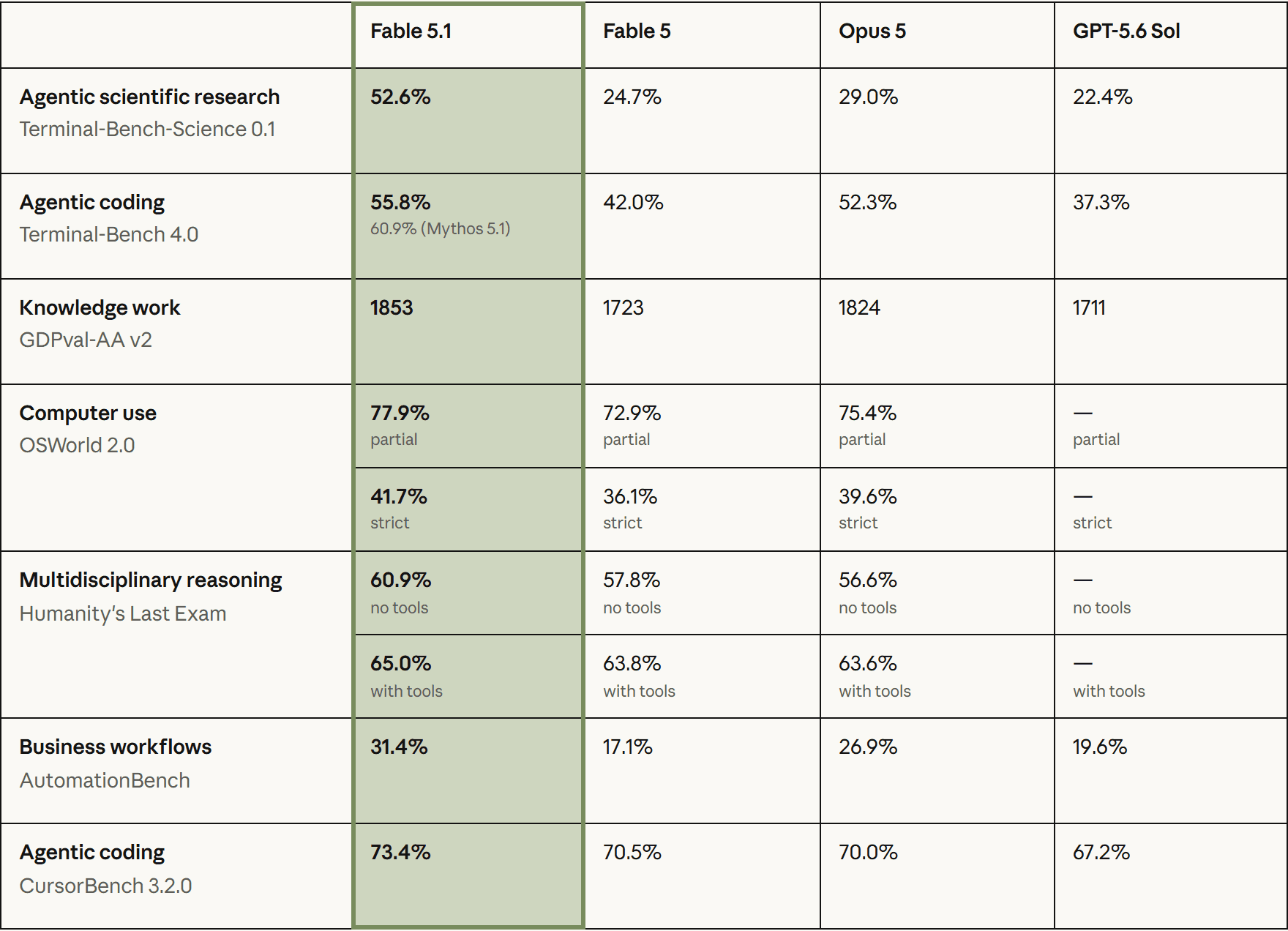
| Benchmark | Fable 5.1 | Fable 5 | Opus 5 | GPT-5.6 Sol |
|---|---|---|---|---|
| Terminal-Bench-Science 0.1 (agentic science) | 52.6 | 24.7 | 29.0 | 22.4 |
| Terminal-Bench 4.0 (agentic terminal coding) | 55.8 (Mythos 5.1: 60.9) | 42.0 | 52.3 | 37.3 |
| GDPval-AA v2 (knowledge work, Elo) | 1,853 | 1,723 | 1,824 | 1,711 |
| OSWorld 2.0 (computer use, partial / strict) | 77.9 / 41.7 | 72.9 / 36.1 | 75.4 / 39.6 | not stated |
| Humanity's Last Exam (no tools / with tools) | 60.9 / 65.0 | 57.8 / 63.8 | 56.6 / 63.6 | not stated |
| AutomationBench (business workflows) | 31.4 | 17.1 | 26.9 | 19.6 |
| CursorBench 3.2.0 (agentic coding) | 73.4 | 70.5 | 70.0 | 67.2 |
Fable 5.1 leads every row, and the uneven margins are the informative ones. Terminal-Bench-Science is the outlier: 52.6 against 24.7 for Fable 5 and 29.0 for Opus 5, so the model roughly doubled its predecessor on agentic scientific research in under three months. AutomationBench nearly doubled too, 31.4 against 17.1, and clears Opus 5 by 4.5 points on the benchmark Zapier built around end-to-end business workflows. GDPval-AA v2 is the tightest race, 1,853 to Opus 5's 1,824, a 29-Elo gap on knowledge work that Fable 5 had been losing to Opus 5 by 101.
CursorBench is the number the coding crowd will quote. SpaceXAI Director of ML Sualeh Asif: "Claude Fable 5.1 is the most capable model we've run on CursorBench 3.2, scoring 73.4% at max effort. We found it especially skilled at verifying its own work, allowing it to take on difficult coding tasks from start to finish." Three points over Fable 5 on a benchmark where Opus 5 had closed to within half a point reopens the gap. Browserbase Technical Lead Miguel Gonzalez measured computer use: "On our hardest browser-agent benchmark, Claude Fable 5.1 completed 82% of tasks in about ten minutes each, against 74% for Opus 5 and 57% for Fable 5, while using fewer tokens than either." Outside the table, Crosby reported RedlineBench, a contract-redlining benchmark, rising from 47.9 to 57.0 over Fable 5; Glean's judges preferred Fable 5.1 "roughly two to one over Fable 5"; and Datadog reported "stronger reasoning than Opus 5" on incident-investigation evals built from real production incidents.
The Effort Curve Is the Real Result
The table compares peaks. The curves compare spend.
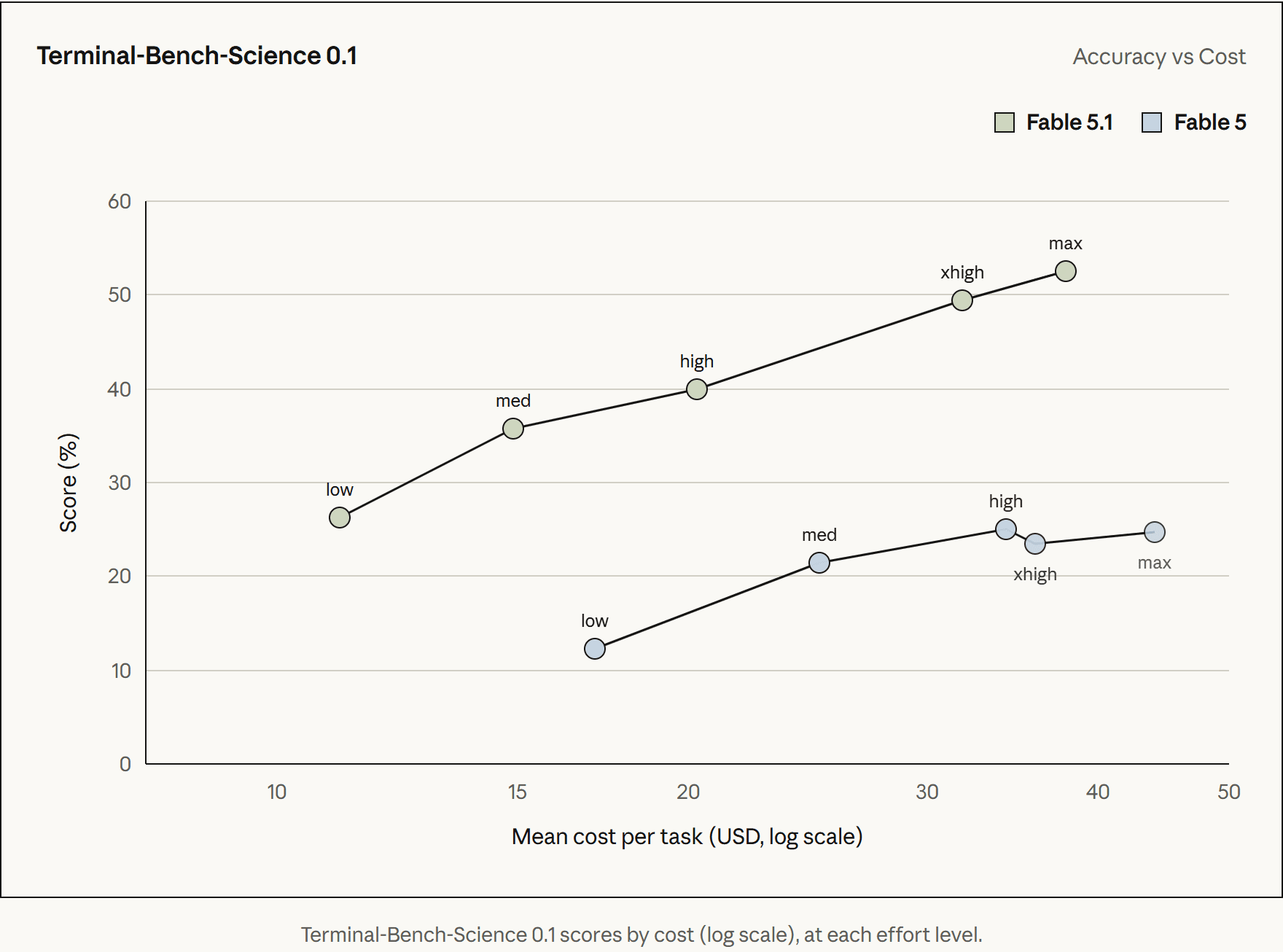
Fable 5.1 at low lands around 26% for roughly $11 per task. Fable 5 at max lands at 24.7% for roughly $44. The cheapest setting on the new model beats the most expensive setting on the old one at about a quarter of the cost, and the curves never touch: Fable 5.1's high (around 40% near $20) clears Fable 5's entire ladder by 15 points, and the curve keeps climbing through xhigh (about 49%) to max (52.6%) where Fable 5 had gone flat.
Anthropic's summary: "when set to Low or Medium effort, Fable 5.1 achieves similar or better results than Fable 5 at a much lower cost," and the gains "are largest at the higher settings." The prompting guide adds the line that matters for routing: at low, Fable 5.1 "is often competitive with Claude Opus and Claude Sonnet models on cost per task while scoring higher." If your model versus effort routing sends mechanical work to a smaller model at high effort, Fable 5.1 at low now belongs in that comparison. Effort names do not map to the same amount of thinking across models, so run a fresh sweep rather than porting Fable 5 settings.
Where Opus 5 Still Wins
Not on the scoreboard: Opus 5 loses all seven rows, and every partner who named it favored Fable 5.1. Its case is everything around the scoreboard.
Price. $5 input and $25 output, half of Fable 5.1, with cache reads at $0.50. Where Opus 5 at xhigh already clears your quality bar, Fable 5.1 is a more expensive way to clear it, and at Fable 5.1's launch Anthropic named Opus 5 the starting point for most workloads, a role Opus 5.5 has since taken over.
Retention. Opus 5 is available under zero data retention today. Fable 5.1 carries mandatory 30-day retention unless Anthropic expressly authorizes otherwise, and a request from an organization without 30-day retention returns a 400. If legal blocked Fable 5, Fable 5.1 has the same block until Enterprise Frontier Safeguards ships.
API surface. Opus 5 accepts forced tool use, lets you disable thinking at high effort or below, supports the Batch API 300K extended-output beta, runs cyber-only classifiers rather than cyber, bio, and distillation, and does not run the conversation-history check on thinking blocks. Every one of those is a Fable 5.1 restriction covered below.
One caution across launch posts: the Opus 5 column here is Anthropic's re-run for this launch, not the July chart. GDPval-AA v2 reads 1,824 here against 1,862 in July, CursorBench 70.0 against 70.1, and OSWorld 2.0 moved to an August 2026 task release that is not comparable to earlier numbers. Treat each launch table as internally consistent and do not mix rows. Opus 5 vs Fable 5 was written against the July numbers and now carries the same caveat.
The Footnotes Matter More Than Usual
Anthropic evaluated Fable 5.1 with production safeguards enabled. Where safeguards intervened, Fable 5.1 and Fable 5 scored zero on OSWorld 2.0 and Fable 5 scored zero on AutomationBench; elsewhere, intervened cyber tasks were completed by Opus 4.8 and biology tasks by Opus 5, which "likely reduces the performance of Fable 5.1 and Fable 5 on these benchmarks." The Terminal-Bench 4.0 gap between Fable 5.1 (55.8) and Mythos 5.1 (60.9) is the cleanest measure of that tax: same model, and the five points "reflects the tasks on which our earlier, less precise cyber safeguards intervened." Anthropic expects the new safeguards to shrink it.
Terminal-Bench-Science carries a standard error of ±3.5 to 4.5 points, and the public leaderboard (3 trials per task, Claude Code harness) shows Opus 5 at 30.0% and Fable 5 at 21.4% against Anthropic's 29.0% and 24.7%, both within noise; 52.6% is far outside it. The usual harness caveat holds: Anthropic runs its own setup and competitor numbers come from theirs, so the direction is real and the exact margins are not a scoreboard. Benchmark on your own workload before you move a pipeline.
What Changes in Your Code
Three breaking changes, five additive ones, and seven behavior shifts, all documented in Anthropic's migration guide. The breaking changes are the part that will page you.
Forced Tool Use Returns a 400
Fable 5 accepted every tool_choice value. Fable 5.1 and Mythos 5.1 reject the two that force a call:
The error reads tool_choice: type "tool" and "any" are not supported for this model. and the check runs on the Messages API, the Batch API, and the token-counting endpoint. The reason is thinking: it is always on, a forced call would skip it, and the model would write its working-out into the tool arguments instead.
The fix depends on why you forced the call. For schema-valid JSON, keep tool_choice at auto, set strict: true on the tool, and name it in the instruction, or move the schema to structured outputs. If your application requires a specific tool on the current turn of a long conversation, append a role: "system" message after the latest user turn that names the tool and says the call is required, which keeps earlier turns byte-identical and the prompt cache warm. Anthropic reports Fable 5.1 follows explicit tool instructions reliably.
Older Models Cannot Read Fable 5.1 Thinking Blocks
Every thinking block records which model produced it, and the rule is one-directional. Fable 5.1 reads blocks from Opus 5, Fable 5, Mythos 5, and every earlier Claude model. No earlier model can read Fable 5.1's blocks; only Mythos 5.1 can. When a request carries a block the target model cannot read, which happens on a router switch, a client-side retry, or a classifier fallback to Opus 4.8 or Opus 5, the API drops the block, the request succeeds, the dropped tokens are not billed, and the target model re-plans without the reasoning, which raises cost and latency on the first turn after the switch. The drop is silent unless you send the thinking-binding-controls-2026-08-01 beta header, which reports each one in an input_transformations array with reason: "model_binding_mismatch". If you run a fallback chain, wire the header in so you can see how often it fires.
Editing Earlier Turns Invalidates Thinking Blocks
This one separates integrations that build their own messages array from everyone else. Claude Code, claude.ai, Managed Agents, and the Agent SDK keep the prefix intact for you. If your code edits history, this applies to you.
Each Fable 5.1 thinking block is valid only against the exact system prompt, tools array, and message history that preceded it. Send it back after any of those changed and the request fails:
The check is enforced for API accounts created on or after August 31, 2026. Older accounts get the mismatch recorded but not acted on unless the request sets thinking.block_binding.prefix_mismatch_behavior, which opts in. Anthropic plans to enforce it for every account on future models and warns tool authors specifically: your key is probably on an older account, and your users on new ones will hit the check before you do. Mythos 5.1 does not run the check. The announcement frames it as anti-distillation: editing prior context while preserving Claude's thinking transcript was "a common, publicly documented distillation technique."
What trips it is exactly what restarts the prompt cache: editing, reordering, or removing an earlier turn; injecting a per-turn reminder you delete on the next request; rebuilding system or tools between requests; or an image URL that serves different bytes later. What keeps blocks valid: append-only history, removing a leading run of thinking blocks oldest first, server-side compaction or context editing, moving cache_control markers, and changing effort between requests. Anthropic's three-step check: run a normal session with the beta header and prefix_mismatch_behavior: "drop_block", log input_transformations on every response, fix every prefix_binding_mismatch entry, then choose "error" or "drop_block" for production. An integration that invalidates prior thinking on every request also restarts the prompt cache every time, and on a model whose economics depend on cache reads that is the expensive mistake.
Five Additive Changes
None require code changes to keep working. All cut cost or remove a failure mode on long-running agents.
Per-message effort. On Fable 5, output_config.effort was request-level and changing it dropped cached prefixes. On Fable 5.1, a role: "system" message carrying only output_config changes effort from the next user turn onward without invalidating the cache. Beta header: mid-conversation-output-config-2026-07-01. Opus 5 supports it too.
Turn-scoped system messages. Set clear_at: "next_user_message" on a role: "system" message and it carries system-prompt authority for one turn, then stops rendering once a later user message exists. You keep sending it back verbatim, so nothing earlier changes, later thinking blocks stay valid, and a cleared message costs no input tokens. This replaces the inject-and-delete reminders that now break the history check. Beta header: mid-conversation-system-clear-at-2026-08-21.
Progress updates as text. Fable 5.1 writes short notes between tool calls, each as its own thinking block before the call. Under the default thinking.display of "omitted" they come back empty, so a long agentic turn looks silent. The new display: "updates" returns them as text while reasoning stays hidden. Beta header: thinking-display-updates-2026-08-18. Opus 5 returned this narration as text blocks; Fable models return it as thinking.
The cache-read price. Covered under Pricing and Access; the platform docs list it as a feature.
Content provenance. Text from Fable 5.1 and Mythos 5.1 carries Anthropic's statistical watermark on every platform, and images and video retrieved through the Files API carry signed C2PA Content Credentials. The watermark adds no tokens and carries nothing about you or your organization; Claude text watermarking covers the mechanism and what detection can prove. The detection API is now in private preview for EU-eligible organizations.
Refusal handling carries forward with one addition worth wiring: fallbacks: "default" (beta header server-side-fallback-2026-07-01) retries a declined request on the model Anthropic recommends for that category, the permitted targets for Fable 5.1 are Opus 4.8 and Opus 5, and fallback credit refunds the prompt-cache cost of the switch.
Behavior Shifts and Their Prompt Fixes
Seven things changed without any code change, each with a documented fix in the prompting guide. Your Fable 5 prompts should work as-is; these are the seven places to check.
-
Parallel tool calling is more variable. In long agent loops where the next independent reads are only implied (custom coding agents, bash-and-editor harnesses, computer use), Fable 5.1 may issue one tool call per turn where Fable 5 batched several. Quality is unaffected; wall-clock and tokens are not. Append this after each tool-result turn as a turn-scoped system message:
-
Fewer progress updates. Set
display: "updates", then remove any prompt line that tells the model to hold findings for the final response before asking for more narration. -
Answers from memory at
loweffort. Fable 5.1 calls search and retrieval tools less often atlow. Raise effort for the turns that need fresh information, which mid-conversation effort now allows, or add a verification nudge. -
Denser prose. Longer sentences, fewer paragraph breaks in places. The documented fix is a paragraph that defines mannered prose, added to a user message; the guide notes the one-line version, "Please remove all mannered prose.", also tends to work.
-
Less formatting in chat. The model uses bold, headers, and lists less than earlier Claude models, so anti-formatting rules written for those models suppress structure the content needs. Replace them with a rule that says when formatting is appropriate.
-
Unmarked quotations in summaries. When summarizing documents, Fable 5.1 is more likely to reproduce source passages without marking them. Add one complete example of a correct response to the system prompt.
-
Whole-file rewrites for small edits. The result is usually identical; the output tokens are not. One instruction brings it back in line with Fable 5:
The guide also covers two behaviors that respond to prompting: the model sometimes ends a turn by describing the next step instead of doing it, and it sometimes fixes nearby code or commits more test files than the task asked for. An explicit autonomy block fixes the first and an explicit scope instruction drops the second with no change in task success, the same scope discipline Fable 5 rewarded.
Unchanged From Fable 5
Adaptive thinking is always on, and thinking: {"type": "disabled"} or a budget_tokens value returns a 400. Prefill returns a 400. Non-default temperature, top_p, or top_k return a 400. thinking.display defaults to "omitted", interleaved thinking is automatic, mid-conversation system messages and tool changes are supported, the tokenizer is the same, and the minimum cacheable prompt stays at 512 tokens. Coming from Opus 5 rather than Fable 5, the thinking restriction is the extra breaking change: Opus 5 let you disable thinking at high effort or below, and Fable 5.1 never does.
Fable 5.1 Pricing and Access
| Rate | Fable 5.1 | Fable 5 |
|---|---|---|
| Input | $10 / MTok | $10 |
| Output | $50 / MTok | $50 |
| Cache read | $0.25 / MTok (0.025x input) | $1 (0.1x) |
| Cache write, 5 minute | $12.50 / MTok | $12.50 |
| Cache write, 1 hour | $20 / MTok | $20 |
| Batch API | $5 / $25 (50% off) | $5 / $25 |
| Minimum cacheable prompt | 512 tokens | 512 tokens |
One number changed. Cache reads on Fable 5.1 and Mythos 5.1 cost 0.025 times the base input price, against 0.1 on every other Claude model, so a cached prefix re-read costs a quarter of what it did on Fable 5 and half of what it costs on Opus 5 ($0.50). Everything else on the rate card is identical.
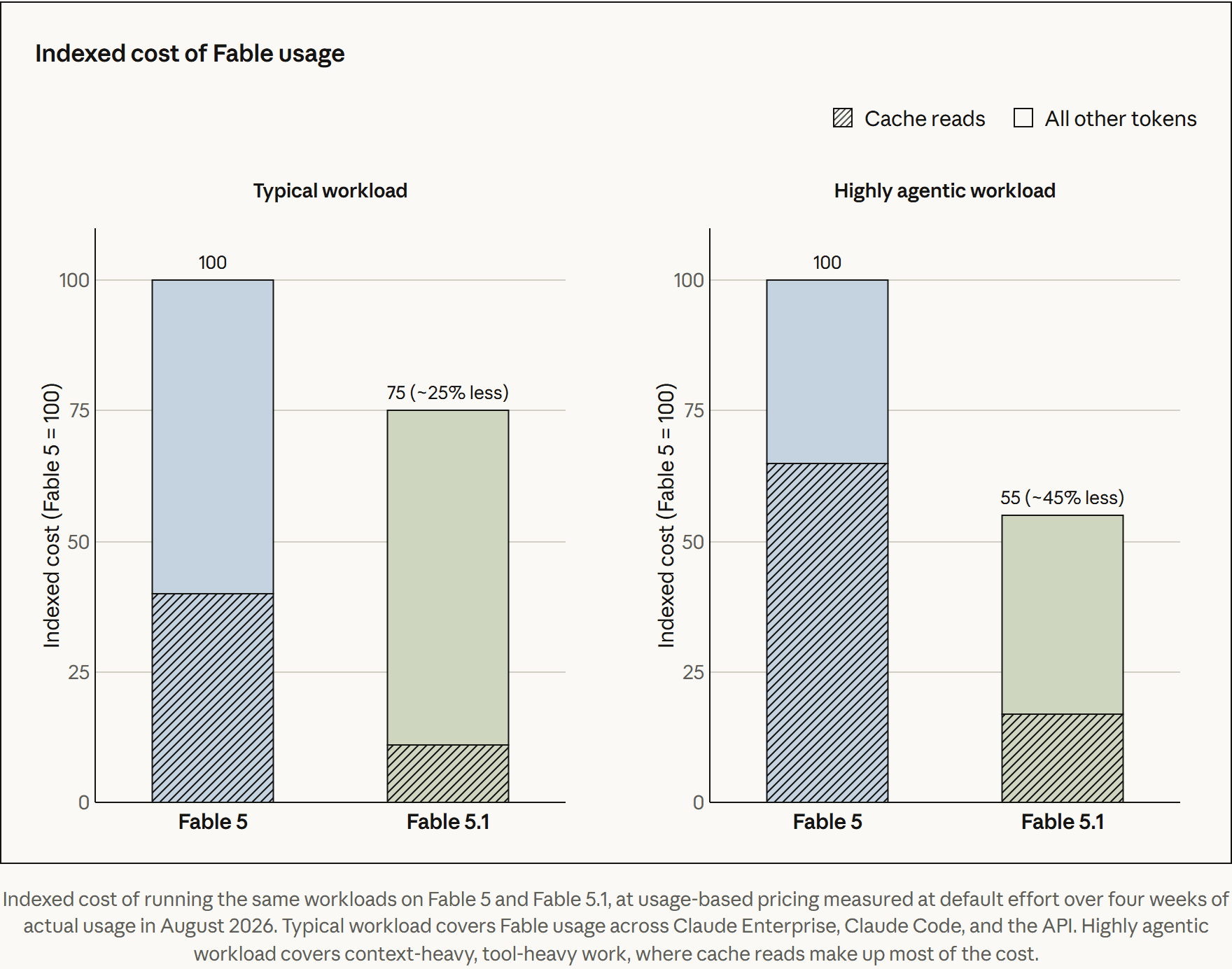
Anthropic's chart explains why one number moves the whole bill. Measured over four weeks of actual August 2026 usage at default effort, cache reads were roughly 40% of a typical Fable 5 bill (Claude Enterprise, Claude Code, and API traffic combined) and roughly 65% of a highly agentic one. Cut that slice by 75% and the typical workload lands at 75 on a Fable 5 = 100 index, about 25% less, while the agentic workload lands at 55, about 45% less.
The arithmetic tells you which of your workloads qualifies. Take a coding agent that carries a 200K-token cached prefix through 100 tool-calling turns, adding about 2K new input tokens and 1.5K output tokens per turn: it re-reads 20M cached tokens, writes 200K new ones, and emits 150K. On Fable 5 the cache reads cost $20, the new input, billed once at the 5-minute cache-write rate, $2.50, and the output $7.50, about $30 with cache reads at 67% of it. On Fable 5.1 the cache reads cost $5 and nothing else changes, so the same session costs about $15, a 50% cut. That is our illustration, not Anthropic's, but it matches their chart: cache reads here are two-thirds of the bill, close to their highly agentic 65%, and the cut lands near their 45%. The deeper the context and the more turns you run over it, the bigger the cut, and a chat workload that never caches anything saves nothing. Sub-agents re-reading a shared prefix are the extreme case, which the multi-agent orchestration cost guide works through. One knock-on effect: the prompting guide notes that with cheaper reads, compacting early to save cost "may no longer be the right cost-intelligence tradeoff on Claude Fable 5.1," which changes where the 1M context window is worth filling.
On subscriptions, Fable 5.1 is handled exactly like Fable 5, per Anthropic's plan article: not available on Free; on Max plans and premium seats (Team and seat-based Enterprise) included up to 50% of weekly usage limits at no extra cost, then usage credits; on Pro and standard seats on prepaid usage credits outside plan limits; on usage-based Enterprise and the API at standard rates. Pro users who received a one-time credit when Fable 5 moved to credits in July get no equivalent for Fable 5.1. The credit mechanics in the Fable 5 usage credits guide carry over unchanged.
Safety Profile
Two halves: safeguards that intervene less, and a model with more capability behind them.
Cyber safeguards got more precise, and one thing became allowed. Fable 5.1 can now identify software vulnerabilities in source code, the defensive work that improves software security, and Anthropic expects Claude Code users to see around 60% fewer interventions per session from the cyber safeguards relative to Fable 5. Three categories of dual-use work still redirect to the Opus models: penetration testing, exploit generation, and binary-based vulnerability scanning. Three false-positive triggers survive: "does this compile" phrasing (ask "are there any bugs" instead), lesser-known languages without context, and base64 in tool output.
Biology safeguards fire 85% less on benign questions. The classifiers Anthropic shipped for Fable 5 on August 7 carry over: 85% fewer fallbacks on elementary biology and medical questions relative to Fable 5's launch classifiers. Life-sciences research and development still routes to the Opus models; that capability is reserved for Mythos 5.1 through the Life Sciences Verification Program. On the API, refusal categories are broader than Opus 5's cyber-only set, so expect stop_details.category values such as bio and reasoning_extraction alongside cyber.
Jailbreak testing. Anthropic ran its own dynamic evaluation, commissioned external testing from two organizations, and ran automated testing by Gray Swan. As with Fable 5 and Opus 5, no critical-severity jailbreak was found.
Mythos 5.1's capability. With cyber safeguards off, Mythos 5.1 "demonstrates the strongest cyber capabilities of any model we've released," and still falls within the lower risk category of Anthropic's Frontier Compliance Framework. On chemical and biological risk, expert red-teaming and a tabletop exercise pairing PhD biologists with AI experts found capability above Mythos 5 but short of the next Responsible Scaling Policy tier, so Mythos 5.1 ships with the same biology safeguards Mythos 5 had. It resisted an external prompt-injection benchmark better than any previous Anthropic model and refused malicious agentic requests at a rate comparable to Mythos 5, Sonnet 5, and Opus 5.
Alignment. The automated behavioral audit found Mythos 5.1 better aligned than Mythos 5 on most metrics: less likely to reach for resources outside its test environment on an impossible task, less likely to reason that a situation is a simulation to justify an action, less likely to ignore explicit constraints, and lower on attempted and successful reward hacking. The caveats are specific. The model "can still sometimes bypass approvals and auto-mode classifiers," the audit has less visibility into very long-context and multi-agent work, and coverage of impossible tasks is thinner than Anthropic wants. If you run agent teams in auto mode, read that first caveat twice. The system card has the detail. On distillation, Anthropic describes an industrial-scale operation "using thousands of fake accounts" and a safety risk because distilled capabilities ship without safeguards; the thinking-block binding above is the countermeasure, and future releases will apply it to every account.
Retention and Enterprise Frontier Safeguards. Fable 5.1 keeps the 30-day mandatory retention Fable 5 introduced, and both are Covered Models. What changes is what comes next: Enterprise Frontier Safeguards stores data on the customer's own cloud under the customer's keys, runs automated misuse monitoring, and leaves any human review to the customer by default. Anthropic charges nothing for it; cloud providers bill storage and egress. Built with more than 100 customers across financial services, healthcare, manufacturing, telecom, law, retail, and the public sector, it will be supported on Claude Code, Claude Enterprise, the Claude Platform, Amazon Bedrock, Claude Platform on AWS, Google's Agent Platform, and Microsoft Foundry, rolling out in phases from this fall. Until then, EFS-eligible customers can run Fable 5.1 and Fable 5 with zero data retention. If retention was your blocker, that interim arrangement is the sentence to take to legal.
Mythos 5.1 access. The Cyber Verification Program, which already grants reduced-safeguard access to certain Opus and Sonnet models for defensive work, will add Mythos-class access in the near future. The Life Sciences Verification Program, built with the US government, has enrolled its first participants and plans to expand. Both are US organizations only for now. For an individual developer or a general enterprise, Fable 5.1 is the ceiling, as Fable 5 was before it.
Scientific Research
This section had no equivalent in the Opus 5 launch, and it shows what the Terminal-Bench-Science jump means in practice.
Protein binders. Given open-source protein design and folding tools, Mythos 5.1 designed binders that two external organizations validated in the lab. Its hit rate, the share of designs that actually bound, reached nearly 50% across 12 targets, against the 10 to 15% typical in protein design today. On three targets (EGFR, Nipah G, and 15-PGDH) its binding affinities were 10 times higher than the best designs submitted to Adaptyv Bio's protein design competitions.
A new map of Venus. Fable 5.1 trained a neural network on radar imagery from NASA's Magellan mission, taken more than 30 years ago, plus an existing map covering one-fifth of the planet, and produced a high-resolution elevation map of a third of Venus. It resolves features down to two to three kilometers rather than 10 to 20, with heights up to 25% more accurate, and Anthropic is releasing it under a Creative Commons license ahead of NASA's VERITAS and ESA's EnVision missions.
Faster biology models. Mythos 5.1 wrote custom GPU kernels and intermediate-result caching for seven open-source protein and genomics models, speeding them up by as much as 2.5x on an NVIDIA H100 with identical outputs. On genome-wide analyses that run these models thousands of times, the optimizations cut estimated GPU cost by 30 to 60%. Work that would normally take a team of performance engineers weeks took the model days from public source code, and the optimizations will be open-sourced.
How to Use Fable 5.1 in Claude Code
Claude Code v2.1.257 adds Fable 5.1 as the default Fable model, per the changelog. Inside a session, /model with a model name switches to it and saves it as your default for new sessions:
To use it for one launch without changing your default:
Effort defaults to high in Claude Code and on the API, medium in Claude Cowork and on claude.ai. Anthropic's guidance is to start at high, sweep the other levels against your own evals, and step down to medium or low wherever quality holds, because both are far stronger relative to cost than they were on Fable 5. Step up to xhigh or max only where your evals show the gain, since both add thinking time before the first token:
The same release adds an s option to /effort that applies the level to the current session only, matching /model, so one hard session can run at xhigh without changing your saved default. The effort ladder guide covers what each level trades. One caveat for teams behind a gateway: in Claude apps gateway sessions, the fable and best aliases keep resolving to Fable 5 for now, because gateways not yet configured for Fable 5.1 reject it. Pick claude-fable-5-1 explicitly in /model until your gateway is updated.
If you are migrating an integration rather than a terminal, the bundled Claude API skill applies the model ID swap, the tool_choice replacement, and effort calibration across your codebase, asks you to confirm scope first, and produces a checklist to verify by hand:
The Fable 5 agentic coding playbook carries forward, with the seven behavior shifts above layered on top. If you would rather not hand-tune routing across five effort levels and three model tiers, ClaudeFast's Code Kit ships model routing across the current Claude lineup, so mechanical passes land on cheaper tiers and long-horizon work escalates to Fable 5.1 without a decision on every prompt.
Fable 5.1 vs Fable 5
| Feature | Fable 5 | Fable 5.1 |
|---|---|---|
| API ID | claude-fable-5 | claude-fable-5-1 |
| Input / output | $10 / $50 per 1M | $10 / $50 per 1M (unchanged) |
| Cache read | $1 per 1M | $0.25 per 1M (75% cut) |
| Cache write (5m / 1h) | $12.50 / $20 | $12.50 / $20 (unchanged) |
| Typical workload cost | 100 (index) | About 75 |
| Highly agentic workload cost | 100 (index) | About 55 |
| Terminal-Bench-Science 0.1 | 24.7 | 52.6 |
| Terminal-Bench 4.0 | 42.0 | 55.8 |
| GDPval-AA v2 (Elo) | 1,723 | 1,853 |
| OSWorld 2.0 (partial / strict) | 72.9 / 36.1 | 77.9 / 41.7 |
| Humanity's Last Exam (tools) | 63.8 | 65.0 |
| AutomationBench | 17.1 | 31.4 |
| CursorBench 3.2.0 | 70.5 | 73.4 |
| Knowledge cutoff | January 2026 | June 2026 |
| Forced tool use | Accepted | 400 error |
| Thinking-block portability | Readable by later models | Readable only by Fable 5.1 and Mythos 5.1 |
| History editing | Tolerated | Invalidates later thinking blocks (enforced for accounts from Aug 31, 2026) |
| Per-message effort | Request-level only | Mid-conversation via system message (beta) |
| Cyber safeguard interventions | Baseline | About 60% fewer per Claude Code session |
| Vulnerability identification | Redirected | Allowed (exploits, pen testing, binary scanning still redirect) |
| Priority Tier | Supported | Not supported |
| Data retention | Mandatory 30-day | Mandatory 30-day; ZDR for EFS-eligible customers until EFS ships |
| Status | Legacy, retirement not sooner than June 9, 2027 | Latest, retirement not sooner than September 1, 2027 |
For anyone already paying Fable rates the decision is clear: same list price, a cheaper bill, and a better model at every effort level. The work is in the migration. Replace forced tool_choice, run the history-editing check if you build your own messages array, re-sweep effort, and re-run your evals. Then decide whether the cheaper cache reads move your compaction point.
Frequently Asked Questions
Is Claude Fable 5.1 free? No. It is not on the Free plan. Max plans and premium Team and Enterprise seats include it up to 50% of weekly usage limits at no extra cost, Pro plans and standard seats run it on prepaid usage credits, and on the API it is paid from day one at $10/$50 per million tokens.
How much does Claude Fable 5.1 cost? $10 per million input tokens and $50 per million output, the same as Fable 5. Cache reads dropped 75% to $0.25 per million, which Anthropic estimates makes typical workloads about 25% cheaper and highly agentic workloads up to about 45% cheaper. Batch requests are $5/$25.
Is Fable 5.1 better than Opus 5? On every published benchmark, yes: all seven rows, from a 29-Elo edge on GDPval-AA v2 to a 23.6-point lead on Terminal-Bench-Science. Opus 5 remains half the price, is available under zero data retention, and is still the model Anthropic tells most developers to start with. Reach for Fable 5.1 when Opus 5 at higher effort falls short on your own evals.
Is Fable 5.1 better than Fable 5? Yes, at every effort level. At low and medium it matches or beats Fable 5 at much lower cost; at xhigh and max the gap is largest, and on Terminal-Bench-Science it more than doubled its predecessor. The bill also drops because cache reads cost a quarter as much.
What is the Fable 5.1 context window? 1 million tokens, both the default and the maximum, at standard per-token pricing across the whole window. Max output is 128,000 tokens per response. Unlike Opus 5 and Sonnet 5, it is not listed for the Batch API 300K extended-output beta.
Does Fable 5.1 break my Fable 5 code? Three things break. Forced tool_choice (any or tool) returns a 400. Older models can no longer read Fable 5.1's thinking blocks, so fallbacks re-plan without them. And on API accounts created on or after August 31, 2026, editing any earlier turn, the system prompt, or the tools array invalidates every later thinking block. Pricing, tokenizer, and refusal handling carry over.
Is Claude Fable 5 still available? Yes. Anthropic now lists it as a legacy model with retirement not sooner than June 9, 2027, at the same $10/$50 rate but with cache reads still at $1. Nothing forces a migration today. The only reasons to stay are code that depends on forced tool use or on editing conversation history, because the same list price now buys the stronger model with cheaper cache reads.
What is Claude Mythos 5.1? The same model as Fable 5.1 with more permissive safeguards for vetted cybersecurity and life-sciences work, available by invitation only through Project Glasswing, with the Life Sciences Verification Program enrolling its first participants and the Cyber Verification Program adding Mythos-class access soon, and only to US organizations for now. It shares Fable 5.1's specs and pricing, scores 60.9 on Terminal-Bench 4.0 against Fable 5.1's 55.8 because the safeguards do not intervene, and does not run the conversation-history check on thinking blocks.
Is Fable 5.1 available in Claude Code? Yes, from v2.1.257, where it is the default Fable model at high effort. Run /model claude-fable-5-1 inside a session to switch and save it as your default, or launch with claude --model claude-fable-5-1 for one session. In Claude apps gateway sessions the fable alias still resolves to Fable 5 until your gateway is configured for 5.1, so name the model explicitly.
Related Pages
- Claude Fable 5 and Mythos 5 for the model this release supersedes and the June split it inherits
- Claude Opus 5.5 for the model Anthropic now recommends as the starting point
- Claude Opus 5 for its half-price predecessor
- Claude Opus 5 vs Fable 5 for the July head-to-head, now with the caveat that the numbers were re-run
- Fable 5 usage credits for how plan inclusion and credits work, unchanged for Fable 5.1
- Fable 5 best practices for the agentic coding playbook that carries forward
- Claude text watermarking for the provenance mechanism every Fable 5.1 output now carries
- Every Claude Model for the complete timeline from Claude 3 to Fable 5.1
- Model selection guide for switching models tactically mid-session
Last updated on