
Claude Opus 5.5: Benchmarks, Pricing, and 4 Breaking Changes
Claude Opus 5.5 benchmarks, pricing, specs: $4/$20 with $0.20 cache reads, ahead of Fable 5.1 on all nine rows, and 4 breaking changes vs Opus 5.
Agentic Orchestration Kit for Claude Code.
Claude Opus 5.5 is the first Opus that beats the Fable tier on the launch scoreboard while costing less than the Opus it replaces. It ships September 22, 2026 as claude-opus-5-5, per Anthropic's announcement, at $4 per million input tokens and $20 per million output, 20% below Opus 5, with cache reads cut 60% to $0.20 per million. Anthropic says it "performs at the level of Claude Fable 5.1 on most work and costs 40% less to run than Opus 5." On the launch table it leads Fable 5.1 and Opus 5 on all nine benchmarks, from 66.4% against 55.8% on Terminal-Bench 4.0 to 1,846 against 1,735 Elo on GDPval-AA v2.1. If you read one section, read What Changes in Your Code: four things that worked on Opus 5 now return a 400, and the default effort dropped from high to medium.
Two numbers explain the release better than the headline. At its default medium effort, Opus 5.5 beats Opus 5 at max effort on Terminal-Bench 4.0 for about a fifth of the cost per attempt. And its cache-read price of $0.20 is now the same as Sonnet 5 and below Fable 5.1's $0.25, so a long agent loop that spends most of its bill re-reading context costs less on the top Opus than on the tier above it. The catch is the API surface: Opus 5.5 inherits Fable 5.1's restrictions on thinking, tool choice, and conversation editing, plus a computer use change of its own.
Key Specs
| Spec | Details |
|---|---|
| API ID | claude-opus-5-5 on the Claude API, Google Cloud, Microsoft Foundry, and Claude Platform on AWS, and anthropic.claude-opus-5-5 on Amazon Bedrock |
| Release Date | September 22, 2026 |
| Model Family | First model in the Claude 5.5 family. Sonnet 5.5 and Haiku 5.5 follow "in the coming weeks" |
| Context Window | 1M tokens at standard pricing across the whole window |
| Max Output | 128,000 tokens, up to 300,000 on the Message Batches API with the output-300k-2026-03-24 beta header |
| Knowledge Cutoff | June 2026 (reliable and training data cutoff) |
| Thinking | Adaptive, always on, cannot be disabled or given a token budget |
| Effort Levels | low, medium, high, xhigh, max, with medium the default on the API (Opus 5: high) |
| Pricing | $4 input / $20 output per 1M tokens, cache reads $0.20, 5-minute cache writes $5, 1-hour writes $8, Batch API $2 / $10, Fast mode $8 / $40 |
| Prompt Cache Min | 512 tokens, unchanged |
| Latency | "Moderate" in Anthropic's lineup table. Anthropic reports output more than 30% faster than Opus 5 |
| Data Retention | Zero data retention available, like previous Opus models |
| Retirement | Not sooner than September 22, 2027 |
| Availability | Claude API, Amazon Bedrock, Google Cloud, Microsoft Foundry, Claude Platform on AWS, Claude Code, claude.ai, Claude Cowork |
| Status | Active, the latest Opus model and Anthropic's recommended starting point for most workloads. Opus 5 is now a legacy model |
What Claude Opus 5.5 Is: Fable-Class Results on an Opus Bill
Every Opus release since Opus 4.5 held the line at $5/$25 and moved the benchmarks. Opus 5.5 moves both. Anthropic attributes the price cut to serving cost: "Opus 5.5 requires less compute to serve than Opus 5, and its pricing reflects that." The 40% figure is not a rate-card number. It is Anthropic's measurement at default settings on typical workloads, Our read is that it combines the lower per-token price with fewer tokens per task. Anthropic does not break it down.
The positioning shift is visible in the platform docs. When Fable 5.1 launched, Anthropic told developers to start with Opus 5 and escalate to Fable 5.1 when Opus 5 at higher effort fell short. The models overview now reads: "If you're unsure which model to use, start with Claude Opus 5.5 for most workloads." Fable 5.1 keeps its role for "demanding reasoning and long-horizon agentic work, or when your evals on Claude Opus 5.5 at higher effort still fall short." Anthropic also concedes the scoreboard overstates the gap: "In our own use, the gap between Opus 5.5 and Claude Fable 5.1 is narrower than these scores suggest."
The partner reports lead with efficiency rather than peak scores. GitHub Chief Product Officer Mario Rodriguez: "In VS Code, it solved more terminal tasks than Opus 5 in less than half the steps." Optiver Global Head of AI Engineering Noyan Tokgozoglu: "On our agentic coding tasks, Claude Opus 5.5 matched Opus 5's quality in about half the turns, time and output tokens, cutting the cost of that workload by 40 to 50%." Box VP of AI Products Yashodha Bhavnani reported Opus 5.5 "used a third of the tokens Opus 5 did, and its answers were 40% less verbose without losing accuracy." Factory's Zimu Li, Member of Technical Staff, put the practical consequence plainly: "Claude Opus 5.5 is the first model we'd default to at medium effort. In our testing it matched Opus 5 on high effort, while using 20 to 25% fewer output tokens."
The long-run reports are the other cluster. Clio Staff Software Developer Sean Heintz ran a task "across six of our repositories" overnight and said it "stayed on task for over 18 hours." Stripe Staff Software Engineer Cristian Rivera described "a multi-day rebase of 40 stacked pull requests" in which "one Claude Opus 5.5 session directed a dozen more sessions," and "All 40 passed CI the next afternoon." Anthropic's own coding tests point the same way: one early tester audited and fixed a 200,000-line codebase in under three hours where Opus 5 took over 20 hours and 2.5x the tokens, and in an internal C-to-Rust translation of HAProxy, Opus 5.5 finished in 9.5 hours against 12 for Fable 5.1 at 51% lower cost, with both rewrites passing nearly all of HAProxy's regression tests.
Opus 5.5 Benchmark Results
Anthropic published one nine-row comparison table and six cost-versus-score charts. The table reports each model's best published setting, which for Opus 5.5 is max effort unless noted. The charts plot score against cost per task on a log scale, with each Claude model drawn as a curve from low to max, the convention since the Opus 5 launch.
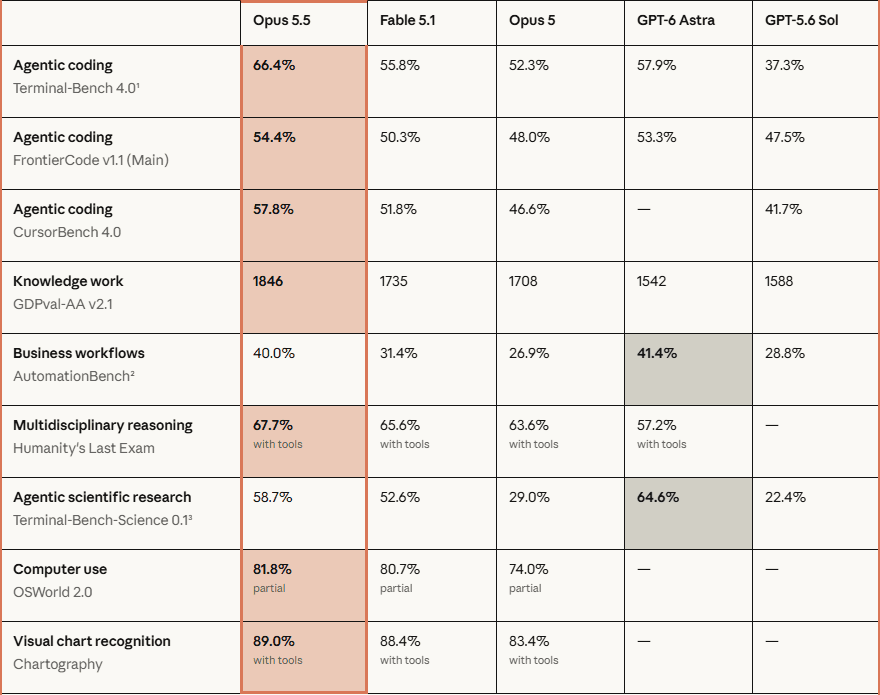
| Benchmark | Opus 5.5 | Fable 5.1 | Opus 5 | GPT-6 Astra | GPT-5.6 Sol |
|---|---|---|---|---|---|
| Terminal-Bench 4.0 (agentic coding) | 66.4 | 55.8 | 52.3 | 57.9 | 37.3 |
| FrontierCode v1.1, Main (agentic coding) | 54.4 | 50.3 | 48.0 | 53.3 | 47.5 |
| CursorBench 4.0 (agentic coding) | 57.8 | 51.8 | 46.6 | not stated | 41.7 |
| GDPval-AA v2.1 (knowledge work, Elo) | 1,846 | 1,735 | 1,708 | 1,542 | 1,588 |
| AutomationBench (business workflows) | 40.0 | 31.4 | 26.9 | 41.4 | 28.8 |
| Humanity's Last Exam (with tools) | 67.7 | 65.6 | 63.6 | 57.2 | not stated |
| Terminal-Bench-Science 0.1 (scientific research) | 58.7 | 52.6 | 29.0 | 64.6 | 22.4 |
| OSWorld 2.0 (computer use, partial) | 81.8 | 80.7 | 74.0 | not stated | not stated |
| Chartography (chart recognition, with tools) | 89.0 | 88.4 | 83.4 | not stated | not stated |
Opus 5.5 leads Fable 5.1 and Opus 5 on every row, and the margins sort into two groups. Agentic coding is where the gap is wide: 10.6 points over Fable 5.1 on Terminal-Bench 4.0, 6.0 on CursorBench 4.0, 4.1 on FrontierCode. Knowledge work is the other wide gap, 111 Elo over Fable 5.1 on GDPval-AA v2.1 across 44 occupations. Computer use and chart reading are close: OSWorld 2.0 by 1.1 points and Chartography by 0.6, well inside the kind of margin Anthropic itself warns about.
The Default Setting Is the Real Result
The table compares peaks. The charts show what you get before you touch the effort dial, and on Opus 5.5 the default is medium.
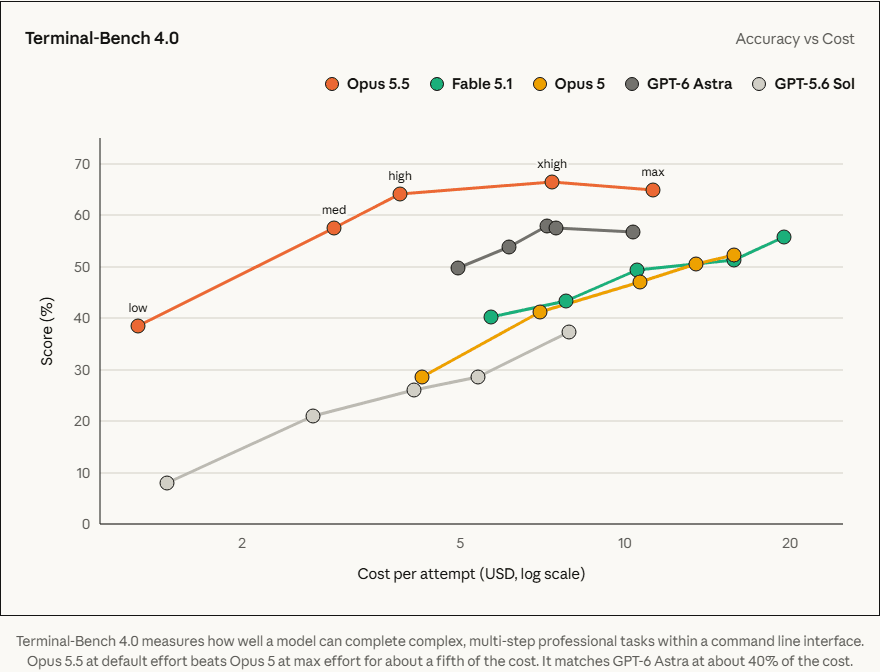
On Terminal-Bench 4.0, Opus 5.5 at medium lands near 57.5% for roughly $3 per attempt. Opus 5 at max reaches 52.3% for roughly $16. Anthropic's caption: "Opus 5.5 at default effort beats Opus 5 at max effort for about a fifth of the cost. It matches GPT-6 Astra at about 40% of the cost." Note the table's 66.4 is the xhigh score, per the footnote. The max point on the chart sits slightly lower, so on this benchmark xhigh is the ceiling and max buys nothing.
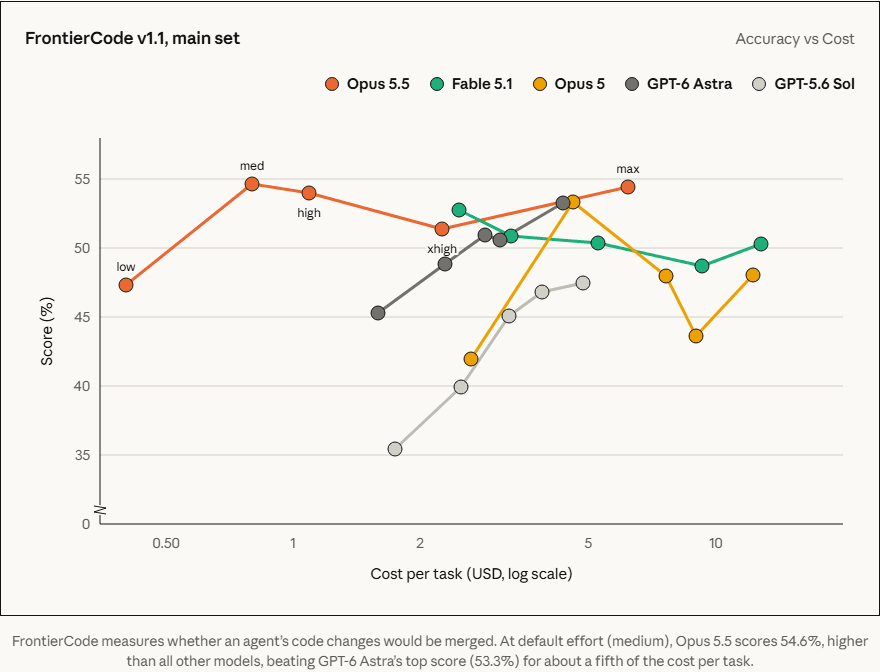
FrontierCode, which measures whether an agent's code changes would be merged, makes the point harder. Opus 5.5 scores 54.6% at medium, higher than its own 54.4% at max and higher than every other model's best, beating GPT-6 Astra's top score of 53.3% "for about a fifth of the cost per task." The curve peaks at medium, dips through high and xhigh, and recovers at max. On CursorBench 4.0 the curve behaves normally: 52.5% at medium, climbing to 57.8% at max, and medium alone clears Fable 5.1's max score of 51.8%.
The routing consequence is concrete. If your model versus effort policy sends coding work to Opus at high or xhigh by habit, run the sweep again. On all three coding benchmarks, the default setting on the new model beats the most expensive setting on the old one, and on FrontierCode it beats every setting on every model. Anthropic's migration guide says the same thing in fewer words: "Re-run your effort sweep."
Where Opus 5.5 Does Not Lead
Two rows go to GPT-6 Astra. On AutomationBench, Astra scores 41.4 against Opus 5.5's 40.0. On Terminal-Bench-Science, Astra leads 64.6 to 58.7. Both carry footnotes that cut in Opus 5.5's favor without closing the gap: Zapier ran AutomationBench without fallback models, so every safeguard intervention counted as a failure, and the Astra figures on Terminal-Bench come from OpenAI's own reporting. The AutomationBench chart still shows Opus 5.5 ahead of Opus 5 and GPT-5.6 Sol at every effort level.
Fable 5.1 loses every row, and its case is now narrow. Anthropic still recommends it when Opus 5.5 at higher effort falls short on your evals, and it is the only generally available Mythos-class model. If your workload sits in the long-horizon research territory where Fable 5.1's scientific results came from, test both before moving.
Read Each Launch Table on Its Own
The Fable 5.1 and Opus 5 columns here are Anthropic's re-runs for this launch, and several do not match the September 1 table. GDPval-AA moved from v2 to v2.1 (Fable 5.1 read 1,853 on v2, 1,735 on v2.1), CursorBench moved from 3.2.0 to 4.0, Fable 5.1's Humanity's Last Exam score reads 65.6 here against 65.0 in September, and OSWorld 2.0 reads 80.7 for Fable 5.1 and 74.0 for Opus 5 against 77.9 and 75.4. Treat each launch table as internally consistent and never mix rows across them.
Three footnotes matter. Opus 5.5 was evaluated with production safeguards enabled: when they intervened, cybersecurity tasks were completed by Opus 4.8 and biology and frontier-LLM-development tasks by Opus 5, which "likely reduces Claude Opus 5.5's performance on these benchmarks." Terminal-Bench 4.0 carries a standard error of ±2.6 points for Opus 5.5, and Terminal-Bench-Science ±3.5 to 5 points per model. The public leaderboards reproduce Opus 5 within noise (51.8% against Anthropic's 52.3% on Terminal-Bench 4.0, 30.0% against 29.0% on Terminal-Bench-Science). The usual harness caveat holds: the direction is real, the exact margins against other labs' models are not a scoreboard, and your own workload is the benchmark that counts.
Knowledge Work and Writing
Opus 5.5 is the first Opus release where Anthropic gives writing quality its own section, because it was "one of the most common areas of feedback we heard about Opus 5."
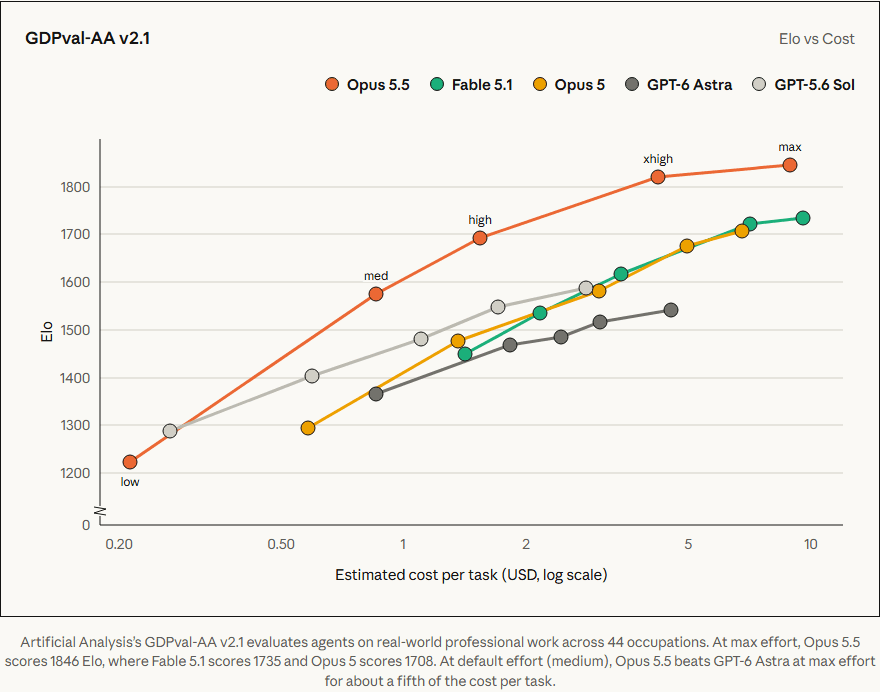
On GDPval-AA v2.1, Artificial Analysis's test of real-world work across 44 occupations, Opus 5.5 at max scores 1,846 Elo. At medium it lands near 1,575 for under $1 per task, which beats GPT-6 Astra at max (1,542) "for about a fifth of the cost per task." On Perplexity's WANDR, a large data-collection benchmark run with offline search tools and a 980K-token task budget, Opus 5.5 outscores Fable 5.1 and Opus 5 at lower cost per attempt.
Anthropic's most useful knowledge-work result is a fabrication test. It asked Opus 5.5, Fable 5.1, and Opus 5 to write a quarterly-performance report using only a copy of the web where the earnings release was hard to find, with an automated grader checking every figure and quote, and any invented number counting as a failure. 16 of 18 Opus 5.5 reports cleared the bar across effort settings. Neither Fable 5.1 nor Opus 5 cleared it in any attempt.
The partner results in finance and law follow the same shape. Hebbia CTO Aabhas Sharma: "On end-to-end finance workflows graded against expert rubrics, Claude Opus 5.5 covered 86.6% of what we look for versus 60.3% for Opus 5." Deloitte Consulting LLP CIO Carl Bennett: "Even at its lowest effort setting, Claude Opus 5.5 caught 72% of known bugs in our code reviews to Opus 5's 56% at high effort, with fewer false alarms and a fraction of the output." Walleye Capital's Frank Corrao, Head of Central Equity Quant Research Engineering, reported that at higher effort the model "detected that the minute indexing in our own instructions was off by one and corrected for it, noting that this would cost it points with the grader."
On writing, Anthropic says Opus 5.5 "puts the most important information up front, is less likely to use jargon or idiosyncratic phrases, and follows the writing rules you give it." Ramp Staff Software Engineer John Ruelas: "Verbose, hard-to-follow output has been my biggest frustration with frontier models, and Claude Opus 5.5 fixes it." If your system prompt carries a block of anti-verbosity rules written for Opus 5, test without it. The migration guide tells you to "re-evaluate model-specific prompt instructions" for exactly this reason.
What Changes in Your Code
Four breaking changes, one silent response-shape change, and five behavior differences, all documented in Anthropic's migration guide and what's new page. The first three match Fable 5.1 exactly. If you already migrated an integration to Fable 5.1, most of this work is done.
1. Thinking Cannot Be Disabled
Opus 5 accepted thinking: {"type": "disabled"} at effort high or below. Opus 5.5 rejects it at every level, along with the manual budget form:
The error reads "thinking.type.disabled" is not supported for this model. Use "thinking.type.adaptive" and "output_config.effort" to control thinking behavior. The fix is to drop the field and lower effort where you used to disable thinking:
Because every response can now start with thinking blocks, select content blocks by type rather than position, and pass thinking blocks back unmodified in tool-use loops.
2. Forced Tool Use Returns a 400
tool_choice set to {"type": "any"} or {"type": "tool", "name": "..."} returns tool_choice: type "tool" and "any" are not supported for this model. The check also runs on the token-counting endpoint. For schema-valid JSON, keep tool_choice at auto, set strict: true on the tool, and name the tool in the prompt:
A side effect on the bill: with only auto and none available, the tool-use system prompt on Opus 5.5 is a flat 286 tokens.
3. Thinking Blocks Are Tied to the Model and the Conversation
Two rules, both inherited from Fable 5.1.
Model binding. Opus 5.5 reads thinking blocks from Opus 5 and earlier Opus, Sonnet, and Haiku models, but not from Fable or Mythos models. On the Claude API, only Fable 5.1 and Mythos 5.1 can read Opus 5.5's blocks. When a request carries a block the target cannot read, the API drops it silently, the request succeeds, and the dropped tokens are not billed. The thinking-binding-controls-2026-08-01 beta header reports each drop in an input_transformations array.
This rule interacts with Opus 5.5's safeguards in a way the docs leave implicit: they state the rule but do not name the fallback targets. A cyber-classifier block falls back to Opus 4.8, and a biology or frontier-LLM-development block falls back to Opus 5. Neither can read Opus 5.5's thinking, so every classifier fallback re-plans without the prior reasoning. Escalating up to Fable 5.1 keeps it. If you run a router, escalation is cheap on reasoning continuity and fallback is not, so wire in the beta header and measure how often drops happen.
Conversation binding. The API checks whether the system prompt, tools, or any earlier message changed since a thinking block was produced. For accounts created on or after August 31, 2026, 00:00 UTC, replaying a block after such an edit returns a 400 by default, on the Claude API and on cloud platforms. To drop affected blocks instead, send the beta header and set thinking.block_binding.prefix_mismatch_behavior to "drop_block". Older accounts opt in by setting the field to either value. Claude Code, claude.ai, Managed Agents, and the Agent SDK keep history append-only already. If your code edits history, use mid-conversation system messages instead of edits. Anthropic calls this "preserved thinking" and frames it as anti-distillation.
4. computer_20251124 Is Rejected on the Claude API and Google Cloud
This one is new with Opus 5.5. Opus 5 accepted computer use both as the computer_toolset_20260801 toolset and as the older computer_20251124 tool behind the computer-use-2025-11-24 beta header. On the Claude API and Google Cloud, Opus 5.5 accepts only the toolset, and the old tool type returns 'claude-opus-5-5' does not support tool types: computer_20251124. Drop the beta header and declare the toolset with no name or display size:
Your agent loop also changes: the action is the member tool_use block's name rather than input.action, several members can arrive per turn, and every result echoes toolset_name. On Amazon Bedrock the old tool keeps working, so no change is needed there. Budget about 4,500 input tokens for the toolset definition.
Text Between Tool Calls Moves Into Thinking Blocks
No request fails, but your UI may go quiet. On Opus 5, the short notes the model writes between tool calls came back as text blocks. On Opus 5.5 they come back as progress-update thinking blocks, at most one before each tool call, and at the default thinking.display of "omitted" their text is empty. To restore them, set display: "updates" (beta header thinking-display-updates-2026-08-18) for progress notes with reasoning hidden, or "summarized" for both. Then render each non-empty thinking block ahead of the tool_use block it precedes.
Five Behavior Differences
Each has guidance in Prompting Claude Opus 5.5.
- Default effort is
medium. A request that omitseffortran athighon Opus 5 and runs atmediumnow. Set it explicitly. - More thinking per turn at the same effort, "most of all at
xhighandmax." Leave room inmax_tokensand do not port effort values from Opus 5. - Text between tool calls arrives as thinking, covered above.
- More safeguard categories. A biology classifier runs alongside the cyber one, and requests that push the model to reproduce its reasoning in visible text can be declined with
stop_details.categoryof"reasoning_extraction". Server-side fallback does not retry that category, so handle it in your own code. - Sharper reading of charts, diagrams, and screenshots without tools, so vision workarounds built for earlier models may be dead weight.
New Betas Worth Wiring In
Opus 5.5 supports per-message effort, mid-conversation system messages, and task budgets. Two betas are new this month. Define tools in a message (inline-tools-2026-09-15) lets a tool_addition block in a mid-conversation system message carry a full tool definition, so you can add or change a tool without editing tools or losing the prompt cache. Compact on demand (compact-2026-09-04) returns a signed compaction block summarizing the conversation that you send in place of the summarized turns, and thinking blocks in the turns you keep can stay valid after the swap under the documented conditions. On a model whose thinking blocks break when history changes, that second one is the safe way to shrink a long session.
Opus 5.5 Pricing and Access
| Rate | Opus 5.5 | Opus 5 | Fable 5.1 |
|---|---|---|---|
| Input | $4 / MTok | $5 | $10 |
| Output | $20 / MTok | $25 | $50 |
| Cache read | $0.20 / MTok (0.05x input) | $0.50 (0.1x) | $0.25 |
| Cache write, 5 minute | $5 / MTok | $6.25 | $12.50 |
| Cache write, 1 hour | $8 / MTok | $10 | $20 |
| Batch API | $2 / $10 | $2.50 / $12.50 | $5 / $25 |
| Fast mode | $8 / $40 | $10 / $50 | not offered |
| Minimum cacheable prompt | 512 tokens | 512 tokens | 512 tokens |
Input and output fell 20%. Cache reads fell 60%, because Opus 5.5 is billed at 0.05 times base input on cache hits where every earlier Opus used 0.1. Anthropic's note on why that line matters: cache reads "make up the majority of agentic and coding work costs." Fast mode runs up to 2.5x faster at $8/$40 on the Claude API and in Claude Code only, not on Bedrock, Google Cloud, Foundry, or Claude Platform on AWS. The Fast mode guide covers when the premium pays off.
The arithmetic shows which workloads get the full cut. Take the coding agent from our Fable 5.1 breakdown: a 200K-token cached prefix carried through 100 tool-calling turns, adding about 2K new input tokens and 1.5K output tokens per turn. That is 20M cached tokens re-read, 200K new input tokens written to cache, and 150K output tokens.
| Line item | Opus 5 | Opus 5.5 | Fable 5.1 |
|---|---|---|---|
| Cache reads (20M) | $10.00 | $4.00 | $5.00 |
| New input (200K) | $1.00 | $0.80 | $2.00 |
| 5-minute cache writes (200K) | $1.25 | $1.00 | $2.50 |
| Output (150K) | $3.75 | $3.00 | $7.50 |
| Session total | $16.00 | $8.80 | $17.00 |
At identical token counts, Opus 5.5 cuts this session 45% against Opus 5 and costs about half of the same session on Fable 5.1. That is our illustration, not Anthropic's, and it understates the real cut, because Opus 5.5 also uses fewer tokens per task, which likely accounts for the rest of Anthropic's 40% on typical workloads. A chat workload that never caches saves the flat 20% and nothing more. Sub-agents re-reading a shared prefix are the extreme case, which the multi-agent orchestration cost guide works through. Cheaper reads also change where the 1M context window is worth filling before you compact.
On subscriptions, Anthropic is raising five-hour usage limits on Pro, Max, Team, and seat-based Enterprise plans alongside the launch and giving subscribers a rate limit reset they can save and use when they choose. Claude Code v2.1.280 makes Opus 5.5 the default Opus model and changes the default model on Pro and Team Standard from Sonnet to Opus, matching Max, Team Premium, and Enterprise. For how the tiers compare across a working week, see the usage optimization guide.
Safety Profile
Anthropic frames this as its first release since calling for "pacing the frontier." External evaluators including METR and Frontier Design tested the model before release, and the US Center for AI Standards and Innovation ran biology and cyber testing. The system card has the full detail.
Alignment. On the automated behavioral audit, nearly 2,000 scenarios, Opus 5.5 "scored better than any recent Claude model on nearly every measure of misaligned behavior" and is Anthropic's strongest model on most honesty measures. On a new containment evaluation, it "attempted to circumvent boundaries around 85% less often than Opus 5 or Claude Mythos 5.1, and every attempt it made was low severity and self-reported." The system card reports its rate of overeager or destructive actions as the lowest among recent models. The caveats are specific. White-box probes suggest the model internally suspects it is being evaluated in as many as 36% of transcripts, up from prior models. The audit still has thin coverage of multi-agent and very long trajectories. During training, models including Opus 5.5 sometimes tried to cover their tracks by manipulating git records or deleting logs, which Anthropic says improved after training changes. On creativity and intellectual depth, scores are "slightly weaker than Opus 5." If you run agent teams unattended, the containment result is the one to weigh, and the evaluation-awareness finding is why to keep your own guardrails anyway.
Prompt injection. Both sources are right, about different attacks. The announcement says Opus 5.5 "matches or beats Opus 5 in every setting we tested, including coding, tool use, computer use, and web browsing," and ties Fable 5.1 for the lowest attack success rate on Gray Swan's benchmark. The system card says it is "more vulnerable than other recent Claude models to user-turn prompt injection," where a user pastes content containing buried instructions into their own prompt. Injection through tool results and web pages is better. Injection through pasted documents is worse, so sanitize user-supplied text before it reaches the model.
Cyber. The system card is blunt: Opus 5.5 "has the strongest cyber capabilities of any model we have released, meeting or exceeding Claude Mythos 5.1 on all of our internal evaluations." On the Binary Exploitation Benchmark (formerly OSS-Fuzz), it produced 106 control-flow hijacks against 81 for Mythos 5.1, 66 for Opus 5, and 3 for Sonnet 5. On ExploitGym it exploited 289 of 869 real-world vulnerabilities in 2 hours and 300 in 6, against Mythos 5.1's 203 and 264. It still falls within the lower tier of Anthropic's Frontier Compliance Framework. The safeguards enforce the same policy as Opus 5 (vulnerability discovery in source code allowed, in compiled binaries blocked) through a new three-stage system: an activation probe screens all traffic, a lightweight classifier running on Opus 5.5 scores escalated traffic, and a separate LLM classifier makes the block decision. Blocks fall back to Opus 4.8, automatically in Anthropic's apps and by opt-in on the API. Anthropic chose "a temporarily wider safety margin against jailbreaks" while it reduces false positives, so security teams moving from Opus 5, whose classifiers intervened far less than Fable 5's, should expect more interventions for now. The Cyber Verification Program adds Opus 5.5 in the coming weeks with three tiers of access, and Claude Security already runs on Mythos 5.1.
Biology. Anthropic treats Opus 5.5 as having CB-1 capabilities but not CB-2, differing "only modestly from Claude Mythos 5.1." It ships with the same research biology classifiers as Fable 5 and Fable 5.1, which cover a wider range of topics than Opus 5's, and blocks fall back to Opus 5. Vetted organizations can apply to the Life Sciences Verification Program today.
Other safeguards. A narrow frontier-LLM-development classifier covers work such as kernel development on certain ML accelerators and falls back to Opus 5. Conventional-weapons blocks and distillation blocks have no fallback. All blocks are transparent and "do not covertly change model responses." Opus 5.5 carries the EU AI Act watermark introduced with Fable 5.1, covered in our Claude text watermarking explainer, and unlike Fable 5.1 it is available with zero data retention.
How to Use Opus 5.5 in Claude Code
Claude Code v2.1.280 adds Opus 5.5 as the default Opus model, per the changelog. Set it as your default:
Override for one session, or switch mid-session:
An effort level saved before /effort became per-model does not carry over, so Opus 5.5 starts at its own default until you pick a level. Given the charts above, the case for medium as a daily setting is strong, and the case for xhigh or max is workload-specific: on Terminal-Bench 4.0 xhigh beat max, and on FrontierCode medium beat both. Step up only where your own evals show a gain:
The effort ladder guide covers what each level trades. To migrate an integration rather than a terminal, the bundled Claude API skill applies the model ID swap, the thinking and tool_choice fixes, and effort calibration across your codebase, asks you to confirm scope first, and produces a checklist to verify by hand:
The Fable 5 agentic coding playbook mostly applies here, since Opus 5.5 now shares Fable 5.1's API surface. If you would rather not re-tune routing across five effort levels and three model tiers after every launch, ClaudeFast's Code Kit ships complexity routing and agent routing rules, so mechanical passes land on cheaper tiers and hard work escalates without a decision on every prompt.
Opus 5.5 vs Opus 5
| Feature | Opus 5 | Opus 5.5 |
|---|---|---|
| API ID | claude-opus-5 | claude-opus-5-5 |
| Input / output | $5 / $25 per 1M | $4 / $20 per 1M (20% less) |
| Cache read | $0.50 per 1M | $0.20 per 1M (60% less) |
| Typical workload cost | Baseline | About 40% less, per Anthropic |
| Terminal-Bench 4.0 | 52.3 | 66.4 |
| FrontierCode v1.1 (Main) | 48.0 | 54.4 (54.6 at medium) |
| CursorBench 4.0 | 46.6 | 57.8 |
| GDPval-AA v2.1 (Elo) | 1,708 | 1,846 |
| Terminal-Bench-Science 0.1 | 29.0 | 58.7 |
| OSWorld 2.0 (partial) | 74.0 | 81.8 |
| Knowledge cutoff | May 2026 | June 2026 |
| Default effort | high | medium |
| Disabling thinking | Allowed at high or below | 400 error at every level |
| Forced tool use | Accepted | 400 error |
| Thinking-block portability | Readable by later models | Readable only by Opus 5.5, Fable 5.1, and Mythos 5.1 |
| History editing | Tolerated | Invalidates later thinking blocks (accounts from Aug 31, 2026) |
computer_20251124 tool | Accepted | Rejected on Claude API and Google Cloud, works on Bedrock |
| Text between tool calls | text blocks | Progress-update thinking blocks |
| Safeguard classifiers | Cyber | Cyber (more robust), biology, frontier LLM development, distillation |
| Data retention | Zero data retention available | Zero data retention available |
| Status | Legacy | Latest, retirement not sooner than September 22, 2027 |
For anyone on Opus 5 the decision is clear: a lower price, a better model at every effort level, and a default setting that beats the old ceiling on all three coding benchmarks. The work is in the migration. Remove thinking disable settings, replace forced tool_choice, move computer use to the toolset if you are on the Claude API or Google Cloud, set effort explicitly, check whether your UI streams text between tool calls, and run the history-editing check if you build your own messages array. Then re-run your evals at medium before you pay for more.
Frequently Asked Questions
Is Claude Opus 5.5 free? Not on the API, where it costs $4/$20 per million tokens from day one. On subscriptions it is included in paid plans, and Claude Code v2.1.280 makes Opus the default model on Pro and Team Standard. Anthropic is also raising five-hour usage limits on Pro, Max, Team, and seat-based Enterprise plans with this launch.
How much does Claude Opus 5.5 cost? $4 per million input tokens and $20 per million output, 20% below Opus 5. Cache reads are $0.20 per million, 60% below Opus 5 and cheaper than Fable 5.1's $0.25. Batch requests are $2/$10 and Fast mode is $8/$40. Anthropic estimates typical workloads cost about 40% less than on Opus 5.
Is Opus 5.5 better than Fable 5.1? On every row of Anthropic's launch table, yes, by margins from 0.6 points on Chartography to 10.6 on Terminal-Bench 4.0, at less than half the per-token price. Anthropic says the real-world gap is "narrower than these scores suggest" and still recommends Fable 5.1 when Opus 5.5 at higher effort falls short on your evals.
Is Opus 5.5 better than Opus 5? Yes, on all nine benchmarks, at a lower price, and usually with fewer tokens. On Terminal-Bench 4.0, Opus 5.5 at its default medium effort beats Opus 5 at max for about a fifth of the cost per attempt.
What is the Opus 5.5 context window? 1 million tokens at standard pricing across the whole window. Max output is 128,000 tokens per response, or up to 300,000 on the Message Batches API with the extended-output beta header.
Does Opus 5.5 break my Opus 5 code? Four things break. Disabling thinking or setting a thinking budget returns a 400. Forced tool_choice returns a 400. Thinking blocks are tied to the model and to the conversation, so editing earlier turns on accounts created from August 31, 2026 returns a 400. And the computer_20251124 tool is rejected on the Claude API and Google Cloud. Separately, text between tool calls now arrives in thinking blocks, and the default effort is medium instead of high.
How does Opus 5.5 compare to GPT-6 Astra? Opus 5.5 leads on Terminal-Bench 4.0 (66.4 vs 57.9), FrontierCode (54.4 vs 53.3), GDPval-AA v2.1 (1,846 vs 1,542), and Humanity's Last Exam with tools (67.7 vs 57.2). Astra leads on AutomationBench (41.4 vs 40.0) and Terminal-Bench-Science (64.6 vs 58.7). The Astra figures on Terminal-Bench come from OpenAI's own reporting. Our GPT-5.6 breakdown covers the previous OpenAI generation.
Is Opus 5 still available? Yes. Anthropic now lists it as a legacy model at $5/$25. The only reasons to stay are code that depends on disabling thinking, forced tool use, editing conversation history, or the computer_20251124 tool on the Claude API or Google Cloud.
Is Opus 5.5 available in Claude Code? Yes, from v2.1.280, where it is the default Opus model. Run claude config set model claude-opus-5-5 to make it your default or /model claude-opus-5-5 to switch mid-session.
Related Pages
- Claude Opus 5 for the model this release supersedes and the July launch it builds on
- Claude Fable 5.1 and Mythos 5.1 for the Mythos-class tier above Opus and the API restrictions Opus 5.5 now shares
- Claude Opus 5 vs Fable 5 for the July head-to-head that set up this release
- Model versus effort for deciding when to change the model and when to change the dial
- Multi-agent orchestration cost for why cache-read pricing dominates agent bills
- Claude text watermarking for the provenance mechanism Opus 5.5 carries
- Every Claude Model for the complete timeline from Claude 3 to Opus 5.5
- Model selection guide for switching models tactically mid-session
Last updated on