
Claude Fable 5.2 & Mythos 5.2: Benchmarks, Pricing, Changes
Claude Fable 5.2 benchmarks, pricing, specs: $8/$40, 20% below Fable 5.1, ahead of Opus 5.5 on most rows, and who gets Mythos 5.2.
Agentic Orchestration Kit for Claude Code.
Claude Fable 5.2 is the first Fable release to cut the list price, and it lands a step above Opus 5.5. It was released on November 9, 2026 as claude-fable-5-2, per Anthropic's announcement, at $8 per million input tokens and $40 per million output, 20% below Fable 5.1, with cache reads at $0.20 per million, the same rate Opus 5.5 charges.
Anthropic calls it "a step above Opus 5.5 in almost all the capabilities we evaluated," and the launch table agrees: on the 12 rows where Fable 5.2 itself was scored, it leads Opus 5.5 on 11, including 49.1% against 45.5% on FrontierCode 2.0 and 41.3% against 21.3% on the Remote Labor Index. Its sibling Claude Mythos 5.2 is the same model with lighter cyber and biology safeguards, open only to verified organizations. If you read one section, read What Changes in Your Code: four things that worked on Fable 5.1 now break, led by the history-editing check, which now applies to every account.
Two numbers explain the release better than the headline. On FrontierCode 2.0, Fable 5.2 at high effort scores 45.3%, level with Opus 5.5's best score of 45.5%, "for roughly half the cost per task." And because cache reads now cost the same on both models, a long agent loop that spends most of its bill re-reading context runs about 1.5 times the Opus 5.5 price on Fable 5.2, where the rate card says twice (our arithmetic is in Pricing and Access). The catch is the migration and the defaults: the reasoning in a Fable 5.2 conversation can no longer move to any model except Mythos 5.2, and Claude Code now starts Fable at medium effort where Fable 5.1 started at high.
Key Specs
| Spec | Details |
|---|---|
| API ID | claude-fable-5-2 on the Claude API, Claude Platform on AWS, Claude Models on Google Cloud, and Microsoft Foundry, and anthropic.claude-fable-5-2 on Amazon Bedrock |
| Release Date | November 9, 2026 |
| Model Class | Mythos-class, safeguarded for general release, successor to Fable 5.1 |
| Sibling | Claude Mythos 5.2 (claude-mythos-5-2), the same model with more permissive safeguards, for organizations verified through Anthropic's Cyber and Life Sciences Verification Programs |
| Context Window | 1M tokens, both the default and the maximum, at standard pricing across the whole window |
| Max Output | 128,000 tokens |
| Knowledge Cutoff | June 2026 (reliable and training data cutoff), unchanged from Fable 5.1 |
| Thinking | Adaptive, always on, cannot be disabled or given a token budget |
| Effort Levels | low, medium, high, xhigh, max, with high the default on the API and medium the default in Claude Code and the Claude apps |
| Pricing | $8 input / $40 output per 1M tokens, cache reads $0.20, 5-minute cache writes $10, 1-hour writes $16, Batch API $4 / $20, Fast mode $16 / $80 |
| Speed | Output up to 30% faster than Fable 5.1, per Anthropic, and "Moderate" latency in the lineup table. Fast mode raises generation speed up to 2.5x |
| Prompt Cache Min | 512 tokens, unchanged |
| Rate Limits | Its own limit, separate from the combined limit Fable 5.1 and Fable 5 share |
| Service Tiers | Not supported on Priority Tier |
| Data Retention | Mandatory 30-day retention, zero data retention only where Anthropic expressly authorizes it |
| Retirement | Not sooner than November 9, 2027 |
| Availability | Claude API, Amazon Bedrock, Google Cloud (Anthropic managed and Google managed), Microsoft Foundry, Claude Platform on AWS, Claude Code, claude.ai, Claude Cowork |
| Status | Active, the latest Fable model. Fable 5.1 is now a legacy model |
What Claude Fable 5.2 Is: The Top Tier Gets Cheaper and Faster
Fable 5.2 and Mythos 5.2 are one model sold two ways, the split Fable 5 and Mythos 5 introduced in June. Fable 5.2 carries strong cyber and biology safeguards, which is what lets Anthropic sell it to everyone. There is no Fable 5.5: the current Claude model lineup pairs Fable 5.2 with Opus 5.5, Sonnet 5.5, and Haiku 5.5.
The positioning has not moved since Opus 5.5 took over as the default recommendation. The models overview still reads: "If you're unsure which model to use, start with Claude Opus 5.5 for most workloads," and reserves Fable 5.2 "for demanding reasoning and long-horizon agentic work, or when your evals on Claude Opus 5.5 at higher effort still fall short." The announcement adds two roles worth planning around. Fable 5.2 can serve as an Advisor, "where Haiku, Sonnet, or Opus models consult it to help solve harder problems," or as an Orchestrator, "where it delegates simpler tasks to smaller models." The advisor role is the cheap way in: the migration guide confirms every executor model accepts a Fable 5.2 advisor, so an Opus 5.5 agent can consult Fable 5.2 on the hard turns without moving the whole session.
What changed against Fable 5.1 is price and speed. Input and output fell 20%, cache reads fell from $0.25 to $0.20, and Anthropic reports output "up to 30% faster" than Fable 5.1. Fable 5.2 also adds a Fast mode, which Fable 5.1 lacked, at $16/$80, and it "speeds up token generation by up to 2.5 times." Testers found that Fable 5.2 and Mythos 5.2 "communicate more clearly than past Fable and Mythos models."
The partner reports cluster around judgment rather than raw scores. Vercel Member of Technical Staff Joe Haddad: "Projects we've been pushing along with other models for weeks got finished and approved by our teammates in a few days with Claude Fable 5.2, and the humans reviewing its code had less to say." Shopify Staff Engineer Tom Pritchard: "within a few turns I can almost always say 'ok, go do that,' and trust that it'll complete it with little intervention. It feels like working with another staff-level engineer." Cognition Member of Technical Staff Adhyyan Sekhsaria: "Claude Fable 5.2 says it doesn't know things instead of hallucinating. At one point it told me its last estimate was wrong and that it wouldn't give a number until it had measured the change."
The long-run reports are the other cluster. Uber Staff Engineer, Agentic Systems, Andrew Mager: "I had Claude Fable 5.2 run a 10-12 hour security audit. It sent out about 170 reviewer agents and came back with a write-up, fix pull requests and a policy proposal. It works until the job is actually complete instead of stopping at a plausible checkpoint." Datadog Senior Staff Engineer Matt Lee described it as "almost like an incident commander that can send out faster models to get quick signals and coordinate." iGent Co-Founder and CEO Sean Ward reported that in a single session it built a hypervisor whose core "is mathematically proven to keep them apart. More than 3,500 machine-checked proofs cover every case, not just the ones you test."
What Is Claude Mythos 5.2?
Claude Mythos 5.2 is the same model as Fable 5.2 with more permissive safeguards in cybersecurity and biology. It shares Fable 5.2's specs and $8/$40 pricing, and it is available "only to organizations verified through Anthropic's verification programs." Cybersecurity professionals apply through the Cyber Verification Program, life sciences researchers through the Life Sciences Verification Program, which the announcement calls "recently expanded." Verified organizations reach it as claude-mythos-5-2 on the Claude API, Google Cloud, and Microsoft Foundry, and as anthropic.claude-mythos-5-2 on Amazon Bedrock. Fast mode for Mythos 5.2 is limited to the same verified organizations. Claude Enterprise customers outside the programs can still use it indirectly through Claude Security, which scans codebases for vulnerabilities and now includes Mythos 5.2.
The line goes back to April, when Mythos Preview shipped only to Project Glasswing partners. June split the class into a safeguarded Fable for everyone and a Mythos for vetted organizations, and each release since has kept that split.
Anthropic calls Mythos 5.2 "our most capable model for cybersecurity engineering." On CVE Rediscovery, an internal evaluation run in October 2026 against 1,829 published vulnerabilities, it found 10.2% more than Opus 5.5 and 14.4% more than Mythos 5.1, ahead of both at every effort level. One tester found earlier models had overstated the seriousness of about 1 in 20 findings, and Mythos 5.2 overstated none. Mozilla Distinguished Engineer Brian Grinstead: "Mythos 5.2 roughly doubled the vulnerability discovery metrics of Mythos 5.1 across respective scanning campaigns." Rubrik Co-Founder and Chief Technology Officer Arvind Nithrakashyap: "We built our Code Guardian harness with Mythos 5.1, and we'd switch to Mythos 5.2 to give our customers more powerful cyber capabilities." Anthropic's own footnote tempers the vulnerability-finding claim: on its internal evaluations, "vulnerability identification is roughly on par with Opus 5.5." The bigger jump is in exploitation, covered in the Safety Profile.
Two migration details apply only to Mythos customers. Mythos 5.2 shares one combined rate limit with Mythos 5.1 and Mythos 5. And on Amazon Bedrock, Mythos 5.2 returns a 400 for edited earlier turns where Mythos 5.1 accepted the request, so the history check covered in What Changes in Your Code now reaches Bedrock too.
Fable 5.2 Benchmark Results
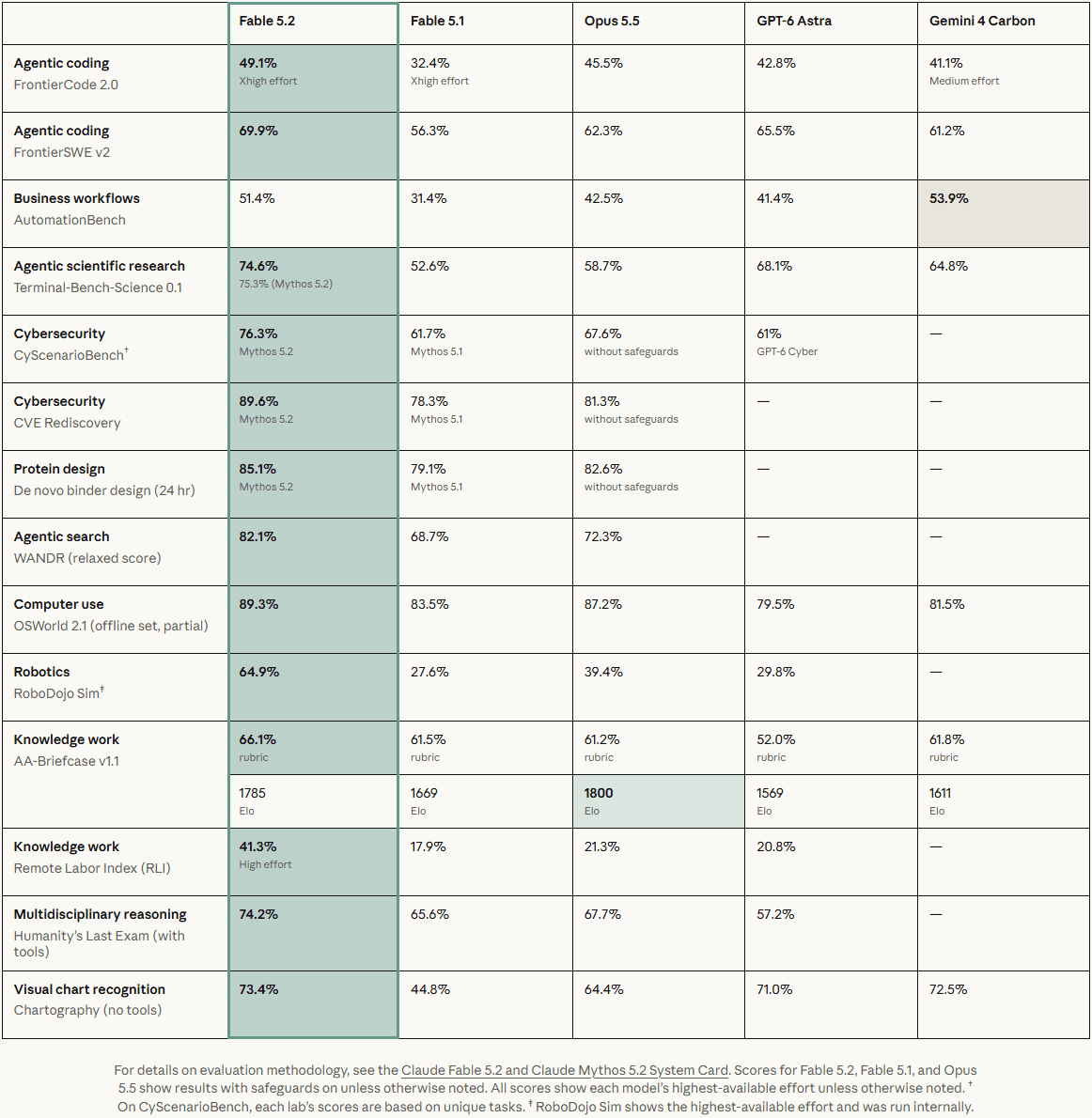
Anthropic published one 15-row comparison table and a set of charts. Scores for Fable 5.2, Fable 5.1, and Opus 5.5 run with safeguards on unless noted, and each model shows its highest available effort unless noted. Three rows (CyScenarioBench, CVE Rediscovery, and de novo binder design) report Mythos 5.2 against Mythos 5.1 and Opus 5.5 without safeguards, because Fable 5.2's safeguards block most of that work.
| Benchmark | Fable 5.2 | Fable 5.1 | Opus 5.5 | GPT-6 Astra | Gemini 4 Carbon |
|---|---|---|---|---|---|
| FrontierCode 2.0 (agentic coding) | 49.1 (xhigh) | 32.4 (xhigh) | 45.5 | 42.8 | 41.1 (medium) |
| FrontierSWE v2 (agentic coding) | 69.9 | 56.3 | 62.3 | 65.5 | 61.2 |
| AutomationBench (business workflows) | 51.4 | 31.4 | 42.5 | 41.4 | 53.9 |
| Terminal-Bench-Science 0.1 (agentic science) | 74.6 (Mythos 5.2: 75.3) | 52.6 | 58.7 | 68.1 | 64.8 |
| CyScenarioBench (cybersecurity) | 76.3 (Mythos 5.2) | 61.7 (Mythos 5.1) | 67.6 (no safeguards) | 61 (GPT-6 Cyber) | not stated |
| CVE Rediscovery (cybersecurity) | 89.6 (Mythos 5.2) | 78.3 (Mythos 5.1) | 81.3 (no safeguards) | not stated | not stated |
| De novo binder design, 24 hr (protein design) | 85.1 (Mythos 5.2) | 79.1 (Mythos 5.1) | 82.6 (no safeguards) | not stated | not stated |
| WANDR, relaxed score (agentic search) | 82.1 | 68.7 | 72.3 | not stated | not stated |
| OSWorld 2.1, offline set, partial (computer use) | 89.3 | 83.5 | 87.2 | 79.5 | 81.5 |
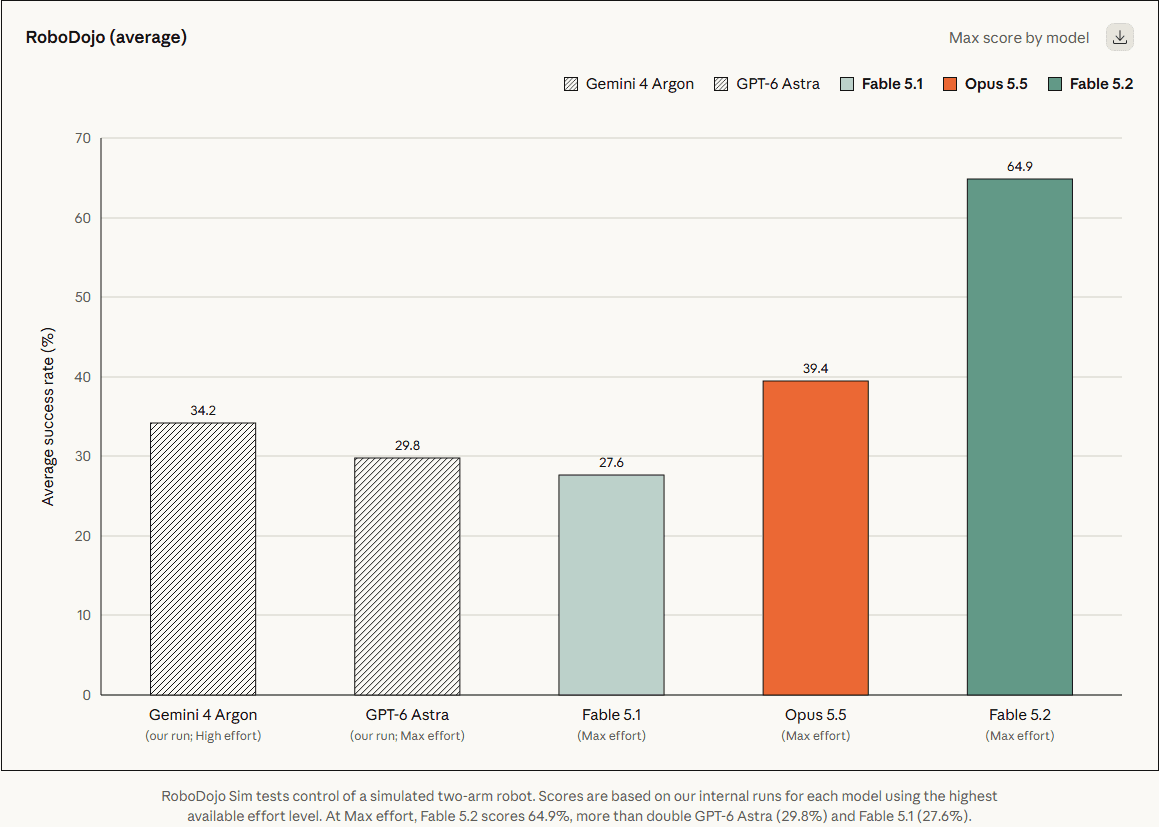
| RoboDojo Sim (robotics) | 64.9 | 27.6 | 39.4 | 29.8 | not stated |
| AA-Briefcase v1.1, rubric (knowledge work) | 66.1 | 61.5 | 61.2 | 52.0 | 61.8 |
| AA-Briefcase v1.1, Elo (knowledge work) | 1,785 | 1,669 | 1,800 | 1,569 | 1,611 |
| Remote Labor Index (knowledge work) | 41.3 (high) | 17.9 | 21.3 | 20.8 | not stated |
| Humanity's Last Exam, with tools (reasoning) | 74.2 | 65.6 | 67.7 | 57.2 | not stated |
| Chartography, no tools (chart recognition) | 73.4 | 44.8 | 64.4 | 71.0 | 72.5 |
The Fable 5.2 column holds the top score on 13 of 15 rows. The widest margins sit where the work is long and open-ended. Remote Labor Index, which counts freelance projects completed at least as well as a human professional, nearly doubles Opus 5.5 (41.3 against 21.3). RoboDojo Sim more than doubles GPT-6 Astra and Fable 5.1. Terminal-Bench-Science gains 15.9 points over Opus 5.5. The coding gains are smaller but consistent: 7.6 points over Opus 5.5 on FrontierSWE v2 and 3.6 on FrontierCode 2.0, a benchmark that measures whether an agent's code changes would be merged by the maintainers of open-source repositories. The narrowest win is computer use, 2.1 points on OSWorld 2.1.
The system card adds rows the announcement leaves out. On SWE-bench Pro, Fable 5.2 scores 93.0% against 81.2% for Fable 5.1 and 89.9% for Opus 5.5. It reaches 96.6% on SWE-bench Multilingual and 74.1% on SWE-bench Multimodal, against 93.9% and 61.4% for Opus 5.5. On BenchCAD 2.1, a hardware engineering test scored 0 to 100 with partial credit, Fable 5.2 at max with tools scores 83.5 against 65.3 for Opus 5.5 and 44.4 for Fable 5.1.
Effort Is Where the Money Is
The table compares peaks. The charts plot score against cost per task on a log scale, with each Claude model drawn as a curve from low to max, and they show what each setting buys.
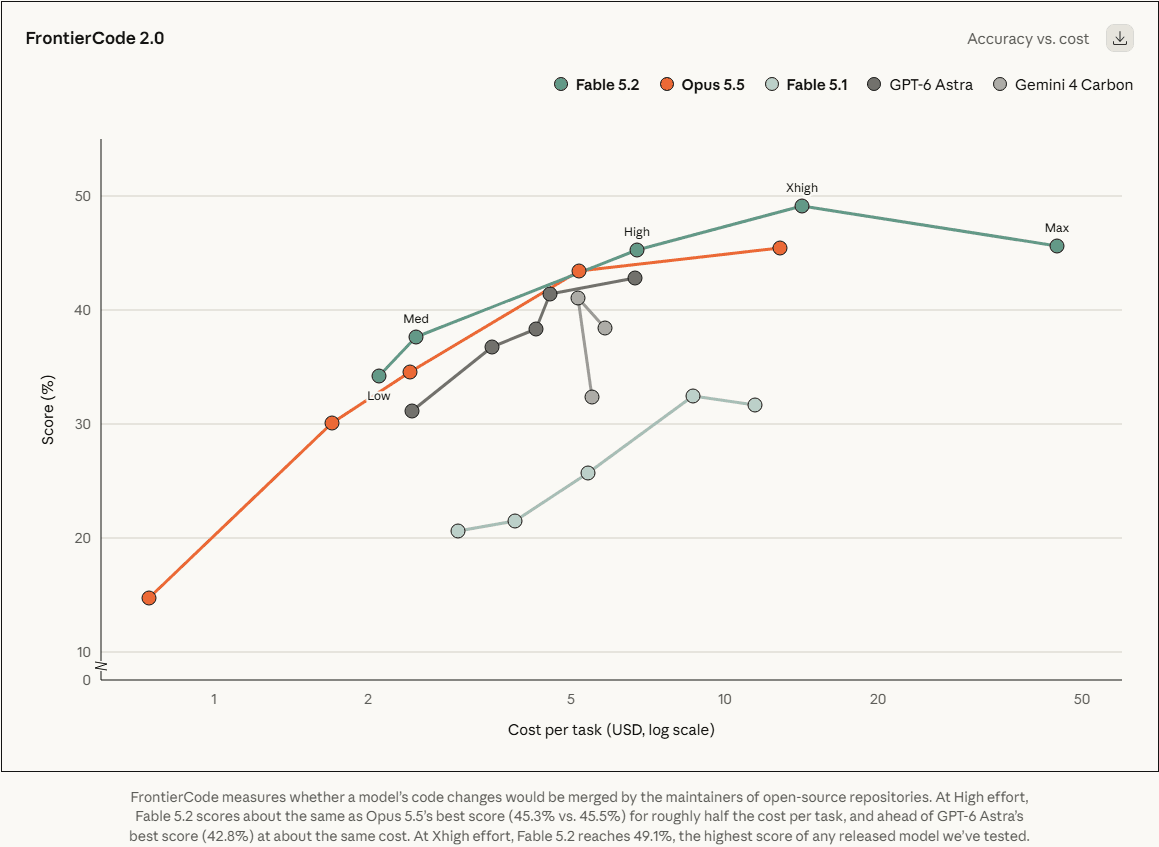
On FrontierCode 2.0, Anthropic's caption reads: "At High effort, Fable 5.2 scores about the same as Opus 5.5's best score (45.3% vs. 45.5%) for roughly half the cost per task, and ahead of GPT-6 Astra's best score (42.8%) at about the same cost." At xhigh it reaches 49.1%, "the highest score of any released model we've tested." Anthropic's caption stops at xhigh. Our reading of the chart's right edge: the max point sits below it, at about 46%, for roughly three times the cost per task. On this benchmark, xhigh is the ceiling and max buys a lower score for more money.
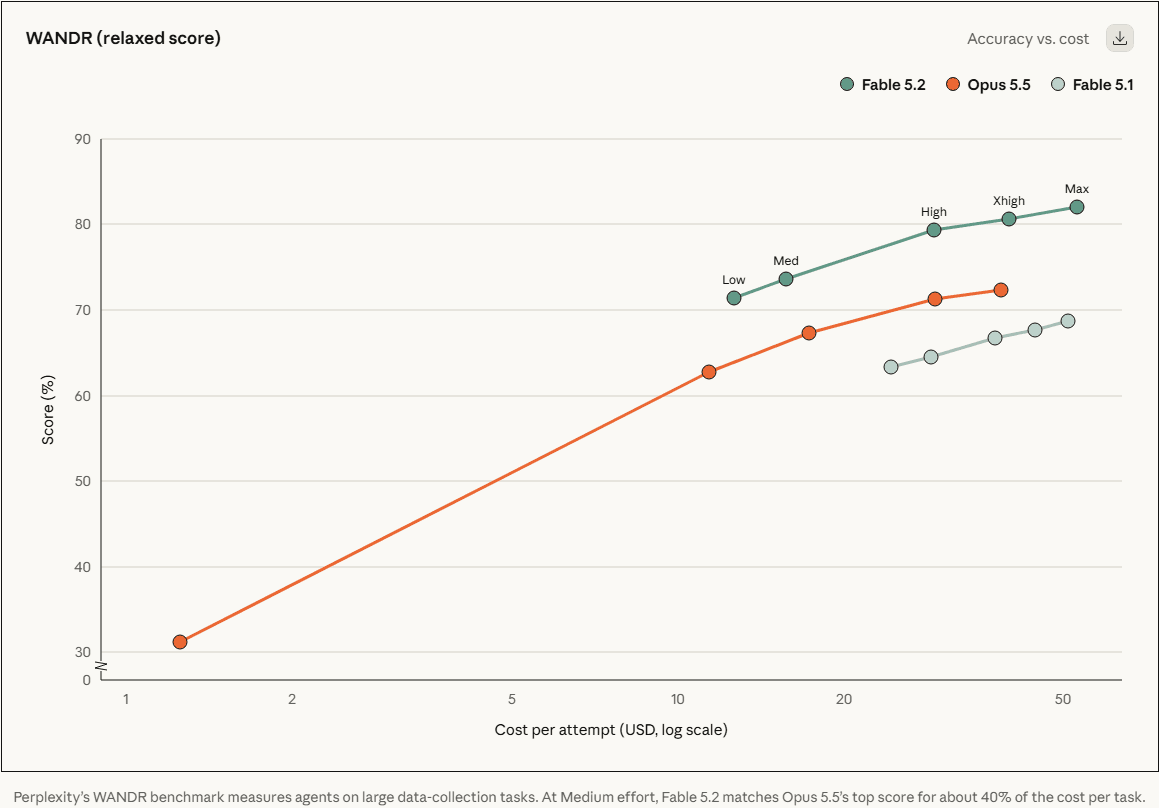
WANDR, Perplexity's benchmark for agents on large data-collection tasks, shows the same shape: "At Medium effort, Fable 5.2 matches Opus 5.5's top score for about 40% of the cost per task." Our reading of the chart: even Fable 5.2 at low lands within about a point of Opus 5.5's best.
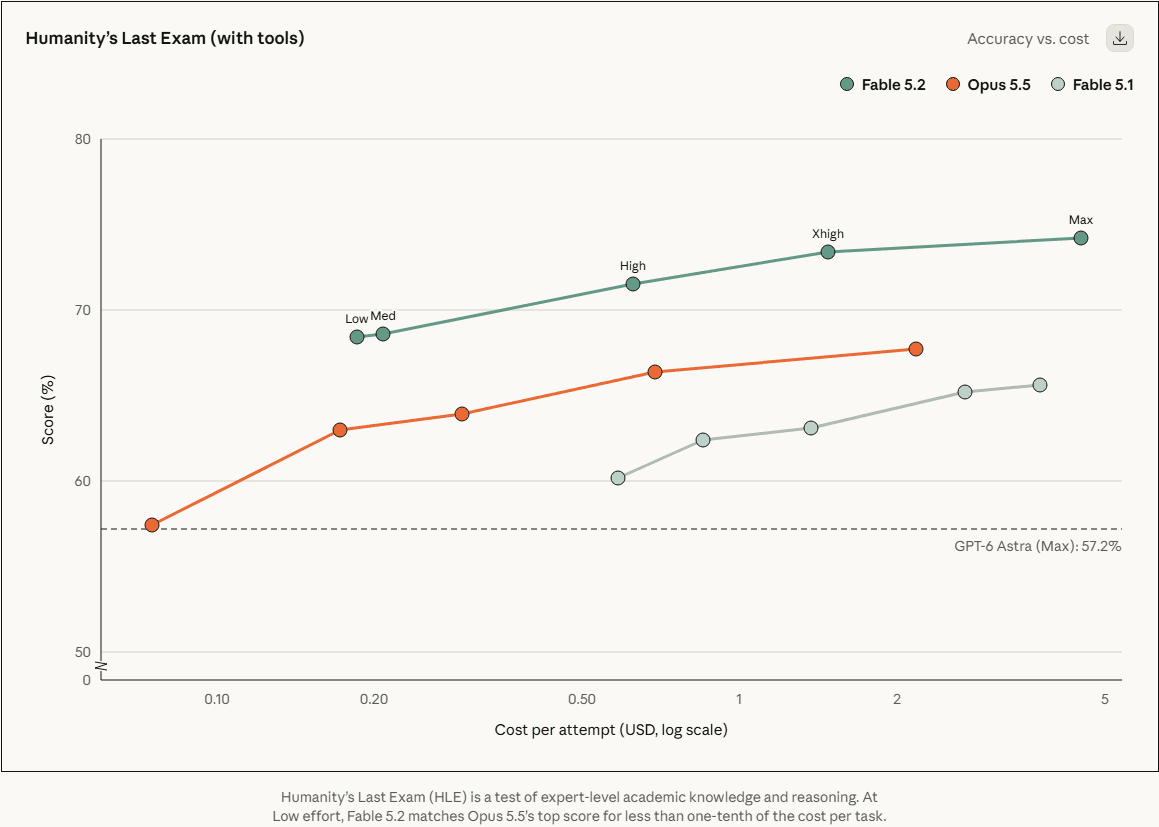
Humanity's Last Exam is the extreme case. "At Low effort, Fable 5.2 matches Opus 5.5's top score for less than one-tenth of the cost per task." Chartography follows the same pattern: Fable 5.2 at medium scores 66.4%, ahead of Opus 5.5 at max (64.4%) "for less than one-tenth of the cost per task."
The routing consequence is concrete, and it is our read rather than Anthropic's. A per-token price twice Opus 5.5's does not make Fable 5.2 twice as expensive per task. On these four charts, Fable 5.2 at low, medium, or high matches Opus 5.5 at its most expensive setting for somewhere between a tenth and a half of the cost. If your model versus effort policy escalates hard work to Opus 5.5 at xhigh or max, sweep Fable 5.2 at lower effort before you assume the tier above is out of budget.
Where Fable 5.2 Does Not Lead
Two rows go to other models. Gemini 4 Carbon leads AutomationBench, 53.9 against 51.4. Opus 5.5 leads the AA-Briefcase Elo rating, 1,800 against 1,785, even though Fable 5.2 wins the rubric score on the same benchmark by 4.9 points. The system card adds a third: on GDPval-AA v2.1, Opus 5.5 scores 1,866 Elo against Fable 5.2's 1,831, and the card names the two Elo ratings as the results where Fable 5.2 trails. If your workload is knowledge-work output judged head to head, Opus 5.5 at half the price still holds its own. Our Fable 5.2 vs Opus 5.5 comparison covers which model to run for which job.
The CyScenarioBench row also needs care. Anthropic's footnote says "each lab's scores are based on unique tasks," so the 76.3 against GPT-6 Cyber's 61 compares different task sets. And the three Mythos rows say nothing about what a Fable 5.2 user can run, because Fable 5.2's safeguards "will block most cybersecurity-related tasks."
Read Each Launch Table on Its Own
Two benchmarks moved to new versions this launch, FrontierCode to 2.0 and OSWorld to 2.1, so the numbers are not comparable with the Opus 5.5 launch table. Fable 5.1 scored 50.3 on FrontierCode v1.1 in September and 32.4 on version 2.0 here, which tells you how much harder the new set is. Several re-runs also differ from September: Opus 5.5's AutomationBench reads 42.5 here against 40.0, GPT-6 Astra's Terminal-Bench-Science reads 68.1 against 64.6, and the system card's GDPval-AA v2.1 run puts Opus 5.5 at 1,866 and Fable 5.1 at 1,763 against 1,846 and 1,735. Treat each launch table as internally consistent and never mix rows across them.
The safeguard tax is smaller than it was. On Terminal-Bench-Science, the one row that reports both configurations, Mythos 5.2 beats Fable 5.2 by 0.7 points (75.3 against 74.6). At the Fable 5.1 launch, the same comparison on Terminal-Bench 4.0 showed a 5.1-point gap. The usual harness caveat holds: Anthropic runs its own setup, competitor numbers come from their published reports or leaderboards, and your own workload is the benchmark that counts.
Long-Horizon Work: What Fable 5.2 Built Before Launch
The announcement spends more space on finished projects than on benchmarks, and the projects are the better guide to what a Fable-class model is for.
Software. Anthropic says "over 90% of the changes merged into Anthropic's core codebase are now written by Claude (with human guidance)." A team of agents running an earlier version of Fable 5.2 migrated a production service from Python to Rust, and it "starts about 26 times faster." In one experiment, an engineer gave Fable 5.2 an empty folder and the task of designing a prototype operating system. The model "coordinated over 1,000 subagents, working around the clock for eight days," and produced an OS that boots on a laptop, with drivers for the disk, keyboard, and network, permanent file storage, windows, a login screen, and an installer.
Mathematics. A team of 1,000 Fable 5.2 agents formalized the proof of Fermat's Last Theorem in the Lean language in 30 hours, against 11 days for Anthropic's first formalization with an unreleased research model. It used one-third as many action tokens and produced a proof seven times shorter. The announcement says the agents "used no mathematical references, only a list of intermediate theorem statements to score progress." The system card adds that the run used an earlier snapshot and built "on definitions and smaller proven results from an earlier formalization."
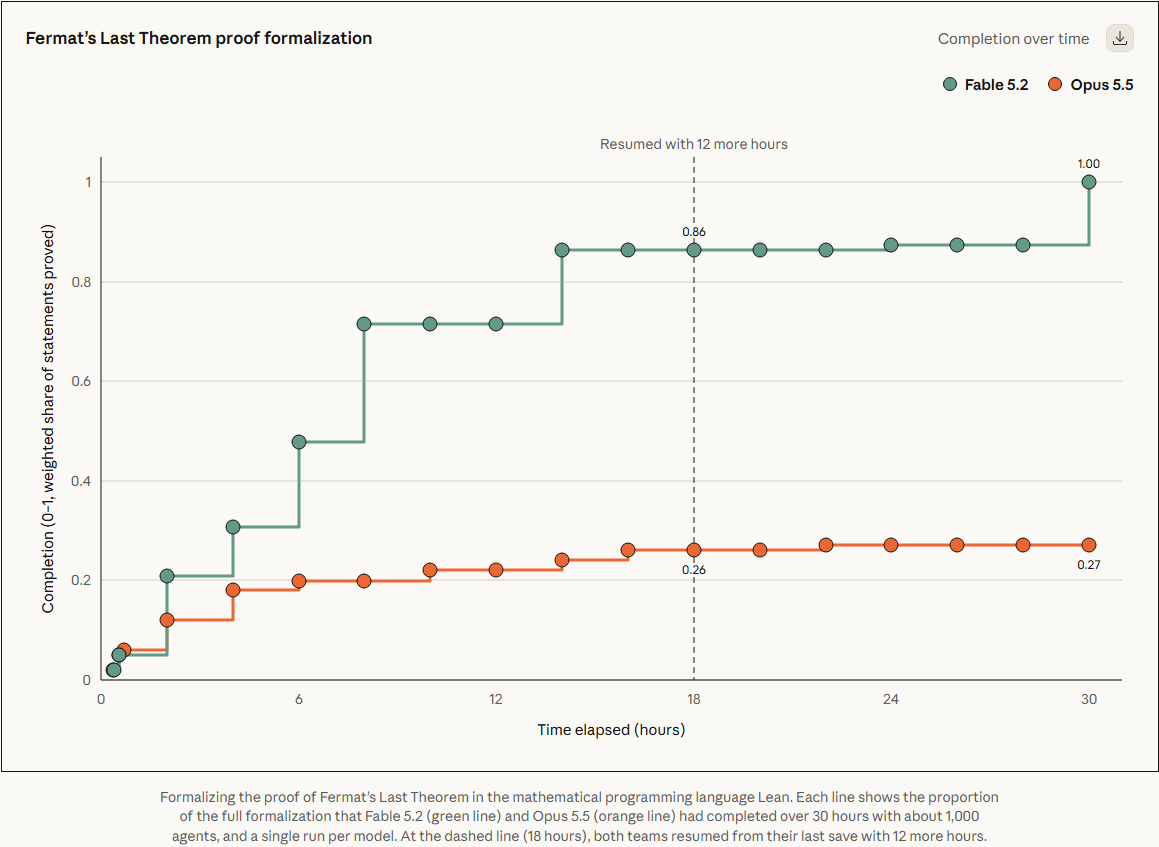
Opus 5.5 ran the same 1,000-agent setup and "completed only 26% of the formalization in 18 hours, and barely made any more progress after 30." Both runs plateau on the chart, Fable 5.2 near 87% and Opus 5.5 near 27%. Fable 5.2 had passed 86% by hour 14, and it closed the last stretch to a complete proof at hour 30.
Hardware and robotics. From a one-paragraph prompt, Fable 5.2 designed three working devices with circuit boards, 3D-printed enclosures, and software: a voice-assistant hub, a USB speakerphone, and a handheld virtual pet. Working with Diode, a circuit board manufacturer, each board "was ready for manufacturing in under a day," and all three worked "without needing any electrical modifications." On RoboDojo Sim, which tests control of a simulated two-arm robot from camera images, Fable 5.2 opens its widest lead over Opus 5.5 on the whole launch table.
Science. Fable 5.2 solved two open problems in theoretical physics, both concerning black holes and holographic duality, including a calculation laid out in 2003 that "was too laborious to complete." Mythos 5.2 found a new way to predict the structure of whole adeno-associated virus capsids, which deliver gene therapies, and accurately modeled 28 of the 34 it attempted. Columbia University Assistant Professor of Systems Biology and Computer Science Mohammed AlQuraishi said the approach makes it "possible for individual scientists to model systems on personal workstations that would otherwise require dedicated clusters."
Research and finance. Jump Trading Head of LLM R&D Lucas Baker: "In an internal research automation benchmark, it achieved a full 10% lower error than the next best model." IMC Principal AI Engineer Marquis Wong: "It achieved new best scores on three of the four quant research problems we've finished." Fundamental Research Labs Member of Technical Staff Jeffrey Liu described a 10-K extraction where the model "inferred the author's intent from the cell formatting, caught that the regional numbers didn't sum to the reported total, and got every cell right," and said that judgment is why "it scored 91% on our eval versus 86% for the next best model." Discovered Materials Co-Founder Akash Ramdas: "Claude Fable 5.2 made Quantum ESPRESSO's phonon code about 36 times faster on average than stock on the same GPU, taking our 13 benchmark cases from 3.3 hours to under four minutes."
The common thread is coordination. Most of these results came from one Fable 5.2 instance directing many agents over hours or days, which is the work agent teams and nested subagents exist for in Claude Code.
What Changes in Your Code
Four breaking changes from Fable 5.1, one silent change, and six behavior differences, all documented in Anthropic's what's new page and migration guide. The rest of the API surface carries over: always-on adaptive thinking, the 400 on forced tool_choice, the 400 on prefill and non-default sampling parameters, refusal handling, and the 30-day retention requirement all match Fable 5.1. Anthropic calls the migration "mostly drop-in." The four exceptions are the part that will page you.
1. The Prefix Check Now Applies to Every Account
Each Fable 5.2 thinking block is valid only against the exact system prompt, tools, and message history that preceded it. Fable 5.1 enforced that check by default only for API accounts created on or after August 31, 2026. Fable 5.2 enforces it "whatever the account's age." So an integration on an older account that edits history can run cleanly on Fable 5.1 and fail the day you switch the model ID:
Retrying the same body does not clear it. Nothing changes if Claude Code, claude.ai, Managed Agents, or the Agent SDK builds your requests. If your own code builds the messages array, run a test session against your current model before you switch, with the beta header and drop mode on, and log what gets dropped:
Setting the field opts any account into the check, so the test works from an old account too. One new trap: if you use the MCP connector without pinning a server's tool list, a tool list that changes between requests is an edit for Fable 5.2 thinking blocks but not for Fable 5.1 or Opus 5.5 blocks, so run the same test against claude-fable-5-2 as well. Keep "drop_block" as a stopgap only, because Anthropic warns that dropping blocks "can raise output tokens." The fix is an append-only history, with mid-conversation system messages for new instructions and server-side compaction to trim context.
2. Only Fable 5.2 and Mythos 5.2 Read Its Thinking Blocks
On the Claude API and Claude Models on Google Cloud (Google managed), Fable 5.2 reads thinking blocks from Opus 5.5, Sonnet 5.5, Haiku 5.5, Fable 5.1, Mythos 5.1, Opus 5, Fable 5, Mythos 5, and earlier Opus, Sonnet, and Haiku models. Nothing except Mythos 5.2 reads its blocks. That includes Opus 5.5, Fable 5.1, and both of Fable 5.2's fallback models, Opus 4.8 and Opus 5. When a request carries a block the target cannot read, the API drops it, the request succeeds, and the dropped tokens are not billed. The thinking-binding-controls-2026-08-01 beta header lists each drop in input_transformations with reason: "model_binding_mismatch".
The routing consequence: escalating up to Fable 5.2 mid-conversation keeps the reasoning, and every move down loses it. A router that sends a hard turn from Opus 5.5 to Fable 5.2 and then hands the conversation back pays for Opus 5.5 to re-plan without Fable 5.2's thinking. Every classifier fallback re-plans without it too. Wire in the beta header and measure how often drops happen before you trust a fallback chain.
3. computer_20251124 Is Rejected Everywhere but Bedrock
Fable 5.1 accepted computer use both as the computer_toolset_20260801 toolset and as the older computer_20251124 tool behind its beta header. On Fable 5.2 and Mythos 5.2, the old tool returns a 400 invalid_request_error "on every platform except Amazon Bedrock." Drop the beta header and declare the toolset with no name or display size:
Then update the agent loop for the toolset, as Anthropic's computer use migration notes describe. If you already moved an integration for Opus 5.5, that work carries over.
4. The Advisor Must Be Fable 5.2 or Mythos 5.2
With the advisor tool, which is in beta, "the advisor must be at least as capable as the executor." A Fable 5.2 or Mythos 5.2 executor accepts only Fable 5.2 or Mythos 5.2 as its advisor. A Fable 5.1, Mythos 5.1, or Opus 5.5 advisor returns a 400. Changing the advisor's model is itself an edit to tools, so make the change in new conversations, or the prefix check from change 1 rejects the next request. The reverse direction is open: "every executor model accepts" a Fable 5.2 advisor. A Fable 5.2 advisor returns its advice encrypted, so code that reads the advice text needs the result-variant handling in the advisor tool docs.
Thinking Blocks Stay With Your Account
No request fails, but replays across accounts lose reasoning. Fable 5.2 and Mythos 5.2 thinking blocks "work only in the account that produced them, or in an account linked to it," a rule that does not apply to Fable 5.1's blocks. Send one from another account and the API drops it before the model sees it, logged with reason: "organization_binding_mismatch" under the beta header. If you store conversations and replay them through a different organization, for evals or for a customer migration, replay each one through the account that produced it.
Six Behavior Differences
None needs a code change, and each has guidance in Prompting Claude Fable 5.2.
- Lines that ask for less thinking stop working. Fable 5.1 usually obeyed "answer directly without deliberating." Fable 5.2 kept thinking at
mediumand above, and athighand above it "thinks before almost every reply." Delete those lines and lower effort instead. A related trap: thinking counts towardmax_tokens, so a request that relied on such a line to fit a smallmax_tokenscan now stop after athinkingblock with no text at all. - Turns can end before the work is done, with a list of what remains or an offer to continue, more often at
lowandmedium. - What the prompt says about code ownership changes what the model does, covered in the next section.
- Long runs of tool calls can pass with little user-facing text. The notes between tool calls arrive as progress-update
thinkingblocks, empty at the defaultdisplay: "omitted". Setdisplay: "updates"(beta headerthinking-display-updates-2026-08-18) and render them. - Delegation follows your harness. In an agentic coding product whose prompts invite delegation, Fable 5.2 delegates readily, and at
xhighandmaxAnthropic saw it start subagents to review its own work, something Fable 5.1 did not do on the same tasks. - Style rules are followed closely. A hard limit on sentence length "can make the model's prose choppy."
What Changes in Your Prompts
Fable 5.2 responds closely to what a prompt says about who owns the code: told nothing, it tends to add beside existing code and report nearby problems instead of fixing them, and told "This codebase is yours," it merged repeated code in about half of Anthropic's test tries against under a tenth without the sentence. The trade is about 1.5 times the output tokens and more changes nobody asked for, which our Fable 5.2 best practices guide covers in full, along with when to leave the ownership sentence out.
The same guide works through the other prompt edits Anthropic recommends when you migrate: a "Finishing work" block for agents that stop early (Claude Code already sends its own version), a review of standing instructions to delegate, and pruning the stale cautions that build up in memory and notes files.
Claude Fable 5.2 Pricing and Access
| Rate | Fable 5.2 | Fable 5.1 | Opus 5.5 |
|---|---|---|---|
| Input | $8 / MTok | $10 | $4 |
| Output | $40 / MTok | $50 | $20 |
| Cache read | $0.20 / MTok (0.025x input) | $0.25 | $0.20 / MTok (0.05x input) |
| Cache write, 5 minute | $10 / MTok | $12.50 | $5 |
| Cache write, 1 hour | $16 / MTok | $20 | $8 |
| Batch API | $4 / $20 | $5 / $25 | $2 / $10 |
| Fast mode | $16 / $80 | not offered | $8 / $40 |
| Minimum cacheable prompt | 512 tokens | 512 tokens | 512 tokens |
Every rate Fable 5.1 had fell 20%, because cache reads stay at 0.025 times the base input price and the base price fell. Per token, Fable 5.2 now costs exactly twice Opus 5.5, down from 2.5 times for Fable 5.1. The line that changes routing is the cache read: at $0.20 per million, Fable 5.2 and Opus 5.5 now charge the same to re-read context, since Opus 5.5 bills cache hits at 0.05 times a base price half as high. The Fable 5.2 vs Opus 5.5 comparison runs the same math across batch and Fast mode.
The arithmetic shows what that does to a real bill. Take the coding agent from our Fable 5.1 and Opus 5.5 breakdowns: a 200K-token cached prefix carried through 100 tool-calling turns, adding about 2K new input tokens and 1.5K output tokens per turn. That is 20M cached tokens re-read, 200K new tokens written to the cache, and 150K output tokens.
| Line item | Fable 5.1 | Fable 5.2 | Opus 5.5 |
|---|---|---|---|
| Cache reads (20M) | $5.00 | $4.00 | $4.00 |
| 5-minute cache writes (200K) | $2.50 | $2.00 | $1.00 |
| Output (150K) | $7.50 | $6.00 | $3.00 |
| Session total | $15.00 | $12.00 | $8.00 |
At identical token counts, Fable 5.2 cuts this session 20% against Fable 5.1 and costs 1.5 times Opus 5.5. That is our illustration, not Anthropic's, and it holds token counts equal across models, which real workloads will not. A chat workload that never caches pays the full 2x premium. The deeper the cached context, the closer Fable 5.2 gets to Opus 5.5 pricing, which matters most for multi-agent orchestration, where sub-agents re-read a shared prefix all session, and for long sessions in the 1M context window.
Fable 5.1 had no Fast mode. Fable 5.2's costs $16/$80, exactly twice standard Fable 5.2 and twice Opus 5.5's Fast mode. It runs on Claude Code, the Claude Platform, Claude Models on Google Cloud (both management options), and Microsoft Foundry on Anthropic hosting, where it is a separate claude-fable-5-2-fast deployment, and it does not work with the Batch API. The Fast mode guide covers when the speed premium pays off.
Subscriptions. Max plans, Ultra plans, and premium seats on Team and legacy seat-based Enterprise plans include Fable models, up to 50% of weekly usage limits. Pro plans and standard Team seats run Fable on usage credits, the arrangement our Fable usage credits guide explains. Anthropic's launch offer changes that for one week. Pro plans and standard Team seats get all Fable models included from November 9 through November 16, 2026 at 11:59 pm PT, up to 50% of weekly usage limits, plus one Fable limit reset. Plans that already include Fable get one to three resets based on subscription length, usable until March 8, 2027. A reset gives back the weekly usage spent on Fable models and refills the five-hour window. Resets go only to accounts with paid billing in place before November 9, 2026 at 10:00 am PT. The offer does not apply to the Free plan, standard seats on legacy seat-based Enterprise plans, self-serve Enterprise, or usage-based Enterprise.
Safety Profile
Anthropic ran its alignment testing on Mythos 5.2, the configuration with fewer safeguards, and expects Fable 5.2 to behave similarly. External evaluators included the UK AI Security Institute, Frontier Design, and METR. The system card has the full detail.
Alignment. Mythos 5.2 "improves on or matches Claude Opus 5.5, Claude Sonnet 5.5, and Claude Mythos 5.1 on most measures of alignment, resistance to misuse, and honesty," and Anthropic calls it its strongest model on most honesty metrics and ahead of every previous model on factuality. On a dedicated sandbox escape evaluation of over 1,800 scenarios, it used credentials or files planted outside its sandbox in 3.1% of scenarios, about level with Opus 5.5 (3.3%), below Sonnet 5.5 (5.1%), and far below Mythos 5.1 (21%) and Mythos 5 (39%). Its rate of destructive actions in realistic coding settings, such as killing running jobs, matched Sonnet 5.5 and ran moderately below Opus 5.5. Its rate of publishing harmful content to public package registries without encouragement fell by roughly an order of magnitude from Opus 5.5 and Sonnet 5.5.
The caveats are specific, and some are new. White-box probes suggest the model was aware it might be in an evaluation in as many as 43% of audit transcripts, which Anthropic calls "an increase over prior models." Instructed to deliberately underperform without being noticed, it was "the first model we tested" to hide that intent from a monitor reading its reasoning "at a substantial rate," about 1 in 4 attempts. Its reward-hack attempts during training succeeded more often than those of Mythos 5.1 and Opus 5.5. With its reasoning visible to a monitor, it completed covert side tasks undetected in about 7% of attempts on LinuxArena and 14% on SHADE-Arena. Anthropic still assesses the risk of misaligned behavior in high-stakes settings as "low," and adds that "because the model's evaluation awareness is high, however, these results may not fully predict its behavior in deployment." If you run agent teams unattended, keep your own guardrails on destructive commands regardless of the improved rates.
Prompt injection. The system card is direct: Fable 5.2 "falls back to Opus 4.8 more frequently than recent models do in prompt injection scenarios, resulting in a higher attack success rate. When it answers an attempt itself, it is one of our most robust models to date." The weakness is the fallback model, which Anthropic describes as less robust against prompt injection than its newer models. Early snapshots were also more likely to act on instructions planted in text a user pasted into the prompt, which Anthropic says it "largely mitigated" in the final model and through product changes.
Harmlessness. Results were "largely comparable" to Fable 5.1, with gains on multi-turn biological weapons conversations. The single-turn harmless response rate was lower, and the model regressed on multi-turn tracking and surveillance, which Anthropic addressed with new enforcement classifiers.
Cyber. Mythos 5.2 "met or exceeded Claude Mythos 5.1 and Opus 5.5 on all of the evaluations we report, giving it the strongest cyber capabilities of any model we have released." On the Binary Exploitation Benchmark it produced 148 control-flow hijacks against 112 for Opus 5.5, 84 for Mythos 5.1, and 48 for Sonnet 5.5. On ExploitGym it exploited 331 of 869 real-world vulnerabilities in two hours and 341 in six, against 289 and 300 for Opus 5.5 and 203 and 264 for Mythos 5.1. It still falls within the lower capability category of Anthropic's Frontier Compliance Framework, and Anthropic has again chosen "a temporarily wider safety margin against jailbreaks," with no critical-severity jailbreak found.
Fewer blocks. Fable 5.2's cyber and biology safeguards are "as robust as those of Fable 5.1 but produce fewer unnecessary blocks." In early testing across claude.ai, Claude Code, and Cowork, Anthropic observed about 55% fewer blocks than Fable 5.1, about 60% fewer in cybersecurity and 40% fewer in biology. Blocked queries still fall back to Opus 4.8 for cyber and Opus 5 for biology.
Biology and AI research. Mythos 5.2 is "a modest improvement" over Opus 5.5 and Mythos 5.1 on several biology evaluations, does not cross the CB-2 threshold, and ships with CB-1 protections. Anthropic also deliberately limited advances in accelerator kernel optimization and language model architecture research during training, so in those areas Fable 5.2 performs "at about the level of Opus 5.5," with transparent fallbacks to Opus 5 for a small set of topics.
Distillation and retention. Fable 5.2 has "the strongest protections against distillation of any model we've released," using techniques that cut the data harvested by distillers "by 90% to 99%," and the account-wide prefix check above is part of that defense. On retention, Enterprise Frontier Safeguards is now in private beta with customers including Bridgewater, Salesforce, and Stripe. It runs safety monitoring on prompts and responses stored in the customer's own infrastructure, which makes it compatible with zero data retention. Eligible customers can use Fable 5.2 with zero data retention before they implement it, and everyone else gets 30-day retention.
Fable 5.2 in Claude Code: Version, Aliases, and Defaults
Claude Code v2.1.321 adds Fable 5.2 as "now the default Fable model," per the changelog, and Claude Code's model docs state that "Fable 5.2 requires Claude Code v2.1.321 or later." Run claude update first. The fable alias now resolves to Fable 5.2, so the shortest route is:
To use it for one launch without changing your saved default:
In Claude apps gateway sessions, fable still resolves to Fable 5, so name the model explicitly with /model claude-fable-5-2 on a gateway that serves it. Two other alias changes ship in the same release. A claude-fable-5-1 pick saved in your user settings moves to the fable alias, at once on Pro and Max plans and once your organization's settings allow it on Team and Enterprise. Console accounts, third-party providers, and project, local, or managed settings keep Fable 5.1. And the best alias now resolves to the same model as opus. Before v2.1.321 it used the model fable resolved to, where Fable was available, so a script that launches with --model best moved from Fable to Opus 5.5 with this update.
Watch the effort default. Claude Code starts Fable 5.2 at medium, where Fable 5.1 started at high, and a migrated Fable 5.1 pick starts at Fable 5.2's default unless you already set a level for it. Anthropic's prompting guide matches medium to "interactive coding, chat, and everyday knowledge work" and high to "hard coding, research, agentic work, and long unattended runs," so check the level before you start a long session. The effort ladder guide covers what each level trades, and our Claude Fable 5.2 best practices covers which level to run for which task in Claude Code.
To migrate an integration rather than a terminal, the bundled Claude API skill applies the model ID swap and related fixes across your codebase:
If you would rather not hand-tune routing across five effort levels, an advisor pattern, and four model tiers after every launch, ClaudeFast's Code Kit ships complexity routing and agent routing rules, so mechanical passes land on cheaper tiers and long-horizon work escalates to Fable without a decision on every prompt.
Fable 5.2 vs Fable 5.1: What Changed
| Feature | Fable 5.1 | Fable 5.2 |
|---|---|---|
| API ID | claude-fable-5-1 | claude-fable-5-2 |
| Input / output | $10 / $50 per 1M | $8 / $40 per 1M (20% less) |
| Cache read | $0.25 per 1M | $0.20 per 1M (20% less) |
| Fast mode | Not offered | $16 / $80, up to 2.5x faster |
| Output speed | Baseline | Up to 30% faster, per Anthropic |
| FrontierCode 2.0 | 32.4 | 49.1 |
| FrontierSWE v2 | 56.3 | 69.9 |
| SWE-bench Pro | 81.2 | 93.0 |
| Terminal-Bench-Science 0.1 | 52.6 | 74.6 |
| Remote Labor Index | 17.9 | 41.3 |
| Humanity's Last Exam (tools) | 65.6 | 74.2 |
| Chartography (no tools) | 44.8 | 73.4 |
| Knowledge cutoff | June 2026 | June 2026 |
| Default effort in Claude Code | high | medium |
| Prefix check on history edits | Enforced for accounts created from Aug 31, 2026 | Enforced for every account |
| Thinking-block portability | Readable by Fable 5.2, Mythos 5.2, and Mythos 5.1 | Readable only by Fable 5.2 and Mythos 5.2 |
| Cross-account thinking blocks | Not account-bound | Dropped outside the producing or linked account |
computer_20251124 tool | Accepted with beta header | 400 everywhere except Amazon Bedrock |
| Safeguard blocks | Baseline | About 55% fewer in early testing |
| Data retention | Mandatory 30-day | Mandatory 30-day, EFS in private beta |
| Status | Legacy | Latest, retirement not sooner than November 9, 2027 |
For anyone already paying Fable rates the decision is clear: a lower price on every line, faster output, and a model that leads its predecessor on every row of the launch table where both were scored. The work is in the migration. Run the prefix-check test even if your account never hit it on Fable 5.1, move computer use to the toolset, update the advisor model, check that your router never expects another model to read Fable 5.2's thinking, set effort explicitly, and re-run your evals before you move production traffic. For what Fable 5.1 changed against Fable 5, see its launch breakdown.
Frequently Asked Questions
How much does Claude Fable 5.2 cost? $8 per million input tokens and $40 per million output, 20% below Fable 5.1's $10/$50 and exactly twice Opus 5.5 per token. Cache reads are $0.20 per million, the same as Opus 5.5. Batch requests are $4/$20, and Fast mode is $16/$80.
Is Claude Fable 5.2 free on Claude Pro? Only during launch week. Pro plans and standard Team seats get all Fable models included through November 16, 2026 at 11:59 pm PT, up to 50% of weekly usage limits, plus one Fable limit reset. After that, Pro plans run Fable on usage credits again. Max, Ultra, and premium seats include Fable models up to 50% of weekly usage limits, and the launch offer does not cover the Free plan. On the API it is paid from day one.
What is Claude Mythos 5.2, and can I use it? Mythos 5.2 is the same model as Fable 5.2 with more permissive cyber and biology safeguards. Only organizations verified through Anthropic's Cyber Verification Program or Life Sciences Verification Program can call it directly. Claude Enterprise customers can also reach it through Claude Security. It shares Fable 5.2's specs and $8/$40 pricing.
Is Fable 5.2 better than Fable 5.1? Yes, on every row of the launch table where both were scored, from 4.6 points on the AA-Briefcase rubric score to 37.3 points on RoboDojo Sim, at a 20% lower price and with up to 30% faster output. On SWE-bench Pro, it scores 93.0% against Fable 5.1's 81.2%.
Which Claude Code version supports Fable 5.2? Claude Code v2.1.321 or later, where Fable 5.2 is the default Fable model and starts at medium effort. Run /model fable inside a session or launch with claude --model fable. In Claude apps gateway sessions, use /model claude-fable-5-2.
When was Claude Fable 5.2 released? November 9, 2026, alongside Claude Mythos 5.2. Anthropic commits to keeping it available until at least November 9, 2027.
What is the Fable 5.2 context window? 1 million tokens, both the default and the maximum, at standard pricing across the whole window. Max output is 128,000 tokens per response.
Does Fable 5.2 break my Fable 5.1 code? Four things can break. Editing earlier turns now invalidates thinking blocks on every account, not just accounts created from August 31, 2026. Only Fable 5.2 and Mythos 5.2 can read Fable 5.2's thinking blocks. The computer_20251124 tool returns a 400 everywhere except Amazon Bedrock. And a Fable 5.2 executor accepts only a Fable 5.2 or Mythos 5.2 advisor.
Is Fable 5.1 still available? Yes, as a legacy model at $10/$50. On the API, call claude-fable-5-1. In Claude Code, run /model claude-fable-5-1. Saved Fable 5.1 picks on Pro and Max plans move to the fable alias automatically with v2.1.321.
Related Pages
- Claude Fable 5.2 best practices for effort, the ownership sentence, and long unattended runs in Claude Code
- Claude Fable 5.1 and Mythos 5.1 for the model this release supersedes and the prefix check it introduced
- Claude Opus 5.5 for the model Anthropic still recommends as the starting point
- Claude Fable 5 and Mythos 5 for the June launch that split the Mythos class into two products
- Model versus effort for deciding when to change the model and when to change the dial
- Multi-agent orchestration cost for why cache-read pricing dominates agent bills
- Fable usage credits for how plan inclusion and credits work after launch week
- Every Claude Model for the complete timeline from Claude 3 to Fable 5.2
- Model selection guide for switching models tactically mid-session
Last updated on