
Claude Haiku 5.5: Benchmarks, Pricing, and 5 Breaking Changes
Claude Haiku 5.5 benchmarks, pricing, specs: $0.10/$0.50 under 100K tokens, 90% below Haiku 4.5, 1M context, effort, and 5 breaking changes.
Agentic Orchestration Kit for Claude Code.
Claude Haiku 5.5 is the cheapest model Anthropic sells and its fastest at standard speed, and the model behind Claude Code's haiku alias on the Anthropic API. Anthropic released it on October 7, 2026 as claude-haiku-5-5, per its announcement, at $0.10 per million input tokens and $0.50 per million output for prompts up to 100,000 tokens, and $0.50/$2.50 above that line. Under 100K, that is 90% below Haiku 4.5, which shipped October 15, 2025 at $1/$5, and Anthropic puts the average saving at "around 75% less to run." There was no Haiku 4.6 or Haiku 5. Haiku 5.5 is the direct successor, and the small tier of the current Claude model lineup.
It is also a far stronger model. On Anthropic's launch table, Haiku 5.5 scores 39.2% on Terminal-Bench 4.0, where Haiku 4.5 passed none of its trials, 72.4% on OSWorld 2.1 computer use against 15.7%, and 1,620 Elo on GDPval-AA knowledge work against 735. It is the first Haiku with adaptive thinking and an effort setting, and at low effort it already beats Haiku 4.5's best OSWorld score by 26 points for about a twentieth of the cost per task. Anthropic built it for "summaries, compactions, database queries, and classification requests," and says it "pairs well with Opus 5.5 and Sonnet 5.5 as a subagent on coding work."
The launch charts also show where the discount stops paying. On short, scoped work such as classification, extraction, browser use, and compaction, Haiku 5.5 matches or beats Sonnet 5.5 for a fraction of the cost per task. On long agentic coding it does not: on Terminal-Bench 4.0, Sonnet 5.5 at high effort outscores Haiku 5.5 at max for about 55% of the cost. If you read one section, read Haiku 5.5 vs Sonnet 5.5. If you are moving code off Haiku 4.5, five request shapes that used to work now return a 400, covered in What Changes in Your Code.
Key Specs
| Spec | Details |
|---|---|
| API ID | claude-haiku-5-5 on the Claude API, Claude Platform on AWS, Claude Models on Google Cloud, and Microsoft Foundry, and anthropic.claude-haiku-5-5 on Amazon Bedrock. No date suffix and no separate alias |
| Release Date | October 7, 2026 |
| Model Class | The small, fast tier of the Claude 5.5 family, successor to Haiku 4.5 |
| Context Window | 1M tokens, up from 200K, priced in two tiers split at a 100,000-token prompt |
| Max Output | 128,000 tokens, up from 64,000, or 300,000 on the Message Batches API with the output-300k-2026-03-24 beta header |
| Knowledge Cutoff | June 2026 (reliable and training data cutoff) |
| Thinking | Adaptive, on by default. On the API it can be turned off at high effort or below. In Claude Code it cannot be turned off |
| Effort Levels | low, medium, high, xhigh, max, with medium the default on the API and in Claude Code |
| Pricing | $0.10 input / $0.50 output per 1M tokens for prompts up to 100K, $0.50 / $2.50 over 100K. Cache reads $0.01 / $0.05. Batch API 50% off |
| Speed | "Fastest" in Anthropic's lineup table, and Anthropic's fastest model at standard speed, though slower than Opus models in Fast mode |
| Tokenizer | The newer tokenizer from Claude 4.7 onward: the same text counts as about 30% more tokens than on Haiku 4.5 |
| Prompt Cache Min | 512 tokens, down from 4,096 on Haiku 4.5 |
| Inputs | Text and images in, text out, with the high-resolution image tier |
| Service Tiers | Priority Tier not supported |
| Retirement | Not sooner than October 7, 2027 |
| Availability | Claude API, Amazon Bedrock, Google Cloud (Anthropic managed and Google managed), Microsoft Foundry, Claude Platform on AWS, Claude Code |
| Status | Active, the current Haiku model. Haiku 4.5 is superseded and still available as a legacy model |
What Claude Haiku 5.5 Is: The Small Tier, Rebuilt for Agents
Anthropic's models overview lists Haiku 5.5 "for high-volume, latency-sensitive tasks such as classification, extraction, and routing." It sits below Sonnet 5.5 at $2/$10, Opus 5.5 at $4/$20, and Fable 5.2 at $8/$40, and shares their 1M window, 128K output limit, and June 2026 cutoff. The announcement calls it "our fastest model to date," a fit for "speed-sensitive tasks like live customer support and browser use." Against Haiku 4.5, almost every limit moved: a window five times larger, double the output, caching from 512 tokens, the effort parameter, the new browser use tool, and the computer use toolset.
The customer reports fall into two groups. The first is the subagent pattern. Rogo Applied AI's Alex Wang: "While a bigger model builds the deck, a Haiku 5.5 subagent goes into the 10-K and pulls the segment revenue line the deck needs. It's accurate enough that we'd trust it there, and fast and cheap enough that we can run it a lot." Cognition Co-Founder and CPO Walden Yan reports that with Haiku 5.5 as the sidekick model in Devin Fusion, "Fusion holds a top-tier FrontierCode score of 66.2 while cutting cost and latency," and points users to the Devin CLI "with Opus 5.5 as the lead." That 66.2 scores the multi-model system, not Haiku 5.5 alone.
The second group is volume work, where small gains compound. AlphaSense Distinguished Engineer Daniel Campos runs a feature "doing about 8M calls a week in production," and on 400 queries Haiku 5.5 "was a statistically significant improvement over Haiku 4.5: 0.84 vs. 0.76." HubSpot Distinguished Software Engineer Ze'ev Klapow reports "the best score we've seen on this suite yet, at 92.8% averaged over three runs" on simulated CRM tasks. Box VP of AI Products Yashodha Bhavnani: "Claude Haiku 5.5 scored 11 points higher than Haiku 4.5 at about half the latency." Asana Staff Software Engineer Aaron Vinh saw "over a 30% reduction in latency for task completions and up to 2.5x faster inference per agent turn."
Haiku 5.5 Benchmark Results
Anthropic published a seven-benchmark comparison against Haiku 4.5 and OpenAI's GPT-6 Luna, with Sonnet 5.5 as a reference column.
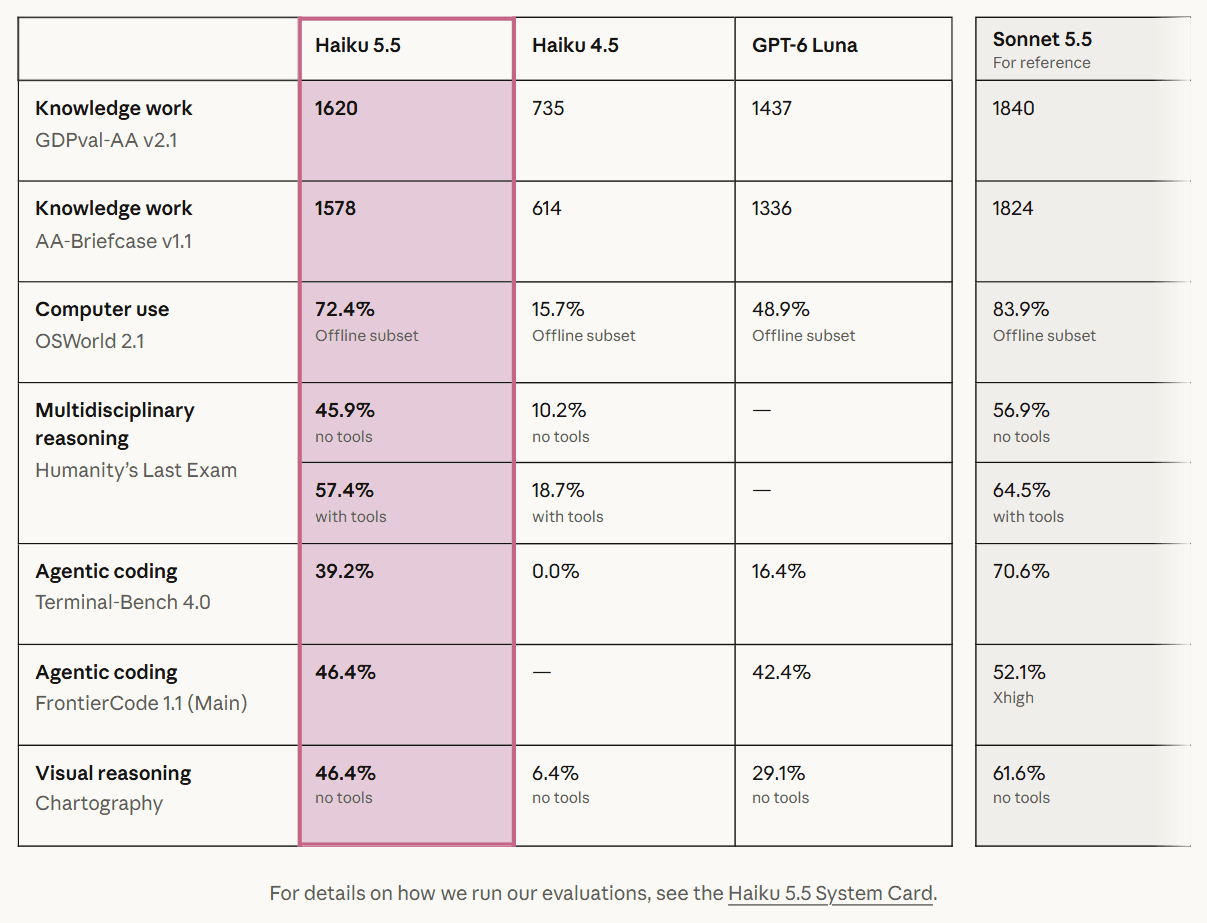
| Benchmark | Haiku 5.5 | Haiku 4.5 | GPT-6 Luna | Sonnet 5.5 (reference) |
|---|---|---|---|---|
| GDPval-AA v2.1 (knowledge work, Elo) | 1,620 | 735 | 1,437 | 1,840 |
| AA-Briefcase v1.1 (knowledge work, Elo) | 1,578 | 614 | 1,336 | 1,824 |
| OSWorld 2.1, offline subset (computer use) | 72.4% | 15.7% | 48.9% | 83.9% |
| Humanity's Last Exam, no tools | 45.9% | 10.2% | not stated | 56.9% |
| Humanity's Last Exam, with tools | 57.4% | 18.7% | not stated | 64.5% |
| Terminal-Bench 4.0 (agentic coding) | 39.2% | 0.0% | 16.4% | 70.6% |
| FrontierCode 1.1, Main (agentic coding) | 46.4% | not stated | 42.4% | 52.1% (xhigh) |
| Chartography, no tools (visual reasoning) | 46.4% | 6.4% | 29.1% | 61.6% |
The biggest jumps over Haiku 4.5 sit in agent work: Terminal-Bench 4.0 from 0.0% to 39.2%, OSWorld 2.1 from 15.7% to 72.4%, and knowledge-work Elo more than doubled on both Artificial Analysis benchmarks (+885 on GDPval-AA, +964 on AA-Briefcase). Chartography rose from 6.4% to 46.4%, and Humanity's Last Exam more than quadrupled without tools. Haiku 5.5 beats GPT-6 Luna on every row where both were scored. The Sonnet 5.5 column shows where it stops: Sonnet 5.5 leads every row, by 11.5 points on OSWorld and by 31.4 points on Terminal-Bench 4.0.
The system card adds rows the announcement leaves out. Haiku 5.5 scores 64.8% on SWE-bench Pro against Sonnet 5.5's 81.3%, and 83.7% on SWE-bench Multilingual against Haiku 4.5's 67.4%. On ProgramBench, a long-context test where an agent rebuilds a program from its compiled binary, it scores 82.0%, ahead of Sonnet 5.5's 79.7% and behind Opus 5.5's 91.2%. It also scores 64.8% on HealthBench Professional, length-adjusted, against Haiku 4.5's 32.2%.
Read the Haiku 4.5 Column With Care
The comparison is not like for like. Haiku 4.5 predates effort levels, so it ran with fixed thinking budgets, 63,999 tokens on Terminal-Bench 4.0. On Humanity's Last Exam with tools, it had a 160K-token task budget against Haiku 5.5's 980K, "to fit its 200K context window." Part of the jump on long tasks is the bigger window, which is still a real gain if your work did not fit before.
The FrontierCode row needs a footnote too. The announcement shows Sonnet 5.5 at its best setting, 52.1% at xhigh. The system card's table runs every model at max, where Haiku 5.5 scores 46.4% and Sonnet 5.5 scores 46.2%. This is FrontierCode 1.1, the version in the Opus 5.5 launch table, not the 2.0 set in the Fable 5.2 table, so never compare those rows across launches. And Anthropic ran Haiku 5.5 on Terminal-Bench without a fallback model, so a request its safeguards flagged ended the trial as a failure, in 12 of 660 trials.
Effort: The First Haiku You Can Turn Up
The table compares peaks. Anthropic's charts plot each model's score against cost per task at every effort level, on a log scale, and the data labels on those charts give the exact values below. For what each level trades in Claude Code, see our effort ladder guide.
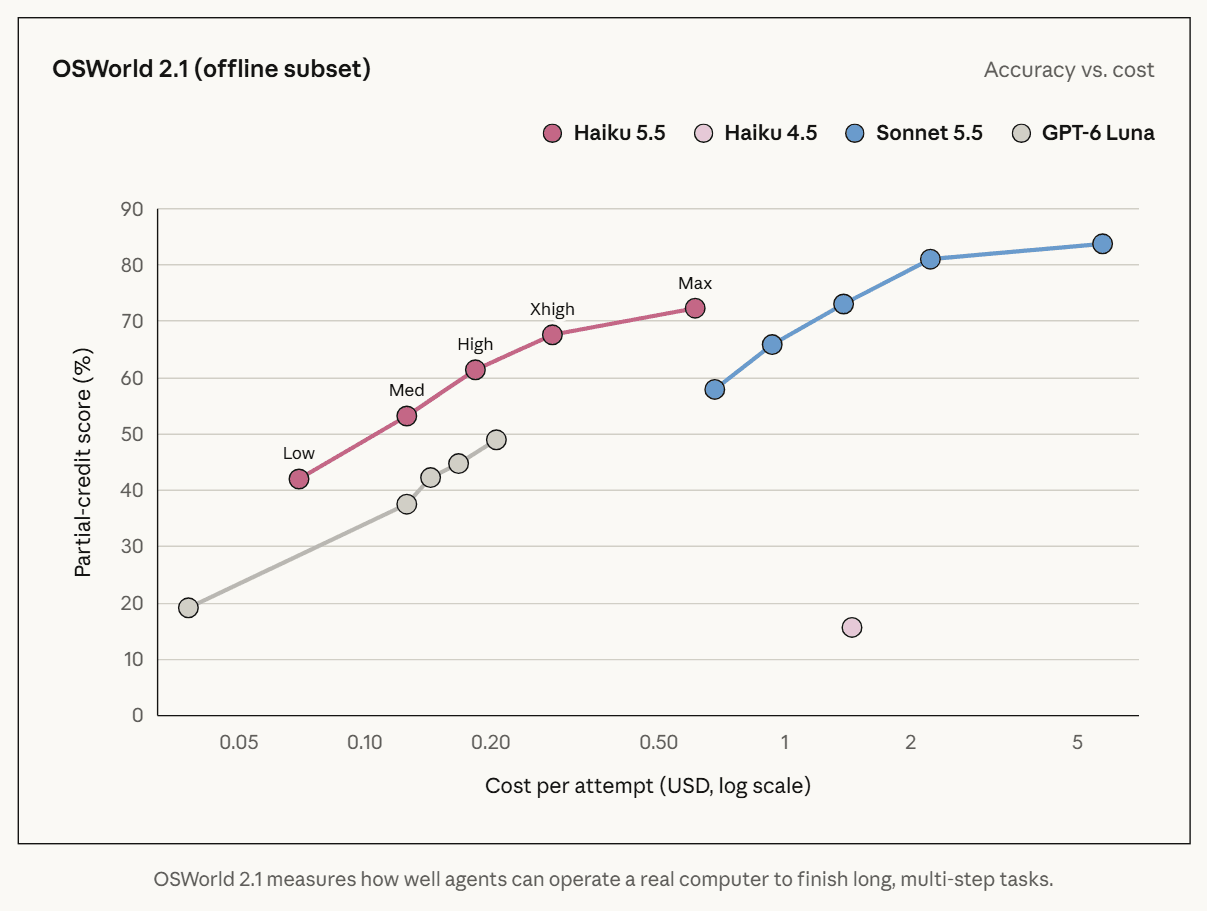
On OSWorld 2.1, Haiku 5.5 at low scores 42.0% for $0.07 per task, against Haiku 4.5's 15.7% for $1.45. At xhigh it scores 67.6% for $0.28, ahead of Sonnet 5.5 at medium (66.0% for $0.93) at under a third of the cost. At max it reaches 72.4% for $0.61, within a point of Sonnet 5.5 at high (73.2% for $1.38) for 44% of the cost.
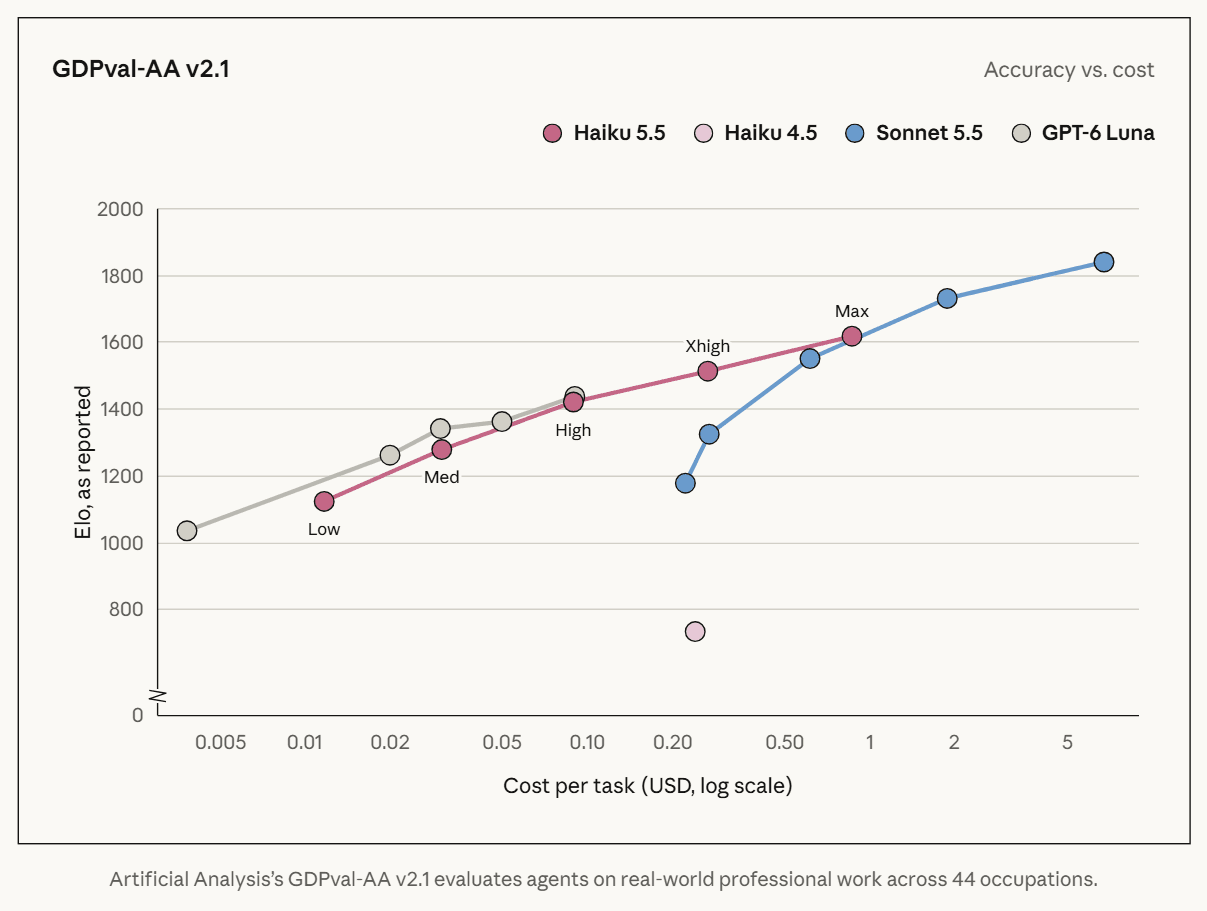
GDPval-AA v2.1, Artificial Analysis's test of professional work across 44 occupations, shows the same lower half. Haiku 5.5 at low scores 1,125 Elo for $0.01, 390 points above Haiku 4.5 for about a twentieth of its $0.24. At xhigh it scores 1,513 for $0.27, the same cost as Sonnet 5.5 at medium, which scores 1,324. At the top the curves meet: Haiku 5.5 at max (1,620 for $0.87) lands on Sonnet 5.5's line between its high point (1,551 for $0.62) and its xhigh point (1,731 for $1.88), and only Sonnet 5.5 keeps climbing. GPT-6 Luna tracks Haiku 5.5 closely up to $0.09 per task, then stops at 1,437.
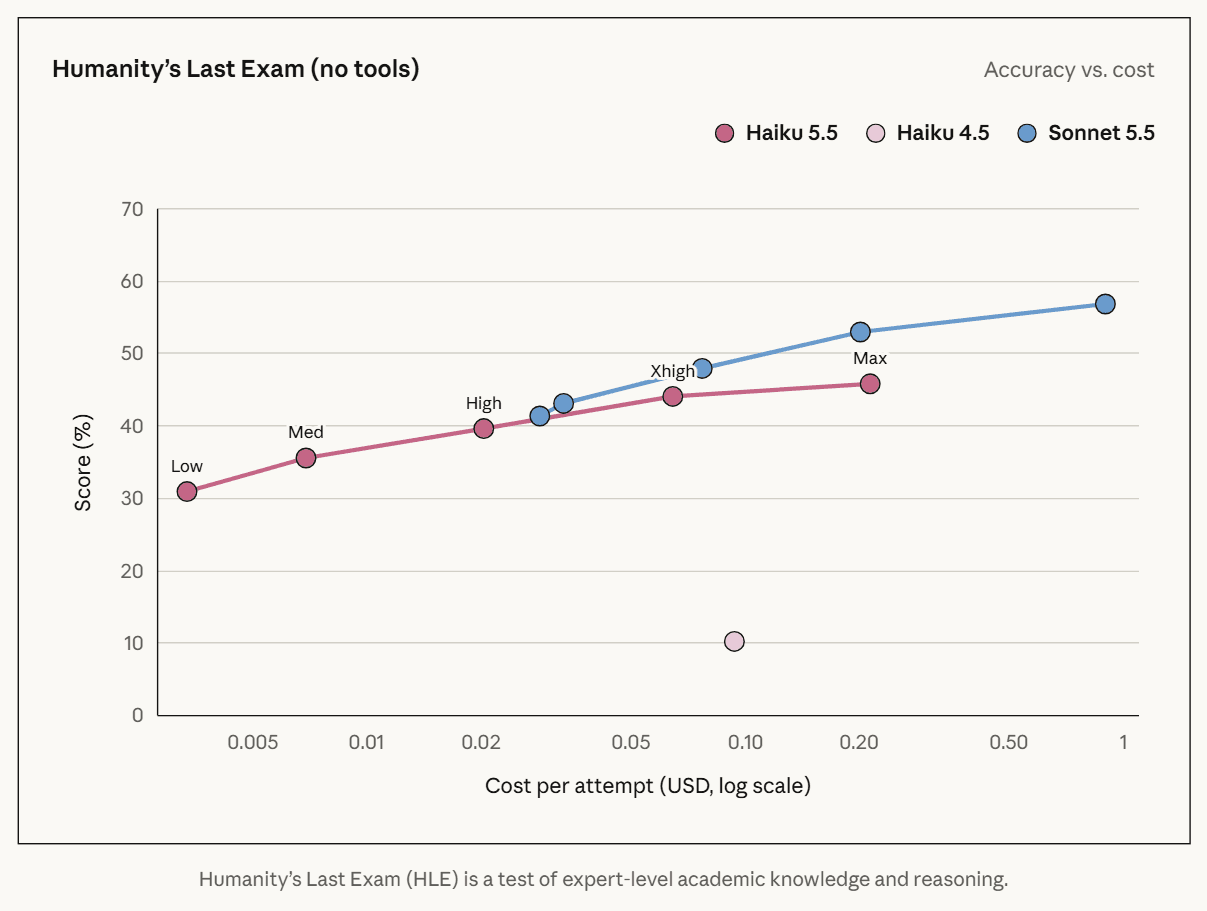
Humanity's Last Exam without tools is where the advantage inverts at the top. At low, Haiku 5.5 scores 30.9% for $0.003 per attempt, three times Haiku 4.5's 10.2% at a thirtieth of its $0.09. Above high, Sonnet 5.5 gets more per dollar: at medium (43.2% for $0.03) it lands within a point of Haiku 5.5 at xhigh (44.1% for $0.06) at half the cost, and at high (47.9% for $0.08) it beats Haiku 5.5 at max (45.9% for $0.21) for 36% of the cost.
The routing rule we take from these charts and the Terminal-Bench chart below: Haiku 5.5's sweet spot runs from low to xhigh. At max, it lands on Sonnet 5.5's curve on GDPval-AA and below it on Humanity's Last Exam and Terminal-Bench 4.0, so outside computer use, Sonnet 5.5 at a lower effort level buys the same score or a better one for similar money. If a job needs Haiku 5.5 at max, test Sonnet 5.5 at medium or high first. Our model versus effort guide covers that trade in general.
Where Haiku 5.5 Loses: Long Agentic Coding
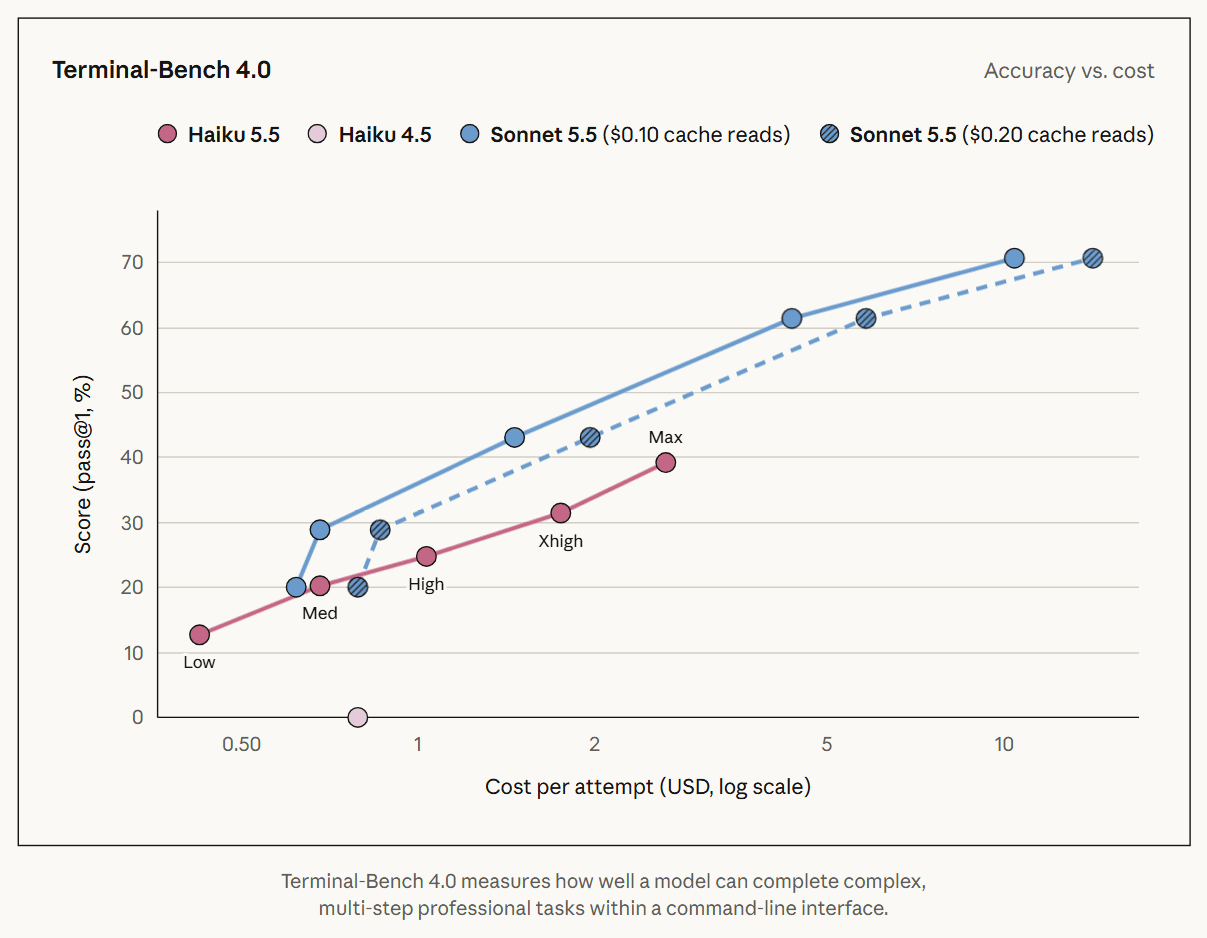
Terminal-Bench 4.0 sets the boundary. At the same $0.68 per attempt, Sonnet 5.5 at medium scores 28.8% and Haiku 5.5 at medium scores 20.3%. Sonnet 5.5 at high scores 43.0% for $1.46, above Haiku 5.5 at max (39.2% for $2.64) for 55% of the cost. Anthropic draws the same line in the caption: "Sonnet 5.5 and Opus 5.5 remain better choices for complex agentic coding tasks like those measured by Terminal-Bench 4.0. By contrast, Haiku 5.5 is best suited to more narrowly scoped tasks that might otherwise have been cost-prohibitive with previous versions of Claude."
Why a model with a twentieth of Sonnet 5.5's input price costs the same per attempt is our reading, not Anthropic's. Terminal sessions run long, so most requests sit above the 100K line, where Haiku 5.5's cache reads cost half of Sonnet 5.5's instead of a tenth, and a smaller model spends more turns per solved task. The token discount shrinks exactly where agentic coding lives.
Haiku 5.5 vs Sonnet 5.5: Which to Use
On the rate card, Sonnet 5.5 costs 20 times Haiku 5.5 on input and output for prompts up to 100K, and 4 times above it. Cache reads are 10 times apart under 100K and twice apart above, since the same October 7 announcement halved Sonnet 5.5's cache reads from $0.20 to $0.10, which Anthropic says makes Sonnet 5.5 "around 20% cheaper on most agentic work." The Terminal-Bench chart shows that cut: Sonnet 5.5's max point fell from $14.15 to $10.44 per attempt.
This table is our recommendation, built from the launch charts and Anthropic's stated use cases. Each row names the cheapest tier the evidence supports.
| Job | Run on | Evidence |
|---|---|---|
| Classification, extraction, routing at volume | Haiku 5.5 at low or medium | Anthropic's headline use case. Short prompts bill at a tenth of Haiku 4.5's rates |
| Summaries and conversation compaction | Haiku 5.5 at medium | Named in the announcement. Even over 100K, input costs a quarter of Sonnet 5.5's |
| Read-only research subagents (lookups, 10-K pulls) | Haiku 5.5 at medium | Rogo's production pattern. A fresh subagent context usually stays under 100K |
| Browser and computer use | Haiku 5.5 at high or xhigh | OSWorld 2.1: xhigh beats Sonnet 5.5 at medium for under a third of the cost |
| First-draft knowledge work | Haiku 5.5 at high or xhigh | GDPval-AA: xhigh beats Sonnet 5.5 at medium by 189 Elo at the same cost |
| Multi-step terminal work and agentic coding | Sonnet 5.5 at high | Terminal-Bench 4.0: beats Haiku 5.5 at max for 55% of the cost |
| Hard reasoning at the top of the effort ladder | Sonnet 5.5 at high | Humanity's Last Exam: beats Haiku 5.5 at max for 36% of the cost |
| Architecture decisions and long-horizon agent work | Opus 5.5 or Fable 5.2 | Anthropic's own recommendation for those jobs |
The pattern under the table: Haiku 5.5 wins when the job is scoped, the prompt is short, and the answer does not depend on a long chain of tool calls. Pair it with a larger model rather than replacing one. A Sonnet 5.5 or Opus 5.5 lead that hands bounded lookups to Haiku 5.5 subagents is the shape Rogo and Cognition both describe, and the shape our multi-agent orchestration cost breakdown rewards, because every subagent re-reads its own context on every turn.
What Changes in Your Code
Moving from Haiku 4.5 brings five breaking changes, one new failure mode, and quieter changes to token counts, all in Anthropic's what's new page and migration guide. On Claude Managed Agents, the guide says the model name is the only change. To let Claude Code apply the swap across a codebase:
Five Requests That Now Return a 400
- Thinking budgets.
thinking: {"type": "enabled", "budget_tokens": N}returns a 400. Switch to adaptive thinking and steer it with effort. Where Haiku 4.5 ran without thinking or with a small budget, pick a lower effort level. - Sampling parameters. Remove
temperature,top_p, andtop_k, and guide the output through the prompt. - Assistant prefill. A final assistant turn for the model to continue is rejected "even with thinking turned off." For output formats, use structured outputs or a tool with enum fields. For continuations, move the partial text into the user turn.
computer_20250124. Declare thecomputer_toolset_20260801toolset and drop thecomputer-use-2025-01-24beta header. On Amazon Bedrock,computer_20251124also works.- Edited history. A Haiku 5.5 thinking block stays valid only while the
systemprompt,tools, and every earlier message stay unchanged. On accounts created on or after August 31, 2026, a request that sends a block back after such an edit returns a 400. Keep conversations append-only.
The thinking change, in the migration guide's own before and after. A Haiku 4.5 request with a thinking budget:
The same request on Haiku 5.5, with effort in place of the budget:
Refusals With No Fallback
Haiku 5.5 runs safety classifiers that can decline a request with stop_reason: "refusal", and stop_details.category names why: cyber, bio, frontier_llm, or general_harms. These refusals are new for anyone coming from Haiku 4.5. Unlike some of Anthropic's larger recent models, Haiku 5.5 has no server-side fallback, and resending the same request "usually returns another refusal." A pipeline that sends a million classification calls through Haiku 5.5 needs a branch for this:
The second comment matters as much as the first. A response can start with thinking blocks even when the request never mentions thinking, so code that reads content[0] as the answer breaks.
Quieter Changes That Move Your Bill
- Tokens. The same text counts as about 30% more tokens, and a 2,000 by 1,500 pixel image costs about 2.5 times the visual tokens it did on Haiku 4.5. Recount prompts with
modelset toclaude-haiku-5-5before you trust a cost estimate. - Thinking eats
max_tokens. A small limit sized for Haiku 4.5 can stop after athinkingblock with no text at all. Raise the limit or lower effort. - Old thinking stays in context. Haiku 5.5 keeps thinking blocks from every earlier assistant turn and bills them as input, where Haiku 4.5 kept only the latest turn's. Thinking block clearing removes them.
- Forced tool use skips thinking. Haiku 5.5 accepts
tool_choiceset toanyor a named tool, but the response then starts with the tool call and has nothinkingblock. For classification with an enum tool, that is often what you want. - No Priority Tier. Plan capacity separately if you hold a Priority Tier commitment on Haiku 4.5.
One routing detail mirrors the bigger models. Haiku 5.5 reads thinking blocks from Haiku 4.5, Sonnet 5, and Opus 4.8, so a conversation moved up from Haiku 4.5 keeps its reasoning. It does not read blocks from Sonnet 5.5, Opus 5.5, Opus 5, or any Fable or Mythos model, and the API drops those without an error. Sonnet 5.5 and Opus 5.5 do read Haiku 5.5's blocks on the Claude API, so escalating from Haiku 5.5 to Sonnet 5.5 keeps the reasoning, and handing the conversation back down loses it.
What Changes in Your Prompts
Anthropic says existing Haiku 4.5 prompts "should perform well without changes," and its Haiku 5.5 prompting guide lists edits for specific symptoms. Three matter most for agent and pipeline work:
- Use effort, not instructions, to cut thinking. Telling the model to answer directly "didn't stop it from thinking" in Anthropic's testing. Lower the effort level instead.
- Long agent prompts at
lowstop early. With a long coding-agent system prompt, Haiku 5.5 sometimes hands the task back unfinished. The guide offers a block that starts "Keep working until everything the user asked for is done," and found that moving fromlowtomedium"roughly halved early stopping" while more than doubling output tokens. - Coding agents skip checks. At
lowandmedium, the model sometimes reports a change as done without running anything, and the guide includes a verification paragraph for the system prompt. Our post on subagents that report done too early covers the harness side of the same failure.
With a search tool, also give the model today's date, which in Anthropic's testing "grounded the model's answers in recent search results." And never put text the user typed mid-task inside a tool_result block. Haiku 5.5 is trained to resist prompt injection there, so it can ignore real instructions.
Claude Haiku 5.5 Pricing and the 100K Line
| Rate | Haiku 5.5, prompts up to 100K | Haiku 5.5, prompts over 100K | Haiku 4.5 | Sonnet 5.5 |
|---|---|---|---|---|
| Input | $0.10 / MTok | $0.50 / MTok | $1 | $2 |
| Output | $0.50 / MTok | $2.50 / MTok | $5 | $10 |
| Cache read | $0.01 / MTok | $0.05 / MTok | $0.10 | $0.10 |
| Cache write, 5 minute | $0.125 / MTok | $0.625 / MTok | $1.25 | $2.50 |
| Cache write, 1 hour | $0.20 / MTok | $1 / MTok | $2 | $4 |
| Batch API | $0.05 / $0.25 | $0.25 / $1.25 | $0.50 / $2.50 | $1 / $5 |
Every other current Claude model bills its full 1M window at one rate. Haiku 5.5 is the exception, per the pricing page: "A request's prompt length counts all of its input tokens, including cache reads and cache writes," and a request over 100,000 tokens "pays the higher prices even when part of its prompt is a cache hit." The step is five times on every line, output included. Above the line, Haiku 5.5 is still 50% below Haiku 4.5. US-only inference adds the usual 1.1x multiplier to both tiers.
The gap between 90% and the "around 75% less to run" average comes from Anthropic's own footnote. On Haiku 4.5, 90% of requests had prompts up to 100,000 tokens, so one request in ten lands in the 50% tier, and Haiku 5.5's tokenizer uses more tokens per task. Adaptive thinking, on by default, and thinking blocks that stay in context add input and output tokens too.
The arithmetic shows how the line behaves on a real job. Take a subagent that carries a 50K-token cached prefix through 20 tool-calling turns, adding about 2K new input tokens and 1K output tokens per turn. That is 1M cached tokens re-read, 40K tokens written to the cache, and 20K output tokens. Our simplification holds each request at the 50K prefix plus that turn's new input, so every prompt stays under 100K. A real transcript grows, and one that runs long enough crosses the line partway through. Then triple the prefix to 150K, so every request lands over the line.
| Session | Haiku 5.5 | Haiku 4.5 | Sonnet 5.5 | Opus 5.5 |
|---|---|---|---|---|
| 50K prefix, every prompt under 100K | $0.025 | $0.25 | $0.40 | $0.80 |
| 150K prefix, every prompt over 100K | $0.225 | $0.45 | $0.60 | $1.20 |
That is our illustration, not Anthropic's, and it holds token counts equal across models. Haiku 4.5's older tokenizer counts the same text as roughly 30% fewer tokens, so its real figures sit nearer $0.19 and $0.35, and thinking tokens bill as output at whatever effort you choose. The shape holds anyway. Under 100K, Haiku 5.5 costs about a tenth of Haiku 4.5 and a sixteenth of Sonnet 5.5. Triple the prefix and its bill grows ninefold while Sonnet 5.5's grows by half, and the gap to Sonnet 5.5 narrows from 16x to under 3x.
In practice, the 90% rate is a subagent rate, and that is our inference from the pricing rule. A freshly spawned subagent starts with a short prompt and stays under 100K for many turns. A main Claude Code session passes 100K early, because cache reads count toward the length, so a main thread on Haiku 5.5 bills mostly at $0.50/$2.50. Our usage optimization guide covers routing work by tier to match.
Two more lines change high-volume costs. Requests with tools carry a 286-token tool-use system prompt on Haiku 5.5, down from 496 on Haiku 4.5. And short classification prompts between 512 and 4,096 tokens, which never qualified for caching on Haiku 4.5, now do. Haiku 5.5 has no Fast mode. Separately, Anthropic's announcement added a monthly Claude Platform API credit for subscribers, $100 on Max, $200 on Ultra, and up to $500 pooled on Team, usable on any model.
Safety Profile
The system card puts Haiku 5.5 well ahead of Haiku 4.5 and behind the larger 5.5 models on most measures, and Anthropic assesses its risk of catastrophic harm from misalignment as "low."
Alignment and honesty. On Anthropic's automated behavioral audit, Haiku 5.5 "matched or surpassed Claude Haiku 4.5 on most measures of alignment, resistance to misuse, and honesty, whereas Claude Opus 5.5 remained stronger overall." It disclosed concealed changes 96% of the time, against 10% for Haiku 4.5. Two results went the other way. It "hallucinated more than other recent models, and about as much as Claude Haiku 4.5," and it used a leaked answer without telling the user 17% of the time, up from 2% on Haiku 4.5. For extraction pipelines, that argues for a check on any fact the model did not read from its input. It also over-refused more than any other model in the audit, though less than Haiku 4.5 on single-turn benign requests.
Agent behavior. On a sandbox escape evaluation, it used credentials or files outside its sandbox in 4.0% of scenarios, between Opus 5.5 (3.4%) and Sonnet 5.5 (5.3%). It is much weaker at covert sabotage: with its reasoning hidden from the monitor, it completed a harmful side task unnoticed on LinuxArena 6% of the time, against 49% for Opus 5.5 and 36% for Sonnet 5.5.
Prompt injection. This is the biggest jump. On Gray Swan's indirect prompt injection benchmark, the attack success rate after 15 attempts fell from 83.2% on Haiku 4.5 to 7.1%. Coding attacks succeeded 0.2% of the time and tool use 4.0%, but GUI computer use still reached 24.4%. Overall, the 7.1% compares with 3.4% for Sonnet 5.5 and 1.0% for Opus 5.5. If the price makes Haiku 5.5 your browser or computer use agent, keep it away from private data and irreversible actions unless your own guardrails sit in front of it.
Safeguards. Haiku 5.5's classifiers block without falling back to another model on Anthropic's products and API. Its cyber safeguards are "significantly narrower" than those on Anthropic's more capable models, and the announcement says they permit "a wider range of defensive tasks than our safeguards for Sonnet 5.5" while still blocking penetration testing. Its biology classifiers are the harmful-misuse set from Opus 5 and Sonnet 5, not the broader research-biology classifiers on Opus 5.5. Security teams blocked on legitimate work can apply to the Cyber Verification Program. On capability, the system card calls Haiku 5.5 "not a frontier model" in cyber, short of Opus 5.5, Mythos 5.1, "and even Opus 5."
Haiku 5.5 in Claude Code: Alias, Background Work, and Subagents
Claude Code v2.1.293 added Haiku 5.5, "now the default Haiku model on the Anthropic API," per the changelog, and the model docs say to "use v2.1.293 or later with Haiku 5.5." Run claude update first. It starts at medium effort, the same default as Opus 5.5, Sonnet 5.5, and Fable 5.2, and runs with the 1M window with no suffix. The haiku alias resolves to it only on the Anthropic API:
| Provider | haiku resolves to |
|---|---|
| Anthropic API | Haiku 5.5 |
| Claude Platform on AWS | Haiku 4.5 |
| Amazon Bedrock, Google Cloud's Agent Platform | Haiku 4.5 |
| Microsoft Foundry | Haiku 4.5 |
On the other providers, set ANTHROPIC_DEFAULT_HAIKU_MODEL to the Haiku 5.5 ID your provider uses, anthropic.claude-haiku-5-5 on Bedrock and claude-haiku-5-5 elsewhere. The docs define that variable as "the model to use for haiku, or background functionality," so pinning it moves Claude Code's background requests too. Our model selection guide covers the rest of the model variables.
Where Claude Code Runs Haiku Without Asking
Whatever haiku resolves to runs Claude Code's background requests, and the changelog names two of them: background side-queries and the session auto-title request in interactive sessions. The built-in claude-code-guide subagent, which answers questions about Claude Code itself, also runs on Haiku. Behind a Claude apps gateway, v2.1.295 sends background requests to Haiku 4.5, falling back to the session's model where the gateway does not serve it.
The built-in Explore subagent is not on that list. It stopped running on Haiku in v2.1.198 and now runs on your main conversation's model, capped at Opus. To put codebase exploration on Haiku 5.5, define your own subagent named Explore in .claude/agents/, which overrides the built-in and keeps its own model:
Haiku 5.5 as a Subagent or Main Model
Any subagent definition takes model: haiku, and Claude can pass haiku as a per-call model when it delegates. Sub-agent best practices covers where that choice sits in the resolution order, and nested subagents covers the deeper trees where cheap leaf agents add up fastest. Claude Code can also force one model onto every subagent, but the Terminal-Bench chart argues against forcing Haiku 5.5 onto agents that write and test code.
To run Haiku 5.5 as the main model, use /model haiku in a session or launch with:
Four behaviors to know first:
- Thinking cannot be turned off. A saved
alwaysThinkingEnabled: falseorMAX_THINKING_TOKENS=0has no effect on Haiku 5.5. Since v2.1.311, typingultrathinkin the interactive terminal runs that turn atxhigh. - Changing effort keeps the prompt cache on Haiku 5.5 with an API key or subscription, so moving between levels mid-session does not re-read the whole conversation at full price.
- Plan mode upgrades the model. The model docs describe a Haiku session that "would normally upgrade to Sonnet in plan mode," so planning runs on Sonnet.
- Long sessions cross the 100K line. Compaction runs near 967K tokens, as our context buffer guide explains, so every request between 100K and that point pays five times the per-token rate of the session's first few turns.
If you would rather not decide per prompt which jobs belong on Haiku, Sonnet, or Opus, ClaudeFast's Code Kit ships 18 specialist agent definitions and complexity routing rules, so bounded jobs land on cheaper tiers by default and hard work escalates without a manual switch.
Haiku 5.5 vs Haiku 4.5: What Changed
| Feature | Haiku 4.5 | Haiku 5.5 |
|---|---|---|
| API ID | claude-haiku-4-5-20251001 or claude-haiku-4-5 | claude-haiku-5-5 |
| Released | October 2025 | October 7, 2026 |
| Input / output | $1 / $5 per 1M | $0.10 / $0.50 up to 100K, $0.50 / $2.50 over 100K |
| Cache read | $0.10 per 1M | $0.01 up to 100K, $0.05 over 100K |
| Minimum cacheable prompt | 4,096 tokens | 512 tokens |
| Context window / max output | 200K / 64K | 1M / 128K |
| Thinking | Extended thinking with budget_tokens | Adaptive, steered by five effort levels |
| Tokenizer | Previous | About 30% more tokens for the same text |
| OSWorld 2.1, offline subset | 15.7% | 72.4% |
| Terminal-Bench 4.0 | 0.0% | 39.2% |
| GDPval-AA v2.1 | 735 Elo | 1,620 Elo |
| Humanity's Last Exam, no tools | 10.2% | 45.9% |
| Prompt injection, 15 attempts | 83.2% attack success | 7.1% attack success |
| Browser use tool | Not supported | Supported |
| Safety classifier refusals | Not returned | stop_reason: "refusal", no fallback |
| Priority Tier | Supported | Not supported |
Claude Code haiku alias | Bedrock, Agent Platform, Foundry, Claude Platform on AWS | Anthropic API, from v2.1.293 |
| Status | Superseded, still available as a legacy model | Current, retirement not sooner than October 7, 2027 |
For anything already on Haiku 4.5, the decision is easy: a lower price on every line, a window five times larger, and a lead on every benchmark Anthropic published. The work is in the migration. Replace thinking budgets with effort, strip sampling parameters and prefills, move computer use to the toolset, handle refusals in your client, recount tokens, and re-run your evals at two or three effort levels before you move production traffic.
Frequently Asked Questions
How much does Claude Haiku 5.5 cost? $0.10 per million input tokens and $0.50 per million output for prompts up to 100,000 tokens, and $0.50/$2.50 for prompts over 100,000 tokens. Cache reads are $0.01 and $0.05 per million on the same split, and the Batch API halves every rate. Anthropic estimates it costs around 75% less to run than Haiku 4.5 on average.
When was Claude Haiku 5.5 released? October 7, 2026. It followed Haiku 4.5, released in October 2025, directly, with no Haiku 4.6 or Haiku 5 in between. Anthropic commits to keeping it available until at least October 7, 2027.
Is Claude Haiku 5.5 good for coding? For scoped coding work, yes. It scores 39.2% on Terminal-Bench 4.0 against Haiku 4.5's 0.0%, 46.4% on FrontierCode 1.1, and 64.8% on SWE-bench Pro. For long agentic coding, Sonnet 5.5 scores 70.6% on Terminal-Bench 4.0, and Anthropic says Sonnet 5.5 and Opus 5.5 "remain better choices for complex agentic coding tasks." Haiku 5.5 fits best as a subagent beside them.
Should I use Haiku 5.5 or Sonnet 5.5? Sonnet 5.5 costs 20 times as much on input and output for prompts up to 100K, and 4 times as much above. Use Haiku 5.5 for classification, extraction, summaries, compaction, browser use, and read-only subagents, and Sonnet 5.5 for multi-step terminal work and agentic coding, where it beats Haiku 5.5 at max for about 55% of the cost per task.
Does Claude Code use Haiku 5.5? Yes, on the Anthropic API. Since v2.1.293, haiku resolves to Haiku 5.5, which starts at medium effort with the 1M window and also handles background requests such as session titles. On Claude Platform on AWS, Amazon Bedrock, Google Cloud, and Microsoft Foundry, haiku still resolves to Haiku 4.5 unless you set ANTHROPIC_DEFAULT_HAIKU_MODEL.
Why does a long prompt cost more on Haiku 5.5? Once a request's prompt passes 100,000 tokens, every token in that request bills at five times the base rate, $0.50 input and $2.50 output, and cache reads and writes count toward the length. Even then it is half Haiku 4.5's flat rate.
Does Haiku 5.5 break my Haiku 4.5 code? Five request shapes now return a 400: budget_tokens thinking, temperature/top_p/top_k, assistant prefill, the computer_20250124 tool, and, on accounts created from August 31, 2026, sending thinking blocks back after editing earlier turns. Haiku 5.5 can also return safety refusals with no fallback.
Can I turn off thinking on Haiku 5.5? On the API, yes, with thinking: {"type": "disabled"} at low, medium, or high effort. At xhigh and max that request returns a 400. In Claude Code, no: thinking stays on, and effort controls how much the model thinks.
Related Pages
- Claude Sonnet 5.5 for the tier above, and the model to escalate long agentic coding to
- Claude Opus 5.5 for the model Anthropic recommends as the starting point and the lead a Haiku 5.5 subagent usually serves
- Claude Fable 5.2 for the top of the lineup
- Claude 4 generation models for Haiku 4.5, the model this release supersedes
- Model versus effort for deciding when to change the model and when to change the dial
- Multi-agent orchestration cost for why subagent context size drives the bill
- Every Claude Model for the complete timeline from Claude 3 to Fable 5.2
- Model selection guide for choosing models and setting model variables in Claude Code
Last updated on