
Claude Fable 5.2 vs Opus 5.5: Benchmarks, Price, Which to Use
Claude Fable 5.2 vs Opus 5.5: Fable leads most benchmarks at twice the price. Where Opus 5.5 still wins, the batch-price math, and which to use.
Agentic Orchestration Kit for Claude Code.
Claude Fable 5.2 vs Opus 5.5 is the first Fable and Opus matchup since July where the pricier model, Fable, wins on Anthropic's own scoreboard. Claude Fable 5.2 shipped November 9, 2026 at $8 per million input tokens and $40 per million output, exactly twice Opus 5.5 at $4/$20. The system card has Fable 5.2 ahead of Opus 5.5 on 14 of its 16 headline results, from 93.0% against 89.9% on SWE-bench Pro to 41.3% against 21.3% on the Remote Labor Index. Opus 5.5 keeps the two knowledge-work Elo ratings, and Anthropic still tells most teams to start there. The open question is which of your workloads justify twice the per-token price.
Our answer fits in two lines. Move to Fable 5.2 for long unattended runs, for the hardest coding you would otherwise push Opus 5.5 to xhigh or max to finish, and for batch jobs, where Fable's $4/$20 batch rate equals Opus 5.5's interactive price. Stay on Opus 5.5 for everyday Claude Code work, for documents and analysis that people will judge, for organizations on zero data retention, and for agents that read untrusted content, where attacks in the Gray Swan injection benchmark Anthropic reports succeeded about four times as often against Fable 5.2.
At a Glance: Who Wins What
| Category | Winner | Margin |
|---|---|---|
| Agentic coding (FrontierSWE v2) | Fable 5.2 | 69.9 vs 62.3 |
| Agentic coding (FrontierCode 2.0) | Fable 5.2 | 49.1 vs 45.5, each at its best effort |
| Long freelance projects (Remote Labor Index) | Fable 5.2 | 41.3 vs 21.3 |
| Agentic science (Terminal-Bench-Science 0.1) | Fable 5.2 | 74.6 vs 58.7 |
| Ranked professional work (GDPval-AA v2.1, Elo) | Opus 5.5 | 1,866 vs 1,831 |
| Ranked long projects (AA-Briefcase v1.1, Elo) | Opus 5.5 | 1,800 vs 1,785 |
| Price per token | Opus 5.5 | Half on input, output, cache writes, batch, and fast |
| Cache reads | Tie | $0.20 per million on both |
| Prompt-injection resistance, with fallbacks on | Opus 5.5 | 0.96% vs 4.09% attack success within 15 tries |
| Zero data retention | Opus 5.5 | Available, where Fable 5.2 requires 30-day retention |
| Claude Code default on every paid plan | Opus 5.5 | default, opus, and best all resolve to it |
Fable 5.2 owns capability. Opus 5.5 owns price, deployment terms, and the default slot.
Fable 5.2 vs Opus 5.5 Price: What 2x Means on a Real Bill
Every rate on Anthropic's pricing page is exactly double for Fable 5.2, with one exception.
| Rate (per 1M tokens) | Opus 5.5 | Fable 5.2 | Fable vs Opus |
|---|---|---|---|
| Input | $4 | $8 | 2x |
| Output | $20 | $40 | 2x |
| Cache read | $0.20 | $0.20 | 1x |
| 5-minute cache write | $5 | $10 | 2x |
| 1-hour cache write | $8 | $16 | 2x |
| Batch input / output | $2 / $10 | $4 / $20 | 2x |
| Fast mode input / output | $8 / $40 | $16 / $80 | 2x |
The exception is the cache read. Fable 5.2 bills cache hits at 0.025 times its input price, Opus 5.5 at 0.05 times a price half as high, so both land on $0.20. The pricing page says cache multipliers "stack with other pricing modifiers, including the Batch API discount," which by our arithmetic puts batch cache reads at $0.10 on both models too.
The Same Price Buys Different Things
Lay the rate card out by price point and a pattern appears that per-model tables hide.
| Price per 1M (input / output) | What it buys |
|---|---|
| $2 / $10 | Opus 5.5 on the Batch API, or Sonnet 5.5 at standard rates |
| $4 / $20 | Opus 5.5 interactive, or Fable 5.2 on the Batch API |
| $8 / $40 | Opus 5.5 in fast mode (up to 2.5x speed), or Fable 5.2 at standard |
| $16 / $80 | Fable 5.2 in fast mode |
At $8/$40 you choose between speed and capability. At $4/$20 you choose between an answer now and a stronger answer returned asynchronously. The fast mode guide covers when the speed premium pays for itself.
Three Workloads, Priced
Our arithmetic at published rates, assuming both models spend the same tokens:
| Workload | Opus 5.5 | Fable 5.2 | Ratio |
|---|---|---|---|
| One uncached request: 50K input, 5K output | $0.30 | $0.60 | 2.0x |
| Claude Code session: 20M cache reads, 200K cache writes, 150K output | $8.00 | $12.00 | 1.5x |
| Overnight job: 2,000 reviews at 30K input and 3K output each | $360 (interactive) | $360 (batch) | 1.0x |
The session row is the agent loop from our Fable 5.2 launch breakdown: a 200K-token cached prefix carried through 100 tool-calling turns. With cache reads priced the same, the deeper the cached context, the closer the bills get. The batch row cuts both ways. If the job already runs on the Batch API, Opus 5.5 does it for $180 and Fable 5.2 still costs double. If it runs interactively out of habit, Fable 5.2 batch costs exactly what you pay today.
Token Counts Are Not Equal
The table holds tokens constant. Anthropic's charts show they are not, and the difference favors Fable 5.2 at the top of the effort range.
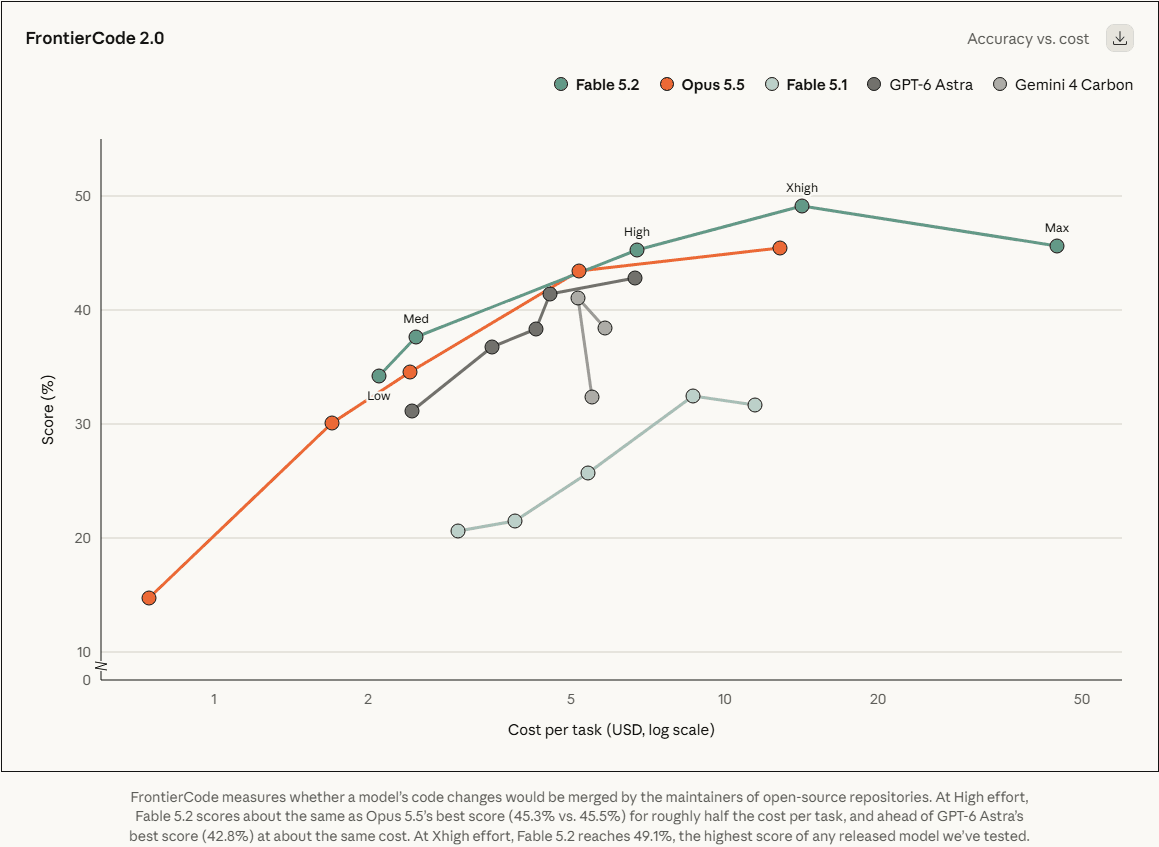
On FrontierCode 2.0, per the announcement, "at High effort, Fable 5.2 scores about the same as Opus 5.5's best score (45.3% vs. 45.5%) for roughly half the cost per task." The other charts repeat the pattern: Fable 5.2 at medium matches Opus 5.5's top WANDR score "for about 40% of the cost per task," and at low it matches Opus 5.5's best on Humanity's Last Exam "for less than one-tenth of the cost per task."
Every one of those comparisons is against Opus 5.5's best score, so they say nothing about replacing Opus 5.5 at medium, where it is the cheaper model. They say a lot about escalation. Our routing rule: when you would raise Opus 5.5 past high, switch to Fable 5.2 at high instead. Our model versus effort guide covers the general version of this decision.
Fable 5.2 vs Opus 5.5 Benchmarks, Like for Like
Mixing rows from two launch pages is the easiest way to get this comparison wrong, so the table uses one source: Table 8.1.A in the Fable 5.2 system card. Both models run with safeguards on and at their highest effort unless noted. Two rows differ. FrontierCode 2.0 shows each model's best effort (xhigh for Fable 5.2, max for Opus 5.5), and the Remote Labor Index uses "default effort settings," which we read as each model's API default: high for Fable 5.2, medium for Opus 5.5.
| Benchmark | Fable 5.2 | Opus 5.5 | Gap |
|---|---|---|---|
| SWE-bench Pro | 93.0 | 89.9 | Fable +3.1 |
| SWE-bench Multilingual | 96.6 | 93.9 | Fable +2.7 |
| SWE-bench Multimodal | 74.1 | 61.4 | Fable +12.7 |
| FrontierCode 2.0 (best effort each) | 49.1 | 45.5 | Fable +3.6 |
| FrontierSWE v2 | 69.9 | 62.3 | Fable +7.6 |
| OSWorld 2.1 (offline set, partial) | 89.3 | 87.2 | Fable +2.1 |
| WANDR (relaxed score) | 82.1 | 72.3 | Fable +9.8 |
| AutomationBench | 51.4 | 42.5 | Fable +8.9 |
| Remote Labor Index (default effort) | 41.3 | 21.3 | Fable +20.0 |
| Humanity's Last Exam, no tools | 73.2 | 64.4 | Fable +8.8 |
| Humanity's Last Exam, with tools | 74.2 | 67.7 | Fable +6.5 |
| Chartography, no tools | 73.4 | 64.4 | Fable +9.0 |
| Chartography, with tools | 91.6 | 89.0 | Fable +2.6 |
| AA-Briefcase v1.1, rubric | 66.1 | 61.2 | Fable +4.9 |
| AA-Briefcase v1.1, Elo | 1,785 | 1,800 | Opus +15 |
| GDPval-AA v2.1, Elo | 1,831 | 1,866 | Opus +35 |
The announcement adds two rows under the same conditions: Terminal-Bench-Science 0.1 (74.6 against 58.7) and RoboDojo Sim, run internally (64.9 against 39.4). Its cyber and protein-design rows compare Mythos 5.2 with Opus 5.5 without safeguards, so they say nothing about what a Fable 5.2 user can run.
Where Opus 5.5 already scores around 90, the gap is about three points. It widens where the task is long, visual, or open-ended: 12.7 points on SWE-bench Multimodal, 15.9 on Terminal-Bench-Science, 20 on the Remote Labor Index. Keep Opus 5.5's September launch table out of this, because FrontierCode moved from v1.1 to 2.0 and re-runs moved AutomationBench from 40.0 to 42.5 and GDPval-AA from 1,846 to 1,866.
Where Opus 5.5 Still Wins
Documents, Slides, and Analysis People Will Judge
GDPval-AA v2.1 grades "documents, slides, diagrams, and spreadsheets" across 44 occupations, with Elo ratings "derived from blind pairwise comparisons of model outputs." Opus 5.5 leads, 1,866 to 1,831, and Fable 5.2 needs max effort to get that close: at xhigh it scores 1,751. AA-Briefcase splits the same way. Fable 5.2 wins the rubric pass rate, 66.1% against 61.2%, while Opus 5.5 wins the pairwise Elo. Our read: Fable 5.2 completes more of the checklist, and reviewers prefer what Opus 5.5 hands them. For client deliverables, keep Opus 5.5 and keep the money.
Agents That Read Untrusted Content
Section 5.2 of the system card holds this evidence. On Gray Swan's indirect prompt injection benchmark, attackers succeeded against Fable 5.2 in 0.30% of single attempts and 4.09% within 15 attempts, against 0.07% and 0.96% for Opus 5.5. That test ran without the injection protections Anthropic deploys in its products, and its results include the fallback to Opus 4.8. Against Gray Swan's adaptive Shade attacks in coding environments, with Anthropic's injection probes on, the rates were 28.16% and 11.13%.
The cause is the fallback path. Fable 5.2's cyber classifier hands flagged requests to Opus 4.8, which resists injection less well, and it fires far more often: on the indirect injection benchmark, 53% of attempts on Fable 5.2 fell back, against 18% for Opus 5.5. In the Shade coding test, none of the 43 requests Fable 5.2 answered itself were compromised, but production traffic takes the fallback too. If an agent browses the web, triages public issues, or reads inbound email, run it on Opus 5.5 and leave Claude Code's auto mode on, which pairs injection probes with a classifier that blocks dangerous tool calls.
Zero Data Retention
Fable 5.2 and Mythos 5.2 "require 30-day data retention and aren't available under zero data retention unless expressly authorized by Anthropic," per the what's new page. Enterprise Frontier Safeguards, in private beta, opens a ZDR route for eligible enterprise customers. Opus 5.5, "like previous Opus models," is available with zero data retention. Under ZDR, Claude Code grays out the Fable row in /model.
Fast Chat and Caution-Heavy Pipelines
At high and above, Fable 5.2 "thinks before almost every reply, including a reply to a greeting," and the line "answer directly without deliberating" did not stop it thinking at medium and above. The Opus 5.5 prompting guide lists that same line as a way to trim thinking at low. For quick back-and-forth, Opus 5.5 gives you two levers where Fable 5.2 gives you one.
Fable 5.2 also follows the notes agents pass around more literally. With a reviewer agent's "stop at the first error" in context, it skipped an allowed retry in about a third of Anthropic's tries, while Fable 5.1 and Opus 5.5 retried. Prune accumulated cautions before you move a multi-agent setup, as our guide on what to delete from your CLAUDE.md walks through.
Security, Biology, and AI Research: No Upgrade
Fable 5.2's "cyber safeguards enforce the same policy as those on Opus 5.5," per the system card, and in Claude Code both models send cyber-flagged requests to Opus 4.8 and biology-flagged requests to Opus 5. Anthropic also capped kernel optimization and language model architecture work on purpose, where Fable 5.2 performs "at about the level of Opus 5.5." For offensive security or wet-lab biology, the path is Mythos 5.2 through Anthropic's Cyber or Life Sciences Verification Program.
What Fable 5.2 Can Do That Opus 5.5 Cannot
The widest gaps sit on work that runs for hours with no fixed recipe. About 1,000 Fable 5.2 agents formalized Fermat's Last Theorem in Lean in 30 hours. Opus 5.5, in the same setup, "completed only 26% of the formalization in 18 hours, and barely made any more progress after 30." That is one run per model, but it matches the Remote Labor Index, where Fable 5.2 finished 41.3% of freelance projects at least as well as a human professional against 21.3% for Opus 5.5.
Uber Staff Engineer, Agentic Systems, Andrew Mager ran a 10 to 12 hour security audit and wrote: "It works until the job is actually complete instead of stopping at a plausible checkpoint." He added: "At High effort, I'd use this over what I run today for long unattended audits and doc-heavy work." Datadog Senior Staff Engineer Matt Lee described the orchestrator role: "It's almost like an incident commander that can send out faster models to get quick signals and coordinate, which removes that burden from me as an operator."
The rest of the list is physical and visual: simulated robot control (64.9 against 39.4 on RoboDojo Sim), hardware design (83.5 against 65.3 on BenchCAD 2.1 with tools, with Fable 5.2 at max), and reading charts and screenshots without tools (73.4 against 64.4 on Chartography, 74.1 against 61.4 on SWE-bench Multimodal). If your issues arrive as screenshots and mockups, test that last gap.
How the Comparison Flipped Since July
| Launch | Matchup | Fable's price premium | Who led on the launch evidence |
|---|---|---|---|
| July 24, 2026 | Opus 5 vs Fable 5 | 2x | Opus 5, 7 of 8 quantified evals |
| September 22, 2026 | Opus 5.5 vs Fable 5.1 | 2.5x | Opus 5.5, all nine launch rows |
| November 9, 2026 | Opus 5.5 vs Fable 5.2 | 2x | Fable 5.2, 14 of 16 system-card rows |
When we compared Opus 5 and Fable 5 in July, Fable's remaining case was narrow and "not a capability case." Opus 5.5 widened that gap in September. Fable 5.2 reverses it, and the premium shrank along the way: 2.5x per token for Fable 5.1, 2x for Fable 5.2, about 1.5x on a cache-heavy session. From July to November the right advice was to treat Fable as a measured exception. It is now a tier with a defined job.
Fable 5.2 or Opus 5.5 in Claude Code
Opus 5.5 is what default resolves to on every paid plan and the Anthropic API, per Claude Code's model configuration docs. Since v2.1.321, best resolves to the same model as opus, so a script launched with --model best now gets Opus 5.5. Fable 5.2 needs v2.1.321 or later. Both models start at medium effort in Claude Code, although Fable 5.2's API default is high. Four setups, with very different bills:
| Setup | How | Cost shape | Best for |
|---|---|---|---|
| Opus 5.5 throughout | /model opus or /model default | Baseline | Most sessions |
| Fable 5.2 throughout | /model fable, then /effort high | 1.5x to 2x at equal tokens | Long unattended runs, the hardest coding |
| Opus 5.5 with a Fable 5.2 advisor | /model opus, then /advisor fable | Opus rates plus one uncached transcript read per call | Short sessions with a few hard decisions |
| Fable 5.2 lead, Opus 5.5 workers | /model fable, model: opus in agents | Fable on planning turns, Opus on delegated work | Orchestration and multi-agent runs |
The advisor row hides a cost trap. Claude Code's advisor docs say the advisor "receives the full conversation" and that "each advisor call processes the full transcript anew, with no reuse between calls," billed at the advisor's rates. In the 200K-token session priced above, each Fable 5.2 advisor call reads about $1.60 of input before it writes a word, while running the whole session on Fable 5.2 adds $4.00. By our arithmetic, from the third call onward the advisor costs more than switching the main model, and earlier once you count the advisor's own output and a transcript that grows past 200K. On a 30K-token transcript a call reads about $0.24, and the advisor stays cheap. On plans where Fable bills to usage credits, /advisor fable works only after you accept that once through /model fable.
For the orchestration row, give executor agents an explicit model, because subagents otherwise inherit the main conversation's:
With Fable 5.2 as the main model on a subscription or Console account, the built-in Explore subagent already runs on Opus. The multi-agent orchestration cost guide covers what each delegated agent adds. To start a long Fable session in one command:
Choose per session, not per turn. A /model switch "reads the entire conversation history with no cache hits," and Opus 5.5 cannot read Fable 5.2's thinking blocks, so a switch down re-reads the context at full price and loses the reasoning.
Plans shape this too. On Max, Ultra, and premium Team or Enterprise seats, Fable 5.2 is included for up to 50% of weekly usage limits and draws them down faster than other models. On Pro and standard Team seats, Fable is included only for launch week, up to 50% of weekly limits through November 16, 2026 at 11:59 pm PT, then returns to usage credits, which non-interactive claude -p runs bill without asking. Our Fable usage credits guide covers the setup. Once you pick Fable 5.2, our Fable 5.2 best practices cover the "this codebase is yours" sentence, effort, and early stopping. If you stay on Opus, get more from Opus 5.5 before switching.
Which Should You Use?
| Work | Use | Why |
|---|---|---|
| Everyday Claude Code work: scoped features, bug fixes, reviews | Opus 5.5 at medium | Anthropic's default recommendation at half the price |
| Documents, slides, spreadsheets, analysis for clients | Opus 5.5 | Wins both ranked Elo ratings |
| Agents that browse, triage public issues, or read inbound email | Opus 5.5 | Lower prompt-injection success with fallbacks counted |
| Organizations on zero data retention | Opus 5.5 | Fable 5.2 requires 30-day retention without an authorization |
| Fast chat and quick back-and-forth | Opus 5.5 | Thinking is easier to keep short |
| Kernel optimization or model-architecture research | Opus 5.5 | Fable 5.2 performs at about Opus 5.5's level there |
Hard coding you would run on Opus 5.5 at xhigh or max | Fable 5.2 at high | Matches Opus 5.5's best for about half the cost per task |
| Multi-hour unattended runs and agent orchestration | Fable 5.2 at high | Remote Labor Index, Fermat, and Terminal-Bench-Science gaps |
| Batch jobs you currently run interactively on Opus 5.5 | Fable 5.2 batch | Same $4/$20 rate, stronger model |
| Visual-heavy work: screenshots, mockups, charts | Fable 5.2 | Chartography and SWE-bench Multimodal leads |
| High-volume, well-specified tasks | Sonnet 5.5 | $2/$10, the same price as Opus 5.5 on batch |
| Offensive security or wet-lab biology | Neither | Both route flagged work to Opus 4.8 or Opus 5. Apply for Mythos 5.2 |
Make Opus 5.5 your default and give Fable 5.2 a named job: long autonomous runs, and the escalations you used to send to Opus 5.5 at max. That matches Anthropic's own line, which starts with Opus 5.5 and moves "upward to Fable or Mythos" as scope and complexity require. Our model selection guide covers the full Sonnet, Opus, and Fable lineup, and routing cheap work to cheaper tiers covers the Sonnet side. If you would rather set this split once than per prompt, ClaudeFast's Code Kit ships 18 specialist agents, each with a model assignment in its definition, plus complexity routing that decides which agent takes a task.
Frequently Asked Questions
Is Fable 5.2 better than Opus 5.5? On most published evidence, yes. Anthropic calls it "a step above Opus 5.5 in almost all the capabilities we evaluated," and the system card has it ahead on 14 of 16 results, including SWE-bench Pro (93.0 vs 89.9). Opus 5.5 leads the two ranked knowledge-work Elo ratings, GDPval-AA v2.1 (1,866 vs 1,831) and AA-Briefcase (1,800 vs 1,785).
How much more does Fable 5.2 cost than Opus 5.5? Exactly 2x per token: $8/$40 against $4/$20. Cache reads cost $0.20 per million on both, so a cache-heavy agent session runs about 1.5x, and Fable 5.2 on the Batch API ($4/$20) costs the same as Opus 5.5 interactive.
What can Fable 5.2 do that Opus 5.5 cannot? Finish long, open-ended work. A 1,000-agent Fable 5.2 team formalized Fermat's Last Theorem in 30 hours, where Opus 5.5 reached 26% in 18 hours and stalled. Fable 5.2 also nearly doubles Opus 5.5 on the Remote Labor Index.
Should I use Fable 5.2 or Opus 5.5 in Claude Code? Start on Opus 5.5, the default on every paid plan. Switch a session to Fable 5.2 with /model fable and /effort high for long unattended runs, or when you would otherwise raise Opus 5.5 to xhigh or max.
Can Fable 5.2 plan while Opus 5.5 does the work? Yes. Anthropic names "Orchestrator" as a Fable 5.2 role, and early testers "had good results with Claude Fable 5.2 as the planner and orchestrator for other models." In Claude Code, run the main session on Fable 5.2 and set model: opus in your executor agents. The reverse also works: Opus 5.5 can consult Fable 5.2 as an advisor, cheapest on short transcripts.
Related Pages
- Claude Fable 5.2 and Mythos 5.2 for the full launch: benchmarks, breaking changes, and the safety profile
- Claude Opus 5.5 for Opus 5.5's specs, launch table, and migration notes
- Fable 5.2 best practices for how to brief Fable 5.2 once you pick it
- Claude Opus 5 vs Fable 5 for how the same comparison went in July
- Model selection guide for routing work across the whole lineup
- Fable usage credits for plan caps and credits after launch week
- Every Claude Model for the complete timeline
Last updated on