
Claude Sonnet 5.5: Benchmarks, Pricing, and 5 Breaking Changes
Claude Sonnet 5.5 benchmarks, pricing, specs: $2/$10, half of Opus 5.5 on every line, cache reads cut to $0.10 on Oct 7, 5 breaking changes.
Agentic Orchestration Kit for Claude Code.
Claude Sonnet 5.5 lands a few points behind Opus 5.5 on most of Anthropic's launch table, at exactly half the price. It was released on September 28, 2026 as claude-sonnet-5-5, the second model in the Claude 5.5 lineup, per Anthropic's announcement, at $2 per million input tokens and $10 per million output, the same list price as Sonnet 5. It launched with cache reads at $0.20 per million. On October 7, 2026, Anthropic halved that to $0.10, which put Sonnet 5.5 at half of Opus 5.5 on every price line.
On the launch table, Sonnet 5.5 trails Opus 5.5 by 3.2 points or less on five of eight rows, counting FrontierCode at Sonnet's best setting, and sits 2 Elo behind it on GDPval-AA v2.1. On Terminal-Bench 4.0 it scores 70.6% at max effort, against 64.8% for Opus 5.5 at max and 66.4% at Opus's best setting, xhigh. Against Sonnet 5 the jump is large: SWE-bench Pro rises from 63.2% to 81.3% in the system card, and Anthropic reports output "30%+ faster" at "up to 30% less" cost per task. If you read one section, read What Changes in Your Code: five things that worked on Sonnet 5 now return a 400, led by thinking: {"type": "disabled"}, which Sonnet 5.5 replaces with a new between_tools setting.
Two numbers explain how to run it. At medium, the Claude Code default, Sonnet 5.5 "far exceeds Sonnet 5's best score" on Terminal-Bench 4.0 "for less than a tenth of the cost per task." And at today's cache rate, the 100-turn agent session we price in our launch posts costs $4.00 on Sonnet 5.5 against $8.00 on Opus 5.5 (our arithmetic is in Pricing and Access). The catch sits at the top of the dial: on our reading of the cost charts, Opus 5.5 at medium or high matches or beats Sonnet 5.5 at xhigh for similar money or less, so Sonnet 5.5 earns its place from low to high.
Key Specs
| Spec | Details |
|---|---|
| API ID | claude-sonnet-5-5 on the Claude API, Claude Platform on AWS, Claude Models on Google Cloud, and Microsoft Foundry, and anthropic.claude-sonnet-5-5 on Amazon Bedrock |
| Release Date | September 28, 2026 |
| Model Family | Second model in the Claude 5.5 family, after Opus 5.5 (September 22) and before Haiku 5.5 (October 7) |
| Context Window | 1M tokens at standard pricing across the whole window |
| Max Output | 128,000 tokens, up to 300,000 on the Message Batches API with the output-300k-2026-03-24 beta header |
| Knowledge Cutoff | June 2026 (reliable and training data cutoff) |
| Tokenizer | Same as Sonnet 5, so the same text produces the same token count. About 30% more tokens than Sonnet 4.6, Sonnet 4.5, and Haiku 4.5 |
| Thinking | Adaptive, on by default. The lowest setting is between_tools, which turns off up-front thinking. disabled returns a 400 |
| Effort Levels | low, medium, high, xhigh, max, with high the default on the API and medium the default in Claude Code and the Claude apps |
| Pricing | $2 input / $10 output per 1M tokens, cache reads $0.10 (launched at $0.20, cut October 7, 2026), 5-minute cache writes $2.50, 1-hour writes $4, Batch API $1 / $5. No Fast mode |
| Speed | Output "30%+ faster than Sonnet 5," Anthropic's fastest Sonnet to date, and "Fast" latency in the lineup table |
| Prompt Cache Min | 512 tokens, down from 1,024 on Sonnet 5 |
| Data Retention | Zero data retention available, as with Opus 5.5 and Sonnet 5 |
| Retirement | Not sooner than September 28, 2027 |
| Availability | Claude API, Amazon Bedrock, Google Cloud (Anthropic managed and Google managed), Microsoft Foundry, Claude Platform on AWS, Claude Code (v2.1.284 or later), claude.ai |
| Status | Active, the latest Sonnet. Sonnet 5 is now a legacy model, still available, with retirement not sooner than June 30, 2027 |
What Claude Sonnet 5.5 Is: Near-Opus Work on a Sonnet Bill
Anthropic positions Sonnet 5.5 as "a faster, lower-cost complement to Claude Opus 5.5." Opus 5.5 "is built for complex work requiring careful judgment," while Sonnet 5.5 "is strongest at well-scoped everyday tasks, fixing bugs, and creating polished documents, slides, and spreadsheets." The models overview calls it "the best combination of speed and intelligence" and still tells developers who are unsure to "start with Claude Opus 5.5 for most workloads." The prompting guide puts the limit plainly: "For the hardest long-horizon work, an Opus model is the better choice."
What changed against Sonnet 5 is speed, token efficiency, and reach. Anthropic says Sonnet 5.5 "typically needs far fewer tokens to do the same work," and that "in head-to-head runs, it batched tool calls together more than Sonnet 5, leading to fewer steps and lower costs." It is the first Sonnet to beat Pokémon Red working only from screenshots. Like Opus 5.5, it "writes more clearly than our previous generation of models." In one internal test, Anthropic gave it a public company's earnings materials, call transcripts, and a slide template, asked for a 10-slide operating review, and two experts judged the first draft "ready to send as is."
The partner reports cluster on efficiency. Base44 AI Engineering Lead Gabriel Grinberg: "Across 118 real app builds, Claude Sonnet 5.5 produced apps that scored level with Opus 5. It got there in 3.6 iterations per build on average, where Opus 5 took 7.7." Balyasny Asset Management Senior AI Engineer Joe Poirier reported that on 2,441 finance tasks it "used about 121k tokens per answer, where Sonnet 5 used 497k." CodeRabbit VP of AI David Loker: "Sonnet 5's tendency to reach for web search too often and its high token use are both gone in this new model." Lovable Co-founder and CTO Fabian Hedin saw "a third fewer tool calls and roughly half the shell runs to finish a task."
The other cluster places Sonnet 5.5 next to Opus. Unity Creative Technologist Sam Zhang described a bar where "a task only counts when the change works, not when the model says it's done," and reported: "The majority of Claude Sonnet 5.5's work passed that check." SpaceXAI Director of ML Sualeh Asif called its CursorBench 4.0 score "frontier-level performance," at "55.5%, second only to Opus 5.5." Kevin Ngo, Creative Coder at Creator, described the split the benchmarks below point to: "When Claude Opus 5.5 sets the architecture and general framework for a game, I would feel confident in letting Sonnet 5.5 implement it."
Sonnet 5.5 Benchmark Results
Anthropic published one eight-row comparison table and four cost-versus-score charts. The table shows each model's best published result, with the effort setting noted where Anthropic gives one, and the system card runs its summary table at max effort.
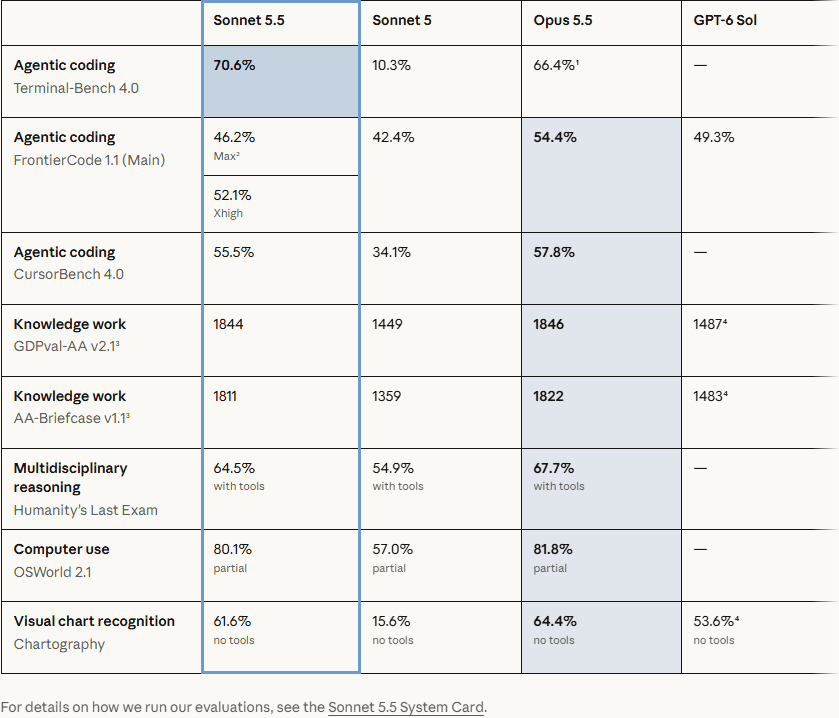
| Benchmark | Sonnet 5.5 | Sonnet 5 | Opus 5.5 | GPT-6 Sol |
|---|---|---|---|---|
| Terminal-Bench 4.0 (agentic coding) | 70.6 (max) | 10.3 | 66.4 (xhigh) | not stated |
| FrontierCode v1.1, Main (agentic coding) | 46.2 (max), 52.1 (xhigh) | 42.4 | 54.4 | 49.3 |
| CursorBench 4.0 (agentic coding) | 55.5 | 34.1 | 57.8 | not stated |
| GDPval-AA v2.1 (knowledge work, Elo) | 1,844 | 1,449 | 1,846 | 1,487 |
| AA-Briefcase v1.1 (knowledge work, Elo) | 1,811 | 1,359 | 1,822 | 1,483 |
| Humanity's Last Exam, with tools (reasoning) | 64.5 | 54.9 | 67.7 | not stated |
| OSWorld 2.1, partial (computer use) | 80.1 | 57.0 | 81.8 | not stated |
| Chartography, no tools (chart recognition) | 61.6 | 15.6 | 64.4 | 53.6 |
Sonnet 5.5 leads Sonnet 5 on every row by wide margins: 60.3 points on Terminal-Bench 4.0, 46.0 on Chartography, 23.1 on OSWorld 2.1, and 395 Elo on GDPval-AA, which Anthropic rounds to "about 400 points." Against Opus 5.5, it trails by 1.7 points on OSWorld 2.1, 2.3 on CursorBench, 2.3 on FrontierCode at its best setting, 2.8 on Chartography, and 3.2 on Humanity's Last Exam, sits 2 and 11 Elo behind on the two knowledge-work rows, and leads on Terminal-Bench 4.0. It also tops GPT-6 Sol on every row where Sol was scored, except FrontierCode at max.
The system card adds rows the announcement leaves out, all at max effort. On SWE-bench Pro, the benchmark our Sonnet 5 page led with, Sonnet 5.5 scores 81.3% against 63.2% for Sonnet 5 and 89.9% for Opus 5.5. It reaches 90.3% on SWE-bench Multilingual and 54.3% on SWE-bench Multimodal. Three system-card rows go to Sonnet 5.5 over Opus 5.5: AutomationBench (44.7 against 42.5), HealthBench Professional (69.2 against 65.6), and Terminal-Bench-Science 0.1 (59.9 against 58.7). On FrontierSWE v2, Proximal's set of ultra-long-horizon engineering tasks, it scores 61.9% against Opus 5.5's 62.3%.
Effort Is the Setting That Decides the Bill
The table compares peaks. The charts plot score against cost per task on a log scale, with each model drawn as a curve from low to max, and they show where Sonnet 5.5 earns its place.
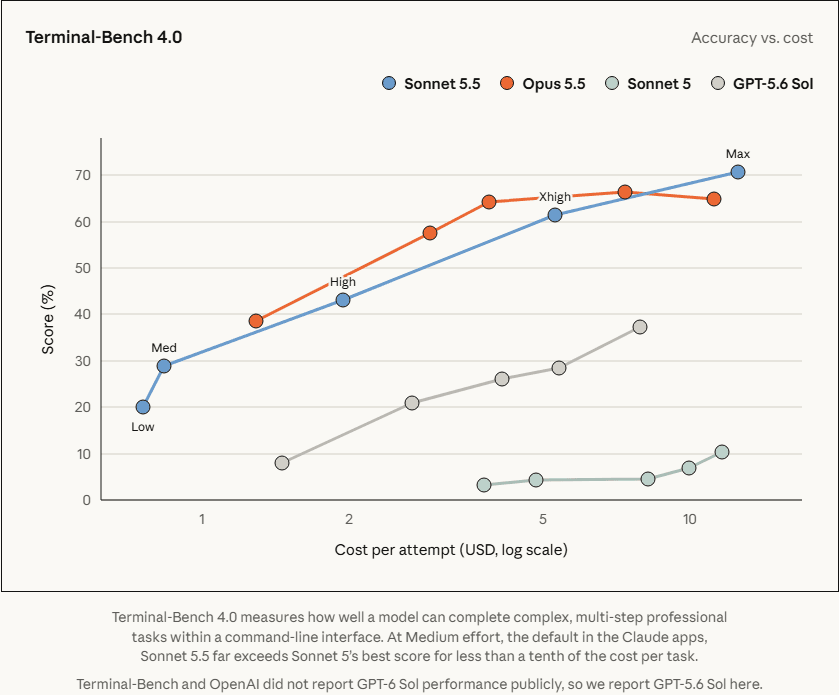
On Terminal-Bench 4.0, Anthropic's caption reads: "At Medium effort, the default in the Claude apps, Sonnet 5.5 far exceeds Sonnet 5's best score for less than a tenth of the cost per task." Our reading of the chart: Sonnet 5.5's low and medium points sit to the left of every Opus 5.5 point, at under $1 per attempt. From about $1.30 to about $8, the Opus 5.5 curve sits above Sonnet's. Opus 5.5 at high scores about 64% for about $4, where Sonnet 5.5 at xhigh scores about 61% for about $5. Sonnet 5.5 passes Opus 5.5 only at its own max point, above $10 per attempt.
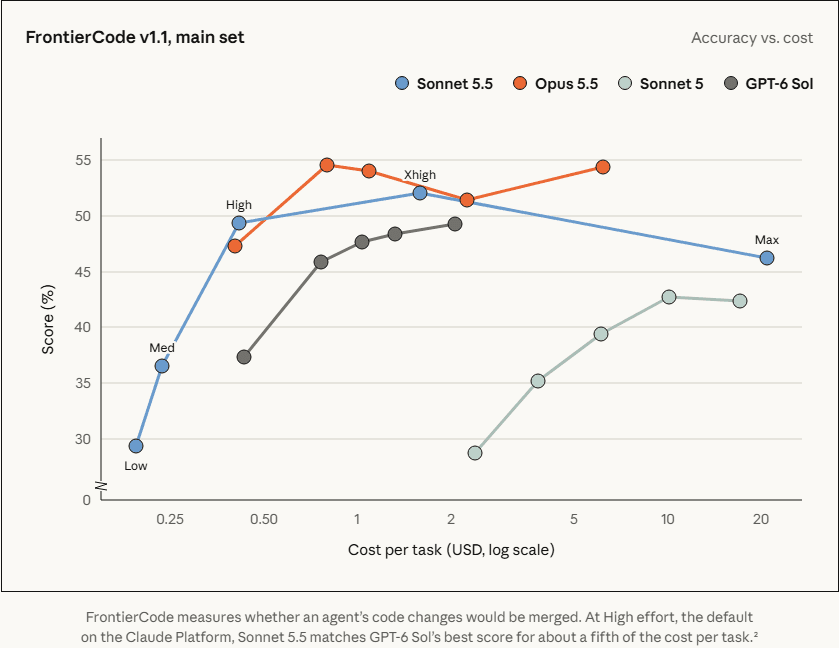
FrontierCode, which measures whether an agent's code changes would be merged, shows the same shape more sharply. "At High effort, the default on the Claude Platform, Sonnet 5.5 matches GPT-6 Sol's best score for about a fifth of the cost per task," and at that setting it "scores 10 points higher than Sonnet 5 at the same setting, at about one fifteenth of the cost per task." The top of the curve is the warning. At max, Sonnet 5.5 scores 46.2%, below its 52.1% at xhigh, because it "more often ran Claude Code's code-review skill, which splits the review across many subagents," and in two cases Cognition examined, that led "to a timeout or to extra edits beyond the task's scope." Our reading of the chart: the max point costs more than ten times the xhigh point, and Opus 5.5 at medium, which scores about 54.5% for under $1 per task, beats Sonnet 5.5's best for about half its cost.
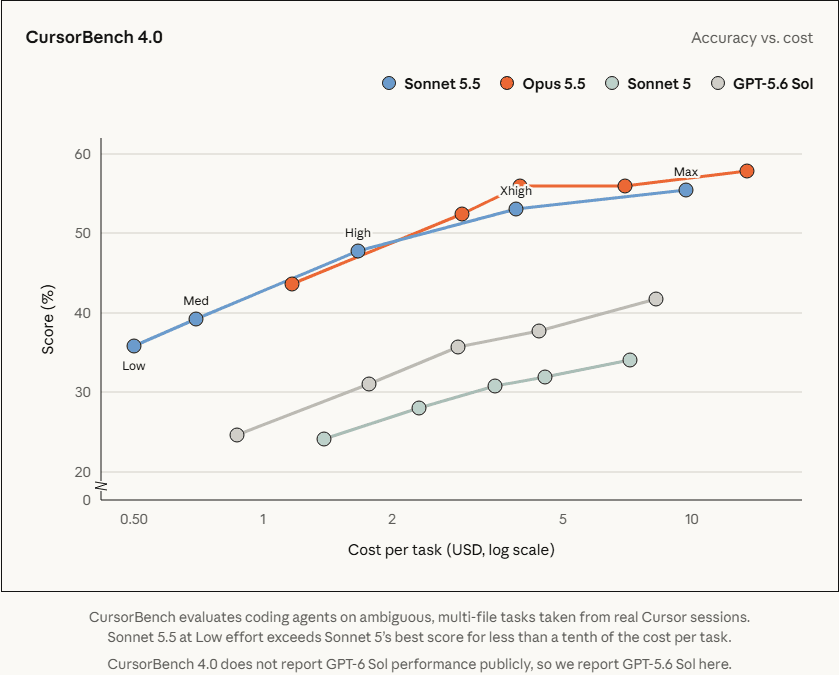
On CursorBench 4.0, built from tasks in real Cursor sessions, "Sonnet 5.5 at Low effort exceeds Sonnet 5's best score for less than a tenth of the cost per task." The system card gives the steps: 39.2% at medium, 47.8% at high, 53.1% at xhigh, 55.5% at max. Our reading of the chart: from about $1 to $3 per task the two curves nearly overlap, and above that Opus 5.5 stays one to three points ahead. On AA-Briefcase, a long-horizon knowledge-work test, "Sonnet 5.5 at Medium effort bests Sonnet 5's best score for about one ninth of the cost per task."
The routing consequence is our read. Anthropic says Sonnet 5.5 "complements Opus 5.5 best when running at lower effort settings, where it costs less per task. At higher settings, it can perform comparably at a similar cost." On all three coding charts, no Opus 5.5 setting matches Sonnet 5.5's score at low, medium, or high for the same money or less. At xhigh and max, a lower Opus 5.5 setting matches or beats it for similar money or less, with one exception: Terminal-Bench 4.0, where Sonnet 5.5 at max tops every Opus 5.5 point. If your model versus effort policy sends hard tasks to Sonnet at xhigh, price Opus 5.5 at medium against it first. The September charts also predate the October 7 cache cut. The launch page they shipped with priced cache reads at $0.20, nine days before the cut, and on our reading their Terminal-Bench points sit much closer to the $0.20 curve in Anthropic's later chart than to the $0.10 one. At today's rate every Sonnet 5.5 point sits further left, which narrows the xhigh comparison, so re-run your own sweep at current prices.
Read the Table With Its Footnotes
Opus 5.5 leads seven of the eight rows, and Anthropic adds that "Opus 5.5 remains clearly stronger at complex, open-ended work requiring sustained judgment." The Terminal-Bench 4.0 row is the one to read carefully. Footnote 1 says the 66.4% is Opus 5.5 at xhigh, "the model's highest score." The system card adds the missing half: Sonnet 5.5's 70.6% was run "at max thinking effort," and Opus 5.5 at max scored 64.8%. So the lead is 5.8 points with both at max and 4.2 points against Opus's best. The card also gives standard errors of ±2.5 points for Sonnet 5.5 and ±2.6 for Opus 5.5, so we read it as a probable lead that a rerun could narrow.
Several benchmarks changed version since June, so the Sonnet 5 column does not match Anthropic's June table. Sonnet 5 scored 80.4% on Terminal-Bench 2.1 at its launch and 10.3% on version 4.0 here. GDPval-AA moved from v2 (1,618) to v2.1 (1,449), and computer use from OSWorld-Verified (81.2%) to OSWorld 2.1 (57.0%). Sonnet 5.5's own numbers also move between launches: the Haiku 5.5 table on October 7 lists it at 1,840 on GDPval-AA v2.1 and 1,824 on AA-Briefcase v1.1. The September runs of both benchmarks also used a pre-release deployment with a structured-outputs bug, whose effect Anthropic expects "to be small and to understate its performance." Treat each launch table as internally consistent and never mix rows across them.
What Changed Since Launch
Sonnet 5.5 is six weeks old, and the price, the lineup around it, and Claude Code's handling of it have all moved since September 28.
| Date | Change | Source |
|---|---|---|
| September 28, 2026 | Sonnet 5.5 released at $2/$10 with $0.20 cache reads. Claude Code v2.1.284 makes it the default sonnet on the Anthropic API | Launch-day announcement, changelog |
| September 30, 2026 | Sonnet 4.5 deprecated on the Claude API, retiring November 30, 2026, with claude-sonnet-5-5 named as its replacement | Model deprecations |
| October 7, 2026 | Sonnet 5.5 cache reads cut to $0.10. Haiku 5.5 released. Monthly API credits announced for Max ($100), Ultra ($200), and Team (up to $500, pooled) | Haiku 5.5 announcement |
| October 9, 2026 | Claude Code v2.1.296 prices Sonnet 5.5 cache reads at $0.10 in /cost, the status line, --max-budget-usd, and the SDK's cost figures | Changelog |
| November 9, 2026 | Fable 5.2 released. It reads Sonnet 5.5 thinking blocks on the Claude API and is an accepted advisor for a Sonnet 5.5 executor | Fable 5.2 and Sonnet 5.5 platform docs |
The price change is the one that matters most. In Anthropic's words on October 7: "Cache reads now cost 50% less: $0.10 per million tokens rather than $0.20. Because cache reads make up a large share of models' token consumption, this reduces the cost of Sonnet 5.5 on most agentic tasks by around 20%." The Sonnet 5.5 announcement page now shows $0.10 without a dated note. If a dashboard or a third-party page shows $0.20, it predates October 7.
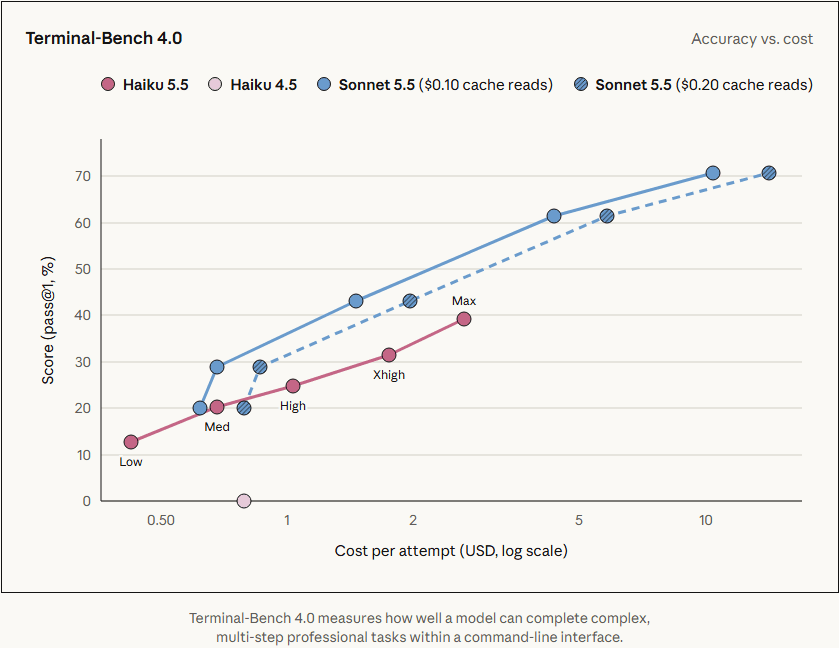
Anthropic's October chart shows what the cut does on Terminal-Bench 4.0: the scores stay put, and on our reading every Sonnet 5.5 effort level moves about 21 to 26% cheaper per attempt. The same announcement says Haiku 5.5 "pairs well with Opus 5.5 and Sonnet 5.5 as a subagent on coding work," and that "Sonnet 5.5 and Opus 5.5 remain better choices for complex agentic coding tasks." Our Claude Haiku 5.5 breakdown covers its prompt-length pricing and where it fits under Sonnet.
What Changes in Your Code
Five breaking changes from Sonnet 5, one silent change to the response shape, and a set of behavior differences, all documented in Anthropic's what's new page and migration guide. The model ID swap is one line. The five changes below are the part that returns errors. If you already moved an integration to Opus 5.5, changes 2 to 4 will look familiar.
1. disabled Thinking Returns a 400: Use between_tools
Sonnet 5 turned thinking off with thinking: {"type": "disabled"}. On Sonnet 5.5 that returns a 400 whose message begins: To turn thinking off on this model, send "thinking": {"type": "between_tools"} instead of {"type": "disabled"}. The new setting skips up-front thinking, and the short progress notes the model writes between tool calls still come back as thinking blocks. Without tools, the response is text only, as disabled was on Sonnet 5.
Four rules come with it. between_tools works at low, medium, and high, and returns a 400 at xhigh or max. It takes no other field, so display, budget_tokens, or block_binding sent with it returns a 400. A per-message effort change that differs from the level in effect returns a 400. And for reasoning tasks without tools, it means no thinking at all, so use adaptive thinking there. Manual budgets ("type": "enabled" with budget_tokens) also return a 400.
2. Forced Tool Use Returns a 400
tool_choice set to {"type": "any"} or {"type": "tool", "name": "..."} returns tool_choice: type "tool" and "any" are not supported for this model., including on the token-counting endpoint. Keep tool_choice at auto, mark the tool strict: true so its input matches the schema, and say in the prompt when to use it:
A request can carry at most 20 strict tools, and the MCP, computer use, and browser use toolset entries don't accept strict.
3. Thinking Blocks Are Tied to the Model and the Conversation
Model binding. Each thinking block records the model that produced it, and only some models read each other's blocks. When a request carries a block the target cannot read, the API drops it, the request succeeds, and the dropped tokens are not billed.
| Conversation moves | Reasoning |
|---|---|
| Sonnet 5, Opus 4.8, Haiku 4.5, or earlier models up to Sonnet 5.5 | Kept |
| Haiku 5.5 to Sonnet 5.5 | Kept on the Claude API and Claude Models on Google Cloud (Google managed) |
| Sonnet 5.5 up to Opus 5.5, Fable 5.2, or Mythos 5.2 | Kept on the Claude API and Claude Models on Google Cloud (Google managed) |
| Opus 5, Opus 5.5, or any Fable or Mythos model down to Sonnet 5.5 | Dropped |
| Sonnet 5.5 to Sonnet 5, Haiku 5.5, or any other model | Dropped |
Escalating up keeps the reasoning, which is what makes a Sonnet 5.5 agent that hands its hardest turns to Opus 5.5 or Fable 5.2 cheap to run. Two consequences are our reading of the table. A cybersecurity block on Sonnet 5.5 falls back to Sonnet 5, which cannot read Sonnet 5.5's blocks, so every cyber fallback re-plans without the prior reasoning. And in opusplan, the plan text carries from Opus 5.5 into Sonnet 5.5 execution, but Opus 5.5's thinking blocks are dropped, because Sonnet 5.5 does not read them. The thinking-binding-controls-2026-08-01 beta header lists every drop in input_transformations, so measure how often it happens before you trust a routing chain.
Conversation binding. The API also checks whether the system prompt, tools, or an earlier message changed since a Sonnet 5.5 thinking block was produced. For accounts created on or after August 31, 2026, 00:00 UTC, replaying a block after such an edit returns a 400, on the Claude API, Amazon Bedrock, and Claude Models on Google Cloud (Google managed). Older accounts get the error only when they opt in. To drop affected blocks instead, send the beta header and set thinking.block_binding.prefix_mismatch_behavior to "drop_block". Anthropic says Claude Managed Agents need no change beyond the model name. If your own code edits history, use mid-conversation system messages instead. Sonnet 5.5 thinking blocks also work only in the account that produced them or a linked account, which Anthropic flags for anyone "switching accounts mid-session in Claude Code."
4. computer_20251124 Is Rejected on the Claude API
Sonnet 5.5 supports computer use through the computer_toolset_20260801 toolset. The older tool returns 'claude-sonnet-5-5' does not support tool types: computer_20251124. on the Claude API, and computer_20250124 is rejected on every platform. Amazon Bedrock still accepts computer_20251124 with its beta header. Drop the header and declare the toolset, then update your agent loop for member tool_use blocks, batched actions, and toolset_name on results:
If you send the fine-grained-tool-streaming-2025-05-14 beta header, remove it too, because it returns a 400 alongside a toolset entry.
5. Four Advisors Are Rejected
With the advisor tool, which is in beta, a Sonnet 5.5 executor accepts Mythos 5.2, Fable 5.2, Mythos 5.1, Fable 5.1, Mythos 5, Fable 5, Opus 5.5, Opus 5, or Sonnet 5.5 itself as its advisor. Opus 4.8, Opus 4.7, Sonnet 5, and Haiku 5.5 advisors worked with a Sonnet 5 executor and return a 400 with Sonnet 5.5. Every accepted advisor returns its advice encrypted, as an advisor_redacted_result block, so code that reads the advice text needs the result-variant handling in the advisor tool docs.
Text Between Tool Calls Moves Into Thinking Blocks
No request fails, but your interface can go quiet. On Sonnet 5, every note the model wrote between tool calls came back as text. On Sonnet 5.5, notes longer than a sentence or two come back as progress-update thinking blocks, empty at the default display: "omitted". With adaptive thinking, set display: "updates" (beta header thinking-display-updates-2026-08-18) or "summarized" and render each non-empty thinking block before the tool_use block that follows it. With between_tools, the notes come back with no display setting. Sonnet 5.5 also declines in more categories than Sonnet 5: stop_details can name cyber, bio, frontier_llm, reasoning_extraction, or general_harms, and server-side fallback retries only cyber and frontier_llm declines.
What Changes in Your Prompts
Anthropic says existing Sonnet 5 prompts "should perform well without changes," and the Prompting Claude Sonnet 5.5 guide lists the edits worth making. Four stand out for agentic coding.
Re-run your effort sweep. The levels are recalibrated, so a Sonnet 5 setting does not carry over. For agentic coding, start at medium for well-specified tasks and move to high for harder or longer ones. To get less thinking, lower the effort: asking for less in the system prompt "doesn't reliably reduce its thinking."
Contain the top of the dial. At xhigh and max, the model can start its own review rounds, sometimes with subagents, which is the behavior that cost it points on FrontierCode. Anthropic's fix, which "cut session cost by about a third, with no change in quality" at max in coding tests:
Expect extras at every level. The model "tends to add tests, documentation, and small supporting files that fit your repository's conventions, even when you don't ask for them." If you want the change and nothing else, add a line telling it not to add features, tests, files, docs, or refactors that weren't asked for. At low and medium, the opposite problem shows up: it sometimes stops to check in before a multipart task is done.
Delete instructions that fight the model. Lines that discourage tool use ("minimize tool calls") make it answer from training data where a search would catch changed details. Lines that ask it to include its reasoning in the response invite reasoning_extraction declines. And never put a user's mid-task message inside a tool_result block, where the model is most likely to treat it as a prompt injection.
Claude Sonnet 5.5 Pricing and Access
| Rate | Sonnet 5.5 | Sonnet 5 | Opus 5.5 |
|---|---|---|---|
| Input | $2 / MTok | $2 | $4 |
| Output | $10 / MTok | $10 | $20 |
| Cache read | $0.10 / MTok (0.05x input) | $0.20 (0.1x) | $0.20 / MTok (0.05x input) |
| Cache write, 5 minute | $2.50 / MTok | $2.50 | $5 |
| Cache write, 1 hour | $4 / MTok | $4 | $8 |
| Batch API | $1 / $5 | $1 / $5 | $2 / $10 |
| Fast mode | not offered | not offered | $8 / $40 |
| Minimum cacheable prompt | 512 tokens | 1,024 tokens | 512 tokens |
Every price line matches Sonnet 5 except the cache read, and every price line is exactly half of Opus 5.5. Sonnet 5.5 bills cache hits at 0.05 times base input, the same multiplier as Opus 5.5, where Sonnet 5 uses the standard 0.1. That multiplier is the October 7 change: at launch, Sonnet 5.5 charged $0.20, the same as Sonnet 5.
The arithmetic shows what that does to an agent bill. Take the coding agent from our Opus 5.5 breakdown: a 200K-token cached prefix carried through 100 tool-calling turns, adding about 2K new input tokens and 1.5K output tokens per turn. That is 20M cached tokens re-read, 200K new tokens written to the cache, and 150K output tokens.
| Line item | Sonnet 5 | Sonnet 5.5 at launch | Sonnet 5.5 today | Opus 5.5 | Fable 5.2 |
|---|---|---|---|---|---|
| Cache reads (20M) | $4.00 | $4.00 | $2.00 | $4.00 | $4.00 |
| 5-minute cache writes (200K) | $0.50 | $0.50 | $0.50 | $1.00 | $2.00 |
| Output (150K) | $1.50 | $1.50 | $1.50 | $3.00 | $6.00 |
| Session total | $6.00 | $6.00 | $4.00 | $8.00 | $12.00 |
At identical token counts, today's Sonnet 5.5 runs this session for a third less than Sonnet 5, half of Opus 5.5, and a third of Fable 5.2. At launch, the same session cost Opus 5.5 only a third more than Sonnet 5.5, because the two charged the same $0.20 to re-read context. That is our illustration, not Anthropic's, and it holds token counts equal across models, which understates Sonnet 5.5's lead over Sonnet 5, since it "typically needs far fewer tokens to do the same work." A chat workload that never caches sees no change from October 7. Sub-agents re-reading a shared prefix are the extreme case, which the usage optimization guide and the multi-agent orchestration cost breakdown work through, and the 1M context window costs the same per token across its whole length.
Plans. Anthropic's plan comparison lists Sonnet models on every claude.ai plan, Free included, and Opus only on paid plans. It does not say which Sonnet version each plan runs or which model the Free plan defaults to. Claude Code starts at Pro. On October 7, Anthropic also announced monthly API credits for subscribers, $100 on Max, $200 on Ultra, and up to $500 pooled on Team, which "can be used on any of our models," Sonnet 5.5 included.
Safety Profile
Anthropic ran a narrower assessment than for Opus 5.5, because "Sonnet 5.5 doesn't advance the frontier of our models' capabilities." The system card treats it as meeting the CB-1 and Autonomy-1 thresholds of its Responsible Scaling Policy, and crossing neither CB-2 nor Autonomy-2.
Alignment. On the automated behavioral audit of roughly 1,850 scenarios, Sonnet 5.5 "improves on or matches Sonnet 5 on most measures of alignment, resistance to misuse, and honesty," and Opus 5.5 "remains stronger overall." In the dedicated sandbox escape evaluation it attempted a crossing in 9 of 196 runs (4.6%), below Opus 5.5, and it had the lowest rate of unprompted boundary probing and unsanctioned third-party contact of the models tested. The caveats: its thinking "is more illegible than many previous models," it reasons about how it expects to be graded somewhat more often than Opus 5.5, and on the AA-Omniscience factuality test it lands ahead of Sonnet 5 and behind every other Claude model shown, slightly more likely than Sonnet 5 to state a wrong answer. Under pressure it holds its stated beliefs more often than Opus 5.5.
Prompt injection. The system card calls it "our most robust Sonnet-class model yet to prompt injections." On Gray Swan's indirect injection benchmark, attackers succeed 3.4% of the time within 15 attempts, against 6.7% for Sonnet 5. Against an adaptive attacker in coding environments, the attack success rate falls from 19.47% on Sonnet 5 to 3.01%, and most of that comes from the fallback: 25% of requests were served by Sonnet 5 after a cyber block, 12.01% of those were compromised, and Sonnet 5.5 itself was compromised in 4 of the 5,901 requests it answered. In browser use through Claude Cowork it is "the first model we have evaluated with no successful attacks" without safeguards. Our read: the weak point is the fallback model, so harden what an injected instruction could reach whether or not a cyber block fires.
Misuse. As a Claude Code agent, Sonnet 5.5 refused 85.2% of malicious requests, against 87.9% for Sonnet 5 and 81.0% for Opus 5.5, and completed 98.4% of dual-use and benign ones. In computer use it refused 79.46% of harmful tasks, identical to Opus 5.5 and below Sonnet 5's 84.68%.
Cyber. Sonnet 5.5 "is able to develop sophisticated exploits much more capably than Sonnet 5." It completed 46.1% of CyScenarioBench challenges, against 0.7% for Sonnet 5 and 67.6% for Opus 5.5, and produced 50 control-flow hijacks on the Binary Exploitation Benchmark against 3 for Sonnet 5 and 106 for Opus 5.5. It is the first Sonnet to ship with cyber safeguards like those on Opus 5.5: vulnerability discovery in source code is allowed, in compiled binaries it is blocked, and higher-risk requests "visibly fall back to Sonnet 5." The card warns that "users should expect increased refusals with Sonnet 5.5, even on benign cybersecurity-related tasks." Security teams can apply to the Cyber Verification Program.
Biology, distillation, and other safeguards. Biology safeguards match Sonnet 5's and have no fallback model, so a flagged request ends in a refusal. A narrow classifier for frontier-LLM development, such as kernel work on certain ML accelerators, falls back to Sonnet 5. It is the first Sonnet to ship with classifiers that block reasoning extraction, and harmlessness results are "largely comparable" to Sonnet 5, with regressions in some multi-turn areas such as tracking and surveillance. Sonnet 5.5 is available with zero data retention.
Sonnet 5.5 in Claude Code: Version, Aliases, and Defaults
Claude Code v2.1.284 adds Sonnet 5.5 as "now the default Sonnet model on the Anthropic API," per the changelog, and the model docs state that "Sonnet 5.5 requires Claude Code v2.1.284 or later." Run claude update first. On the Anthropic API the sonnet alias resolves to Sonnet 5.5:
To use it for one launch without changing your saved model:
The alias resolves differently on other providers, per the model configuration docs:
| Provider | sonnet resolves to | opus resolves to |
|---|---|---|
| Anthropic API | Sonnet 5.5 | Opus 5.5 |
| Claude Platform on AWS | Sonnet 4.6 | Opus 5.5 |
| Amazon Bedrock, Google Cloud's Agent Platform | Sonnet 4.5 | Opus 5.5 |
| Microsoft Foundry | Sonnet 4.5 | Opus 4.6 |
On Bedrock and Google Cloud, sonnet still means Sonnet 4.5, which retires on the Claude API on November 30, 2026, with Sonnet 5.5 named as its replacement. Bedrock and Google Cloud set their own lifecycle dates. To run Sonnet 5.5 there today, select it by your provider's model ID or set ANTHROPIC_DEFAULT_SONNET_MODEL.
Three defaults are worth checking before a long session:
- Sonnet 5.5 is not the account default. Since v2.1.280, the
defaultmodel resolves to Opus 5.5 on Pro, Max, Ultra, Team, Enterprise, and the Anthropic API. Before that release, Pro and Team Standard defaulted to Sonnet 5. You get Sonnet 5.5 when you picksonnet, run the execution phase ofopusplan, or set it per sub-agent. - Effort starts at
medium. Claude Code starts Sonnet 5.5 atmedium, where Sonnet 5 started athigh. The docs matchmediumon Sonnet 5.5 to "day-to-day engineering work with a clear scope, such as implementing a new feature," andhighto work "where verification matters or edge cases are likely." Since v2.1.311, typingultrathinkin the interactive terminal runs that turn atxhighon Sonnet 5.5. The effort ladder guide covers what each level trades. - Thinking stays on, and fallback switches the session. Thinking can't be turned off on Sonnet 5.5 in Claude Code, so
MAX_THINKING_TOKENS=0has no effect there. A cybersecurity flag re-runs the request on Sonnet 5, and "after a fallback, the session continues on the fallback model," so run/model sonnetto return.
To migrate an integration rather than a terminal, the bundled Claude API skill applies the model ID swap and the breaking-change fixes across your codebase:
Choosing the tier per task is the job our model selection guide covers. If you would rather not re-tune that routing after every launch, ClaudeFast's Code Kit ships complexity routing and agent routing rules, so mechanical passes land on Sonnet and judgment-heavy work escalates to Opus without a decision on every prompt.
Sonnet 5.5 vs Opus 5.5
| Dimension | Sonnet 5.5 | Opus 5.5 |
|---|---|---|
| Price | $2 / $10, cache reads $0.10 | $4 / $20, cache reads $0.20 |
| 100-turn session (our math) | $4.00 | $8.00 |
| Anthropic's positioning | "Well-scoped everyday tasks, fixing bugs," documents, slides, spreadsheets | "Complex work requiring careful judgment" |
| Launch table | Leads Terminal-Bench 4.0 (70.6 vs 64.8 at max, 66.4 at Opus's xhigh) | Leads the other seven rows |
| SWE-bench Pro (system card) | 81.3 | 89.9 |
| Default effort, API / Claude Code | high / medium | medium / medium |
| Fast mode | Not offered | $8 / $40 |
| Cyber fallback | Sonnet 5 | Opus 4.8 |
| Reads the other's thinking | No | Yes, on the Claude API and Google Cloud (Google managed) |
Anthropic draws the line at judgment, and on our reading the charts draw it at effort. Run Sonnet 5.5 at low to high for implementation, bug fixes, documents, and well-specified agent loops, where no Opus 5.5 setting matches it for the money. Move to Opus 5.5 when a task needs open-ended judgment or would push Sonnet 5.5 to xhigh, where Opus 5.5 at a lower setting costs about the same or less. The thinking-block rules favor that direction too: a conversation that escalates from Sonnet 5.5 to Opus 5.5 keeps its reasoning, and one that steps down loses it. For how the gap looked a generation ago, see Sonnet 5 vs Opus 4.8, and for which tier to put in front of each kind of task, see the model selection guide.
Sonnet 5.5 vs Sonnet 5: What Changed
| Feature | Sonnet 5 | Sonnet 5.5 |
|---|---|---|
| API ID | claude-sonnet-5 | claude-sonnet-5-5 |
| Input / output | $2 / $10 per 1M | $2 / $10 per 1M |
| Cache read | $0.20 per 1M | $0.10 per 1M (since October 7, 2026) |
| Output speed | Baseline | "30%+ faster," per Anthropic |
| Cost per task | Baseline | "Up to 30% less," per Anthropic, before the cache cut |
| Terminal-Bench 4.0 | 10.3 | 70.6 |
| SWE-bench Pro | 63.2 | 81.3 |
| CursorBench 4.0 | 34.1 | 55.5 |
| GDPval-AA v2.1 (Elo) | 1,449 | 1,844 |
| OSWorld 2.1 (partial) | 57.0 | 80.1 |
| Knowledge cutoff | January 2026 | June 2026 |
| Tokenizer | Current generation | Same as Sonnet 5, same token counts |
| Turning thinking off | disabled | between_tools, at high effort or below |
| Forced tool use | Accepted | 400 error |
| History editing | Tolerated | Invalidates later thinking blocks (accounts from Aug 31, 2026) |
computer_20251124 tool | Accepted | Rejected on the Claude API, works on Bedrock |
| Text between tool calls | text blocks | Progress-update thinking blocks |
| Default effort in Claude Code | high | medium |
| Cyber safeguards | Sonnet 5-era policy | Opus 5.5-style, with fallback to Sonnet 5 |
| Minimum cacheable prompt | 1,024 tokens | 512 tokens |
| Status | Legacy, retirement not before June 30, 2027 | Latest, retirement not before September 28, 2027 |
For anyone on Sonnet 5 the decision is clear: the same list price, half-price cache reads, the same tokenizer, and a model that leads on every row of the launch table. See what Sonnet 5 shipped in June for the generation it replaces. The work is in the migration. Swap disabled for between_tools, replace forced tool_choice, move computer use to the toolset if you are on the Claude API, check your advisor pairings, render progress-update thinking blocks if your UI streams them, then re-run your effort sweep from medium before you pay for more.
Frequently Asked Questions
Is Claude Sonnet 5.5 free? On claude.ai, Anthropic's plan comparison lists Sonnet models on every plan, Free included, with limited usage, but it does not say which Sonnet version the Free plan runs. Claude Code needs Pro or above. API use is billed at $2/$10 per million tokens, and the monthly API credits Anthropic announced on October 7 for Max, Ultra, and Team plans work on any model.
How much does Claude Sonnet 5.5 cost? $2 per million input tokens and $10 per million output, the same as Sonnet 5. Cache reads cost $0.10 per million since October 7, 2026, down from $0.20 at launch. 5-minute cache writes are $2.50, 1-hour writes $4, and Batch API requests $1/$5. Every line is half of Opus 5.5.
Is Sonnet 5.5 better than Opus 5.5 for coding? It leads on one launch row, Terminal-Bench 4.0: 70.6% against 64.8% with both at max, or against 66.4% at Opus's best setting. Opus 5.5 leads CursorBench (57.8 vs 55.5), FrontierCode (54.4 vs 52.1 at Sonnet's best), and SWE-bench Pro (89.9 vs 81.3). Anthropic recommends Opus 5.5 for "complex work requiring careful judgment" and Sonnet 5.5 for "well-scoped everyday tasks."
Should I upgrade from Sonnet 5 to Sonnet 5.5? Yes, once your code clears the five breaking changes. The list price and tokenizer are unchanged, cache reads cost half, and Sonnet 5.5 leads Sonnet 5 on every launch benchmark. Replace disabled thinking with between_tools, drop forced tool_choice, keep history append-only, move computer use to the toolset, and check advisor pairings.
When was Claude Sonnet 5.5 released? September 28, 2026, six days after Opus 5.5 and nine days before Haiku 5.5. Anthropic commits to keeping it available until at least September 28, 2027.
How do I use Sonnet 5.5 in Claude Code? Update to v2.1.284 or later, then run /model sonnet on the Anthropic API, or /model claude-sonnet-5-5 to pin it. It starts at medium effort. On Bedrock and Google Cloud, the sonnet alias still resolves to Sonnet 4.5, so select Sonnet 5.5 by its provider model ID or set ANTHROPIC_DEFAULT_SONNET_MODEL.
Related Pages
- Claude Opus 5.5 for the model Anthropic names as the starting point, at twice Sonnet 5.5's price
- Claude Haiku 5.5 for the tier below and the October 7 launch that cut Sonnet 5.5's cache reads
- Claude Sonnet 5 for the June release this model supersedes
- Sonnet 5 vs Opus 4.8 for how the Sonnet-to-Opus gap looked a generation ago
- Model selection guide for which Claude model to use for coding and when to switch
- Model versus effort for when to raise effort instead of switching model
- Every Claude Model for the complete timeline from Claude 3 to Fable 5.2
Last updated on