
Claude Sonnet 5.5 vs Opus 5.5: Benchmarks, Price, Which to Use
Claude Sonnet vs Opus, 5.5 generation: Sonnet is exactly half the price and within 3.2 points on most rows. When Opus earns 2x, task by task.
Agentic Orchestration Kit for Claude Code.
Claude Sonnet vs Opus comes down to one number in the current generation: Opus costs exactly twice as much. Sonnet is Anthropic's mid tier, which its models overview calls "the best combination of speed and intelligence." Opus is the more capable tier, and the same page tells developers who are unsure to "start with Claude Opus 5.5 for most workloads." Today the pair is Claude Sonnet 5.5, released September 28, 2026 at $2 per million input tokens and $10 per million output, and Claude Opus 5.5, released September 22 at $4/$20. Since October 7, when Anthropic halved Sonnet 5.5's cache reads to $0.10, the 2x holds on every line of the pricing page. On the Sonnet 5.5 launch table, Sonnet trails by 3.2 points or less on five of eight rows, counting FrontierCode at Sonnet's best setting, and leads Terminal-Bench 4.0. In the system card, Opus leads SWE-bench Pro 89.9% to 81.3%.
Our answer: run Sonnet 5.5 from low to high effort for well-scoped implementation, bug fixes, documents, and execution sub-agents, where no Opus 5.5 setting matches it for the same money on Anthropic's coding charts. Run Opus 5.5 at medium or high for hard changes in large repositories, long-context and unattended runs, and anything you would otherwise push Sonnet 5.5 to xhigh for. The trap is comparing the two at the same effort label. At medium, the Claude Code default for both, Opus 5.5 scores 57.6% on Terminal-Bench 4.0 against Sonnet 5.5's 28.8%, at about four times the cost per attempt.
At a Glance: Who Wins What
| Category | Winner | Margin |
|---|---|---|
Repository coding (SWE-bench Pro, both at max) | Opus 5.5 | 89.9 vs 81.3 |
| Long-context coding (ProgramBench) | Opus 5.5 | 91.2 vs 79.7 |
Terminal tasks (Terminal-Bench 4.0, both at max) | Sonnet 5.5 | 70.6 vs 64.8, or vs 66.4 at Opus's best setting, xhigh |
| Knowledge work (GDPval-AA v2.1, Elo) | Even | 1,846 vs 1,844 |
Coding score per dollar, low to high | Sonnet 5.5 | No Opus 5.5 setting matches it for the same money or less |
Coding score per dollar, above high | Opus 5.5 | A lower Opus setting matches or beats it, except Terminal-Bench max |
| Price per token | Sonnet 5.5 | Half on every line, cache reads and batch included |
Claude Code default | Opus 5.5 | On every paid plan since v2.1.280 |
Opus owns depth and the middle of the effort dial. Sonnet owns price, the low end of the dial, and terminal work at full effort.
Sonnet vs Opus Pricing: Exactly Half on Every Line
| Rate (per 1M tokens) | Sonnet 5.5 | Opus 5.5 | Opus vs Sonnet |
|---|---|---|---|
| Input | $2 | $4 | 2x |
| Output | $10 | $20 | 2x |
| Cache read | $0.10 | $0.20 | 2x |
| 5-minute cache write | $2.50 | $5 | 2x |
| 1-hour cache write | $4 | $8 | 2x |
| Batch input / output | $1 / $5 | $2 / $10 | 2x |
| Fast mode input / output | not offered | $8 / $40 | Opus only |
Both models bill cache hits at 0.05 times base input, half the standard multiplier. The pricing page says cache multipliers "stack with other pricing modifiers, including the Batch API discount," which by our arithmetic puts batch cache reads at $0.05 on Sonnet 5.5 and $0.10 on Opus 5.5. Sonnet 5.5 launched with $0.20 cache reads, the same as Opus, until the Haiku 5.5 announcement on October 7: "Cache reads now cost 50% less: $0.10 per million tokens rather than $0.20." Any page that prices Sonnet 5.5 cache reads at $0.20 predates that.
The Same Price Buys Different Things
| Price per 1M (input / output) | What it buys |
|---|---|
| $1 / $5 | Sonnet 5.5 on the Batch API |
| $2 / $10 | Sonnet 5.5 interactive, or Opus 5.5 on the Batch API |
| $4 / $20 | Opus 5.5 interactive |
| $8 / $40 | Opus 5.5 in fast mode |
If a job can wait for the Batch API, Opus 5.5 costs exactly what Sonnet 5.5 costs interactively.
Three Workloads, Priced
Our arithmetic at published rates, holding token counts equal:
| Workload | Sonnet 5.5 | Opus 5.5 |
|---|---|---|
| One uncached request: 50K input, 5K output | $0.15 | $0.30 |
| Claude Code session: 20M cache reads, 200K cache writes, 150K output | $4.00 | $8.00 |
| Overnight job: 2,000 reviews at 30K input and 3K output each | $180 interactive, $90 batch | $360 interactive, $180 batch |
The session row is the 100-turn agent loop from our Sonnet 5.5 pricing breakdown: a 200K-token cached prefix carried through 100 tool-calling turns. At launch the same session cost $6.00 on Sonnet 5.5, so for its first nine days Opus cost only about 1.33x on cache-heavy agent work. Equal token counts are the assumption that breaks first, and the next section shows by how much. The usage optimization guide covers routing work by tier once you know the per-task numbers.
Sonnet vs Opus for Coding: Cost Per Task at Each Effort Level
Anthropic's Sonnet 5.5 announcement plots both models' score against cost per task at every effort level, and the page carries the values behind each point. Here is Terminal-Bench 4.0, with Sonnet 5.5 at today's cache price from Anthropic's October chart. Opus 5.5's prices have not changed.
| Effort | Sonnet 5.5 score | Sonnet 5.5 cost per attempt | Opus 5.5 score | Opus 5.5 cost per attempt |
|---|---|---|---|---|
low | 20.0% | $0.62 | 38.5% | $1.29 |
medium | 28.8% | $0.68 | 57.6% | $2.94 |
high | 43.0% | $1.46 | 64.2% | $3.88 |
xhigh | 61.5% | $4.34 | 66.4% | $7.35 |
max | 70.6% | $10.44 | 64.8% | $11.24 |
At the same label, Opus 5.5 does far more work. Its medium point costs 4.3 times Sonnet's and scores twice as high, so a 2x rate card becomes anywhere from 1.1x to 4.3x per attempt. Claude Code's model configuration docs put the reason plainly: "The effort scale is calibrated per model, so the same level name does not represent the same underlying value across models." Compare the two by spend, not by label.
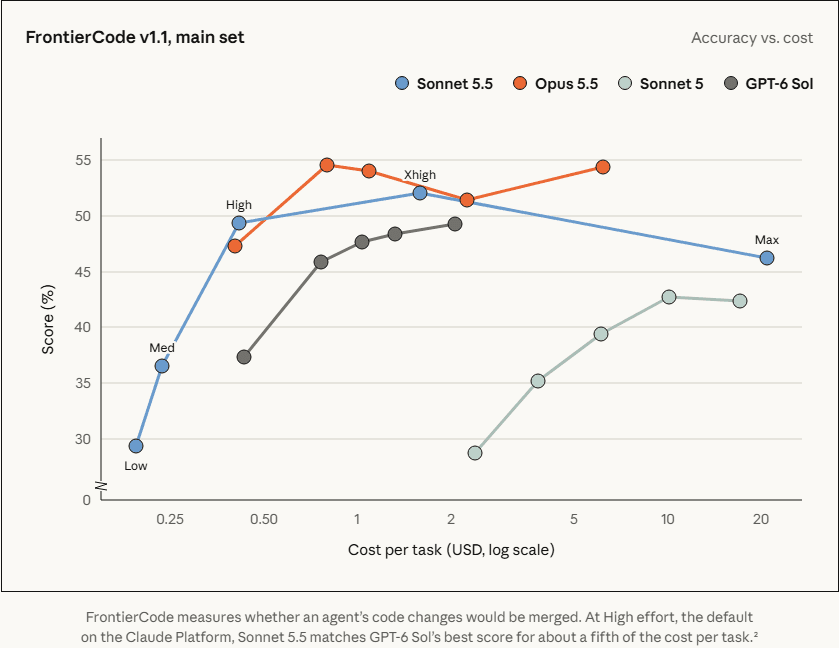
Matched Spend on the Three Coding Charts
Pair each Sonnet 5.5 point with the Opus 5.5 point that costs about the same. The FrontierCode and CursorBench values are at September prices, before Sonnet's cache cut, so Sonnet's costs there run high by roughly the 21 to 26% the October chart shows on Terminal-Bench (our estimate).
| Benchmark | Sonnet 5.5 point | Opus 5.5 point | Better buy |
|---|---|---|---|
| FrontierCode v1.1 | high: 49.4% for $0.42 | low: 47.3% for $0.40 | Sonnet, 2.1 points at the same cost |
| FrontierCode v1.1 | xhigh, its best: 52.1% for $1.59 | medium: 54.6% for $0.80 | Opus, higher score for half the cost |
| CursorBench 4.0 | high: 47.8% for $1.67 | low: 43.7% for $1.17 | Sonnet |
| CursorBench 4.0 | xhigh: 53.1% for $3.88 | high: 56.0% for $3.97 | Opus, 2.9 points at the same cost |
| Terminal-Bench 4.0 | high: 43.0% for $1.46 | low: 38.5% for $1.29 | Sonnet |
| Terminal-Bench 4.0 | xhigh: 61.5% for $4.34 | high: 64.2% for $3.88 | Opus, higher score for less |
| Terminal-Bench 4.0 | max: 70.6% for $10.44 | xhigh, its best: 66.4% for $7.35 | Sonnet, the one top-end win |
Through high, Sonnet 5.5 wins every pairing: on all three charts, no Opus 5.5 setting matches Sonnet's low, medium, or high score for the same money or less. Above high, a lower Opus 5.5 setting matches or beats it for similar money or less, except at Terminal-Bench max. The sharpest point is FrontierCode, Cognition's test of whether an agent's patch would be merged: Opus 5.5 at medium scores 54.6% for $0.80, above every Sonnet 5.5 point, including its best.
The Top of the Dial Costs More on Sonnet
At max, Sonnet 5.5 cost more per task than Opus 5.5 on three of the four September charts: Terminal-Bench 4.0 ($12.54 against $11.24), FrontierCode ($20.78 against $6.19), and AA-Briefcase ($29.19 against $21.05). Only CursorBench went the other way ($9.67 against $13.43). The October cache cut moves Sonnet's Terminal-Bench max to $10.44, under Opus, and leaves FrontierCode far apart. Anthropic's footnote explains that spike: at max, Sonnet 5.5 "more often ran Claude Code's code-review skill, which splits the review across many subagents," which led to timeouts or edits beyond the task's scope. The Sonnet 5.5 prompting guide says the same of both top levels, where the model "can start its own rounds of review and verification, sometimes with subagents."
Our routing rule: run Sonnet 5.5 from low to high, and when a task needs more, switch to Opus 5.5 at medium or high instead of raising Sonnet. Anthropic's own line points the same way: Sonnet 5.5 "complements Opus 5.5 best when running at lower effort settings." Our model versus effort guide covers the general version of this decision, and the effort ladder guide covers what each level trades.
Sonnet vs Opus Benchmarks, Like for Like
Rows copied from two launch pages mix effort settings and benchmark versions, so this table uses one source: the Sonnet 5.5 system card, which runs both models at max unless the effort column says otherwise. The CursorBench row comes from the Sonnet 5.5 announcement table, with each model at max.
| Benchmark | Effort (Sonnet / Opus) | Sonnet 5.5 | Opus 5.5 | Gap |
|---|---|---|---|---|
| SWE-bench Pro | max / max | 81.3 | 89.9 | Opus +8.6 |
| SWE-bench Multilingual | max / max | 90.3 | 93.9 | Opus +3.6 |
| SWE-bench Multimodal | max / max | 54.3 | 61.4 | Opus +7.1 |
| ProgramBench (long-context coding) | not stated | 79.7 | 91.2 | Opus +11.5 |
| FrontierCode v1.1, Main | xhigh / max | 52.1 | 54.4 | Opus +2.3 |
| CursorBench 4.0 | max / max | 55.5 | 57.8 | Opus +2.3 |
| FrontierSWE v2 | max / max | 61.9 | 62.3 | Opus +0.4 |
| Terminal-Bench 4.0 | max / max | 70.6 | 64.8 | Sonnet +5.8 |
| Terminal-Bench-Science 0.1 | max / max | 59.9 | 58.7 | Sonnet +1.2 |
| Humanity's Last Exam, no tools | max / max | 56.9 | 64.4 | Opus +7.5 |
| Humanity's Last Exam, with tools | max / max | 64.5 | 67.7 | Opus +3.2 |
| OSWorld 2.1, partial / strict | max / max | 80.1 / 43.5 | 81.8 / 48.7 | Opus +1.7 / +5.2 |
| Chartography, no tools / tools | max / max | 61.6 / 90.2 | 64.4 / 89.0 | Opus +2.8 / Sonnet +1.2 |
| GDPval-AA v2.1 (Elo) | max / max | 1,844 | 1,846 | Opus +2 |
| AA-Briefcase v1.1 (Elo) | max / max | 1,811 | 1,822 | Opus +11 |
| AutomationBench | max / max | 44.7 | 42.5 | Sonnet +2.2 |
| HealthBench Professional | max / max | 69.2 | 65.6 | Sonnet +3.6 |
| Toolathlon-Verified, Pass@1 / Pass³ | max / max | 77.8 / 68.5 | 77.8 / 72.2 | Tie / Opus +3.7 |
Opus 5.5's widest leads sit on the work closest to a real codebase: 8.6 points on SWE-bench Pro, built from "actively-maintained repositories with large, multi-file diffs," and 11.5 on ProgramBench, whose Sonnet 5.5 episodes run "up to the full 1M token window." It also leads by 7.5 on reasoning without tools. Sonnet 5.5 leads on both terminal benchmarks, Zapier's business-workflow AutomationBench, and HealthBench Professional. The terminal leads sit near the noise, with standard errors of about 2.5 points on Terminal-Bench 4.0 and 4.7 on Terminal-Bench-Science.
One pattern runs across the scoring methods. Where a benchmark gives partial credit, the two sit close: 1.7 points apart on OSWorld 2.1's partial score. Where it demands every checkpoint, Opus pulls ahead by 5.2. Toolathlon splits the same way: a tie on single attempts, Sonnet ahead when any one of three trials may pass (85.2 against 82.4), and Opus ahead when all three must (72.2 against 68.5). Our read: Sonnet 5.5 gets most of the way about as often, and Opus 5.5 finishes the whole task more reliably, which is what an unattended agent needs.
Two cautions. The GDPval-AA and AA-Briefcase runs used a pre-release Sonnet 5.5 deployment with a structured-outputs bug whose effect Anthropic expects "to be small and to understate its performance." And Opus 5.5's own September table reports some rows from earlier runs, such as AutomationBench at 40.0 before refused tasks were re-run with fallbacks, so keep its numbers out of this one.
What Each Model Does Differently
Where Sonnet 5.5 Fits
Anthropic draws the line in one sentence: Opus 5.5 "is built for complex work requiring careful judgment," while Sonnet 5.5 "is strongest at well-scoped everyday tasks, fixing bugs, and creating polished documents, slides, and spreadsheets." The prompting guide adds: "For the hardest long-horizon work, an Opus model is the better choice." Creator Creative Coder Kevin Ngo described the split this page recommends: "When Claude Opus 5.5 sets the architecture and general framework for a game, I would feel confident in letting Sonnet 5.5 implement it."
Two behaviors decide how you brief it. At low and medium, Sonnet 5.5 is "more likely to stop and check in with the user before it completes its work" on long agentic tasks. At every level it "tends to add tests, documentation, and small supporting files" you did not ask for. For latency, Sonnet 5.5 is the only one of the two with a setting that turns up-front thinking off: thinking: {"type": "between_tools"}, accepted at high or below. Opus 5.5's thinking is "always on," so its levers are low effort or fast mode.
Where Opus 5.5 Fits
The Opus reports cluster on long, unwatched work. Clio Staff Software Developer Sean Heintz: "I handed Claude Opus 5.5 a large engineering task across six of our repositories and let it run overnight, unattended. It stayed on task for over 18 hours." Stripe Staff Software Engineer Cristian Rivera ran a multi-day rebase of 40 stacked pull requests where "one Claude Opus 5.5 session directed a dozen more sessions." His result: "All 40 passed CI the next afternoon." Anthropic's own summary, from the Sonnet launch page: "Opus 5.5 remains clearly stronger at complex, open-ended work requiring sustained judgment."
Safeguards Route Differently
Both run safety classifiers, and the fallbacks differ. Cyber-flagged requests re-run on Sonnet 5 from Sonnet 5.5 and on Opus 4.8 from Opus 5.5. Biology-flagged requests re-run on Opus 5 from Opus 5.5, while Sonnet 5.5 "has no biology fallback model," so they end in a refusal. Both are available with zero data retention.
Sonnet vs Opus in Claude Code
Claude Code turns the question around. Since v2.1.280, default resolves to Opus 5.5 on Pro, Max, Ultra, Team, Enterprise, and the Anthropic API, where Pro and Team Standard used to get Sonnet 5. Both models start at medium. So the real decision is when to drop to sonnet, and there are five ways to make it:
| Setup | How | Cost shape | Best for |
|---|---|---|---|
| Opus 5.5 throughout | /model default or /model opus | Baseline | Sessions full of judgment calls |
| Sonnet 5.5 throughout | /model sonnet, /effort high when hard | Half per token | Well-scoped implementation |
opusplan | /model opusplan | Opus in plan mode, Sonnet executing | One plan, then a long build |
| Opus lead, Sonnet workers | model: sonnet in agent definitions | Opus on decisions, Sonnet on delegated work | Multi-agent runs |
| Sonnet main, Opus advisor | /model sonnet, then /advisor opus | Sonnet rates plus one uncached transcript read per call | Long tasks with a few hard decisions |
For the worker row, give each executor an explicit model and effort:
Set effort in the definition, because a sub-agent on a different model from the main conversation does not take the session's level, per the sub-agent docs. To move every sub-agent to Sonnet regardless of definitions, set CLAUDE_CODE_SUBAGENT_MODEL=sonnet with CLAUDE_CODE_SUBAGENT_MODEL_FORCE=1. Our sub-agent best practices cover the setup, and the multi-agent orchestration cost breakdown covers what each delegated agent adds.
The advisor row carries a cost trap. Claude Code's advisor docs list "Sonnet main + Opus advisor" as a standard pairing, and say "each advisor call processes the full transcript anew, with no reuse between calls." On the 200K-token session priced above, each Opus 5.5 advisor call reads about $0.80 of input, while moving the whole session to Opus adds $4.00. By our arithmetic, five calls cost as much as switching, before the advisor writes a word. On a 30K-token transcript a call reads $0.12, and the advisor stays cheap. Anthropic's docs say Claude "calls the advisor at decision points rather than on every turn," so the pairing "typically costs less than running the stronger model throughout." Our break-even is the exception, for long transcripts with many calls. It runs on the Anthropic API only.
Three switching rules follow from the docs:
- Turn the dial before you change the model. With an API key or a subscription, changing effort keeps the prompt cache on both models, while a
/modelswitch "reads the entire conversation history with no cache hits," per the prompt caching docs. - Escalate up, not down. Opus 5.5 reads Sonnet 5.5's thinking blocks on the Claude API, and Sonnet 5.5 does not read Opus 5.5's, so a conversation moved down loses its reasoning. Under
opusplan, "each plan-mode toggle is a model switch and starts a fresh cache," and by our reading the plan text reaches execution without Opus's thinking. Toggle plan mode once per task. - Check what
sonnetmeans on your provider. On Amazon Bedrock and Google Cloud's Agent Platform it resolves to Sonnet 4.5, which retires on the Claude API on November 30, 2026, andopusplanexecutes on it too. SetANTHROPIC_DEFAULT_SONNET_MODELto Sonnet 5.5's provider ID.
How the Sonnet vs Opus Answer Moved
This page is updated in place at each Sonnet or Opus launch. Last update: November 10, 2026.
| Generation | Sonnet (in / out) | Opus (in / out) | Opus premium | What changed |
|---|---|---|---|---|
| Claude 4: Sonnet 4, Opus 4 and 4.1 | $3 / $15 | $15 / $75 | 5x | Opus was the expensive exception |
| Opus 4.5 to 4.8, Sonnet 4.5 and 4.6 | $3 / $15 | $5 / $25 | 1.67x | Opus cut by two thirds |
| June 2026: Sonnet 5, Opus 4.8 | $2 / $10 | $5 / $25 | 2.5x | SWE-bench Pro gap 6.0 points |
| September 2026: Sonnet 5.5, Opus 5.5 | $2 / $10, $0.20 cache | $4 / $20, $0.20 cache | 2x, about 1.33x on cached sessions | Claude Code default moves to Opus 5.5 on every paid plan |
| Since October 7, 2026 | $2 / $10, $0.10 cache | $4 / $20, $0.20 cache | 2x on every line | SWE-bench Pro gap 8.6 points |
Mid-tier models beating the flagship is an old story here, from Claude 3.5 Sonnet against Claude 3 Opus to Sonnet 4.6 against Opus 4.5. Anthropic marked the turn at the Sonnet 5 launch: "For many developers, the agentic AI era began with Sonnet-class models". Its next sentence: "More recently, though, the clearest gains in agentic capabilities have been in our Opus-class models." The numbers since June agree. In our June comparison, Sonnet 5 trailed Opus 4.8 on SWE-bench Pro by 6.0 points (63.2 against 69.2) at 60% less per token. Sonnet 5.5 trails Opus 5.5 by 8.6 points at 50% less. The premium shrank and the gap on repository coding grew, so the June verdict, Sonnet by default and Opus on escalation, has flipped for coding.
Which Should You Use?
| Work | Use | Why |
|---|---|---|
| Well-scoped features, bug fixes, tests | Sonnet 5.5 at medium or high | Anthropic's named strength, and the low end of every coding chart |
| Execution sub-agents under an Opus lead | Sonnet 5.5 at high | Half the rate, effort set in the definition |
| Hard changes in large or unfamiliar repositories | Opus 5.5 at medium | SWE-bench Pro +8.6, and the best FrontierCode score per dollar |
| Long-context work near the 1M window | Opus 5.5 | ProgramBench 91.2 vs 79.7 |
| Unattended multi-hour runs and orchestration | Opus 5.5 | Leads on strict pass rates and all-trials-pass consistency |
Anything you would run Sonnet 5.5 at xhigh for | Opus 5.5 at medium or high | Same or better score for similar money or less |
| Terminal-heavy work where the last points matter | Sonnet 5.5 at max | 70.6% vs Opus's best 66.4%, at $10.44 vs $7.35 per attempt |
| Documents, slides, spreadsheets | Sonnet 5.5 at high | Level with Opus 5.5 at medium on AA-Briefcase, $3.95 vs $4.40 per task |
| Chat and latency-sensitive API calls | Sonnet 5.5 | "Fast" latency, and between_tools skips up-front thinking |
| Classification, extraction, short read-only lookups | Haiku 5.5 | The tier below, from $0.10/$0.50 per million tokens |
Hard work Opus 5.5 at xhigh still misses | Fable 5.2 | See when Opus 5.5 is not enough |
Keep Opus 5.5 as the default for work that needs judgment, put Sonnet 5.5 on everything well-scoped from low to high, and price Opus 5.5 at medium before you ever raise Sonnet past high. For the whole lineup, including Haiku and Fable, our guide to which Claude model to use for coding covers routing per task, and the Opus 5.5 best practices cover which Opus level fits which job. If you would rather make this split once than per prompt, ClaudeFast's Code Kit ships 18 specialist agents, each with a model assigned in its definition, plus complexity routing that decides which agent takes a task.
Frequently Asked Questions
Is Claude Opus better than Sonnet? On most benchmarks, yes, by small margins. Opus 5.5 leads seven of the eight rows on Anthropic's Sonnet 5.5 launch table, by 1.7 to 3.2 points counting FrontierCode at Sonnet's best setting, or by 2 and 11 Elo, and leads SWE-bench Pro 89.9% to 81.3% in the system card. Sonnet 5.5 leads Terminal-Bench 4.0, 70.6% to 64.8% with both at max. Anthropic says Opus 5.5 "remains clearly stronger at complex, open-ended work requiring sustained judgment."
How much cheaper is Sonnet than Opus? Exactly half on every price line since October 7, 2026: $2/$10 against $4/$20, cache reads $0.10 against $0.20, 5-minute cache writes $2.50 against $5, and Batch API $1/$5 against $2/$10.
When should I use Opus instead of Sonnet? When a task would need Sonnet 5.5 above high effort, when it touches a large or unfamiliar codebase, when it runs for hours without supervision, or when it needs the full 1M-token context. On Anthropic's charts, Opus 5.5 at medium or high matches or beats Sonnet 5.5 at xhigh for similar money or less.
Is Sonnet good enough for coding? For well-scoped work, yes. From low to high effort, Sonnet 5.5 reaches coding scores no Opus 5.5 setting matches for the same money. At medium, though, it trails Opus 5.5 at medium by 28.8 points on Terminal-Bench 4.0, so raise it to high for harder tasks, and move to Opus beyond that.
Does Opus use more tokens than Sonnet? At the same effort label, yes. On Terminal-Bench 4.0, Opus 5.5 at medium costs 4.3 times Sonnet 5.5 at medium per attempt, about twice what the rate card alone explains. At the top of the dial it reverses: at max, Sonnet 5.5 cost more per task on three of Anthropic's four September charts, including $20.78 against $6.19 on FrontierCode.
Does Opus use up Claude Code limits faster than Sonnet? Our read is yes: at twice the per-token rate and more work per effort level, an Opus 5.5 session draws on a weekly allowance faster, and /model sonnet halves the per-token rate for any session that does not need Opus. Anthropic does not publish how much faster. It did raise five-hour usage limits on Pro, Max, Team, and seat-based Enterprise plans with the Opus 5.5 launch, and our model selection guide and usage limits guide cover the plan mechanics.
Related Pages
- Claude Sonnet 5.5 for its specs, launch table, and five breaking changes
- Claude Opus 5.5 for its specs, pricing, and migration notes
- Claude Sonnet 5 vs Opus 4.8 for how this comparison looked in June
- Model selection guide for routing work across Opus, Sonnet, Haiku, and Fable
- Model versus effort for when to change the dial instead of the model
- Every Claude Model for the complete timeline
Last updated on